Historic Saint-Paul Church Fire, Montreal (Canada): Total Loss

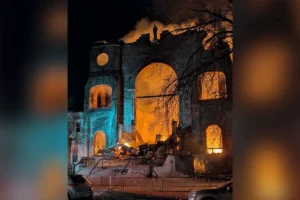
View of the destroyed former Saint-Paul Church (Montreal, 23 Feb 2026), flames extending to adjacent rectory/seniors residence. Credit: Facebook/Jean-François Gravel (via Catholic Register, 23 Feb 2026).
Early Monday 23 February 2026, ~1:40am, a fire engulfed the former Saint-Paul Church (Sud-Ouest borough, Montreal).
The historic church, converted for community use including a food bank in the basement, was severely damaged in a fire.
Rapid vertical spread of the fire to the adjacent former rectory, repurposed as a seniors’ residence (73 occupants), prompted the evacuation of 148 people. No injuries were reported.
The church sustained total structural loss while food bank operations were destroyed.
Fire dynamics suggest a rapid vertical spread via the roof and steeple (likely a wood-framed post-1910 masonry shell). Horizontal exposure to the rectory was likely via a shared party wall or eaves proximity <2m (Quebec code minimum 1.2m for unprotected buildings).
The basement origin of the fire (as reported by the food bank director) suggests an electrical overload or deep-seated combustibles (stockpiled goods >50kg/m²).
No sprinklers were evident in the worship volume, relying instead on standpipes and hydrants.
Smoke logging and thermal runaway accelerated untenable conditions within <2 minutes.
The fire likely originated in the basement food bank (as reported by the on-site director) and was fuelled by electrical issues or stockpiled combustible goods exceeding 50kg/m².
Without sprinklers in the main worship area, the building relied solely on hydrants and hoses.
Flames raced upward through the likely wooden roof and steeple within a 1910s masonry shell while spreading sideways to the neighbouring seniors’ home. This was possibly via a shared wall or roof edges closer than the Quebec code minimum of 1.2m for unprotected buildings.
Thick smoke buildup and runaway heat rendered the space unusable within 2 minutes.
For historic sites repurposed in this manner, the risks are clear. Mixing uses such as worship, charity storage and senior housing weakens fire barriers (lacking 2-hour rated walls as required by Canada’s NBC 3.2.3.13). Seniors’ slower movement can double or triple evacuation time.
Key lessons include installing smoke detection suitable for large spaces over 5,000m³, combining sealed compartments with sprinklers for conversions (per NFPA 914 Chapter 13) and protecting neighbours with fire-resistant roof undersides or ember guards.