Germany’s KulturGutRetter: Pioneering the First UCPM Cultural Heritage Response Unit (CHRU)
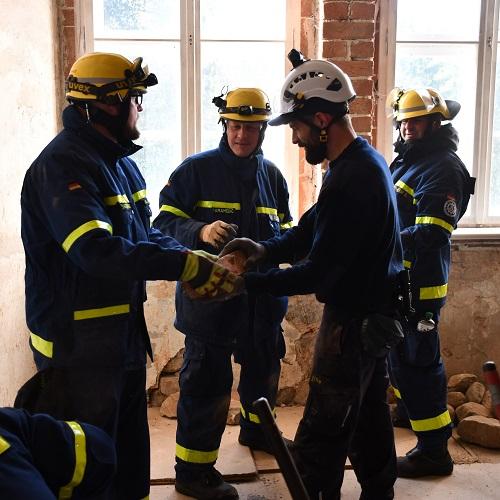
KulturGutRetter CHRU team during the first full-scale exercise at Demerthin Castle (25-28 Sep 2024), simulating earthquake damage assessment.Source: Official EU Civil Protection Knowledge Network (DG ECHO-funded, European Commission platform).
Summary
- Germany’s KulturGutRetter pioneers the first UCPM Cultural Heritage Response Unit (CHRU)—a self-sufficient team for rapid protection of cultural assets during cross-border disasters like fires, floods, or earthquakes.
- UCPM modules ensure interoperability: pre-certified personnel, tools, and procedures activated via ERCC for seamless EU-wide response, now extended to heritage (MCA/ICA).
- Core tech: Minimal Standard Procedures (MSP) with smartphone photogrammetry, Leica BLK360 LiDAR, and drones—1-5 cm accuracy for damage assessment.
- LiDAR challenges: EU countries use diverse approaches (TLS, UAV, airborne); no unified standard creates interoperability gaps, limiting reuse for routine CH management.
- Standardization benefits: Harmonized protocols enable financial sustainability through multi-use datasets (emergency + preventive monitoring).
- Validation process: 6-18 months, €100-300K per protocol via pilot tests, peer review (BAM/CNR), and EU grants—essential for UCPM certification.
- Timeline: Tested at Demerthin Castle (2024), operational by late 2025. Links to EU funding needs for heritage 3D survey standards.
Read the full article →
Understanding the UCPM Framework
The EU’s Union Civil Protection Mechanism (UCPM) is the central framework coordinating disaster response operations among EU Member States and associated countries. It ensures that when a natural or human-made disaster overwhelms one nation’s capacities, others can respond seamlessly under a common operational structure.
Within this system, each UCPM module represents a self-contained, pre-certified team—comprising trained personnel, standardized equipment, and operating procedures—that can be deployed abroad at short notice through the Emergency Response Coordination Centre (ERCC).
Examples include Urban Search & Rescue (USAR) units, emergency medical teams, or forest fire modules. The same structure is now being adapted for the protection of cultural heritage, marking a major milestone in integrating cultural assets into Europe’s emergency response system.
The KulturGutRetter (KGR) Initiative
Germany’s KulturGutRetter (KGR) project leads this transformation by developing the first Cultural Heritage Response Unit (CHRU) compatible with the UCPM framework.
Launched in 2019 by the German Archaeological Institute (DAI), LEIZA Institute, and Technisches Hilfswerk (THW), it connects research-based innovation with field practice.
The CHRU focuses on rapid, interdisciplinary interventions to safeguard both movable cultural assets (MCA)—artworks, archives, museum objects—and immovable cultural assets (ICA) like historic buildings struck by earthquakes, floods, or fires.
Following full-scale testing at Demerthin Castle (September 2024) and continuous training through 2025, the unit targets operational readiness by late 2025, capable of international deployment.
Its over 100 certified volunteers—including conservators, IT specialists, and logisticians—undergo THW basic training in safety and first aid, supplemented by specialized KGR exercises. Once certified, they qualify for UCPM missions lasting between 7–14 days, operating autonomously while fully integrated into the EU Civil Protection architecture.
From Protocols to Practice: The Minimal Standard Procedures
At the operational core of the CHRU are Minimal Standard Procedures (MSPs)—a scientifically validated set of protocols designed to guarantee consistent quality even when applied by responders with basic training. The MSPs unfold in three operational stages:
- Condition assessment through rapid 3D documentation;
- Stabilization and emergency protection of objects and structures;
- Recovery and handover to conservation authorities.
For documentation, the CHRU employs open-source smartphone tools (iDAI.field, QField), portable laser scanners (Leica BLK360), and drone-based photogrammetry cross-referenced with Copernicus satellite data, achieving object- to site-scale accuracy (1–5 cm).
Expanding Scenarios and LiDAR Approaches
The CHRU framework is flexible enough to cover a broad range of damage and risk scenarios—from localized fires in museums to large-scale seismic collapses or floods affecting entire heritage districts. In such operations, LiDAR surveys play a central role for both damage documentation and response planning.
Different EU countries currently apply heterogeneous LiDAR methods depending on their emergency modules, hardware availability, and institutional protocols:
- Ground-based (TLS) scans for micro-scale damage in sites and interiors;
- Drone-mounted LiDAR (UAV LiDAR) for building façades and roof-level damage;
- Airborne LiDAR and satellite-integrated models for regional disaster mapping.
This diversity, while valuable for flexibility, poses interoperability challenges when data must be merged across borders. Calibration conventions, coordinate systems, and output resolutions may differ considerably, preventing seamless integration of results. Hence, a common EU standard for heritage emergency 3D surveys—covering data formats, minimum technical specifications, and metadata requirements—has become an urgent need.
Such standardization would also extend LiDAR’s value beyond emergencies, allowing its reuse for routine monitoring, preventive conservation, and facility management of cultural heritage buildings. This would make the technology financially more sustainable, as the same survey datasets could support multiple life-cycle uses rather than single-event interventions.
Scientific Validation of Protocols:
Scientific validation is essential for Minimal Standard Procedures to gain UCPM acceptance. The process generally involves:
- Pilot testing in controlled environments (laboratories, test sites) supervised by universities and technical institutes;
- Field validation in simulated or real disaster exercises coordinated by civil protection agencies;
- Peer review and certification through national institutes (BAM in Germany, ICR in Italy, or equivalent EU-accredited laboratories).
Depending on complexity, validation campaigns typically require 6-24 months, with estimated costs ranging from €100,000-€300,000 per protocol (instrumentation, expert review, cross-lab reproducibility). Collaborative EU research (Horizon Europe, ECHO, UCPM grants) reduces duplication through shared datasets and open innovation frameworks.
Toward a Unified European Framework
As highlighted in the recent FireRiskHeritage post on EU funding, there is a research gap that leads to the absence of a unified EU standard for emergency 3D surveys of heritage. This results in interoperability challenges due to the wide variation in formats resolutions and protocols.
The KulturGutRetter CHRU therefore stands not only as a pioneering operational model but also as a testbed for European standardisation in emergency 3D documentation and digital heritage resilience.