New Zealand Heritage Wildfire
In early December 2025, a human-caused wildfire ignited within Tongariro National Park, a dual World Heritage landscape recognized for its exceptional natural and cultural significance.
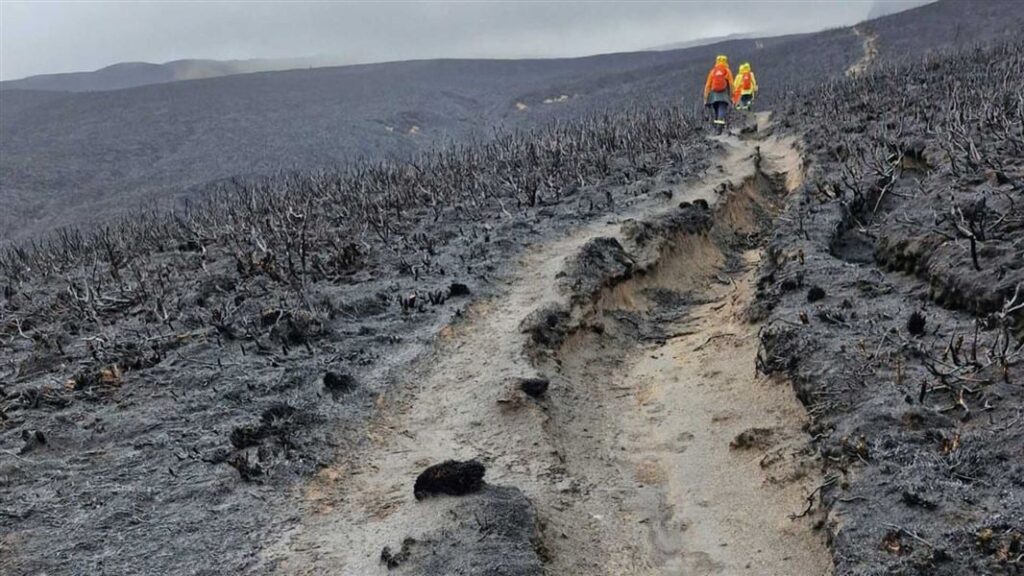
The fire consumed approximately 300 to 322 hectares, prompting a multi-day, air and ground-based suppression effort. Concurrently, conservation and Māori authorities implemented coordinated closures to mitigate the impact of the wildfire.
The context
Tongariro National Park, a dual UNESCO World Heritage Site, had already suffered a major November wildfire that burned nearly 3,000 ha of culturally and ecologically significant terrain.
- Natural World Heritage values. Tongariro was first inscribed in 1990 for its natural attributes, including a chain of active and extinct volcanoes (Ruapehu, Ngauruhoe, Tongariro) that illustrate major stages of Earth’s geological evolution. The park’s dramatic craters, lava flows, alpine ecosystems and high scenic value meet UNESCO criteria for outstanding natural beauty and ongoing geological and ecological processes.
- Cultural World Heritage values. In 1993, Tongariro became the first site listed as an “associative cultural landscape,” acknowledging powerful spiritual and cultural associations rather than built monuments. For the iwi Ngāti Tūwharetoa and Ngāti Rangi, the mountains are ancestors and sacred entities, symbolising the spiritual bond between the community and the environment, which UNESCO now recognises as of “outstanding universal value.”
The December fire ignited in the same general area only a month later, heightening concern for cumulative impacts on alpine ecosystems and on sites held sacred by mana whenua (Ngāti Hikairo ki Tongariro).
Cause: “unintentional mishap” and human factors
Incident controllers indicated that the December fire was likely started by an “unintentional mishap” involving a vehicle, and police were reported to have a clear line of inquiry on the ignition scenario.
Fire and Emergency New Zealand (FENZ) and national media used the event to underline that the overwhelming majority of New Zealand wildfires—around 97 percent—are linked to human activity, emphasizing behaviour change near forests and parks.
Fire development and spread
Fire was reported around 1:10 pm on 8 December, in vegetation near State Highway 47 on the central plateau, with rapid growth to roughly 296–322 ha and a perimeter of about 8.5 km under windy conditions. The fire burned through tussock and scrub in complex terrain, close to existing November burn scars, with authorities warning that wind shifts could cause flare‑ups and further spread despite early containment lines.
Operational response and tactics
- FENZ mounted an immediate multi‑agency response, building up to approximately 60 firefighters, 10–16 fire appliances and support vehicles, and a rotating fleet of 2–5 helicopters equipped with monsoon buckets and later fixed‑wing aircraft for sustained aerial attack.
- Ground crews focused on constructing and strengthening containment lines, supported by thermal‑imaging drones to identify and monitor hotspots overnight once open flame was reduced, allowing the perimeter to reach 80–100 percent containment within roughly 24–36 hours.
Visitor safety, closures, and evacuations
- The Department of Conservation (DOC) closed the Tongariro Alpine Crossing and cancelled bookings for Mangatepopo Hut and the Tongariro Northern Circuit, while staff swept tracks to ensure all visitors were accounted for and informed.
- Residents and accommodation operators in Whakapapa Village and along SH47 were placed on standby to evacuate, highways 47 and 48 were closed or controlled, and local civil defence channels amplified prepare‑to‑evacuate messaging until the risk diminished.
Cultural governance and recovery considerations
Ngāti Hikairo ki Tongariro and DOC framed the incident within a broader recovery and protection strategy that includes temporary and long‑term rāhui over fire‑affected areas, both to support ecological recovery and to respect the mana of the maunga and associated sacred sites. Once thermal‑imaging flights confirmed no remaining hotspots, FENZ formally handed control of the park back to DOC, which is now leading damage assessment, access management, and long‑term restoration planning in partnership with iwi and conservation stakeholders.