Damage Limitation Team in Resource-Constrained Heritage Sites
A Damage Limitation Team (DLT) in the context of cultural heritage is a trained group of staff and volunteers dedicated to mitigating damage to irreplaceable artifacts and architectural features in the event of an emergency, such as a fire.
Many cultural heritage sites operate with limited budgets, relying on restricted public funds or modest tourism revenues. Nevertheless, these sites frequently house irreplaceable artefacts, historic decorative elements, and architectural features that would be catastrophic to lose in a fire.
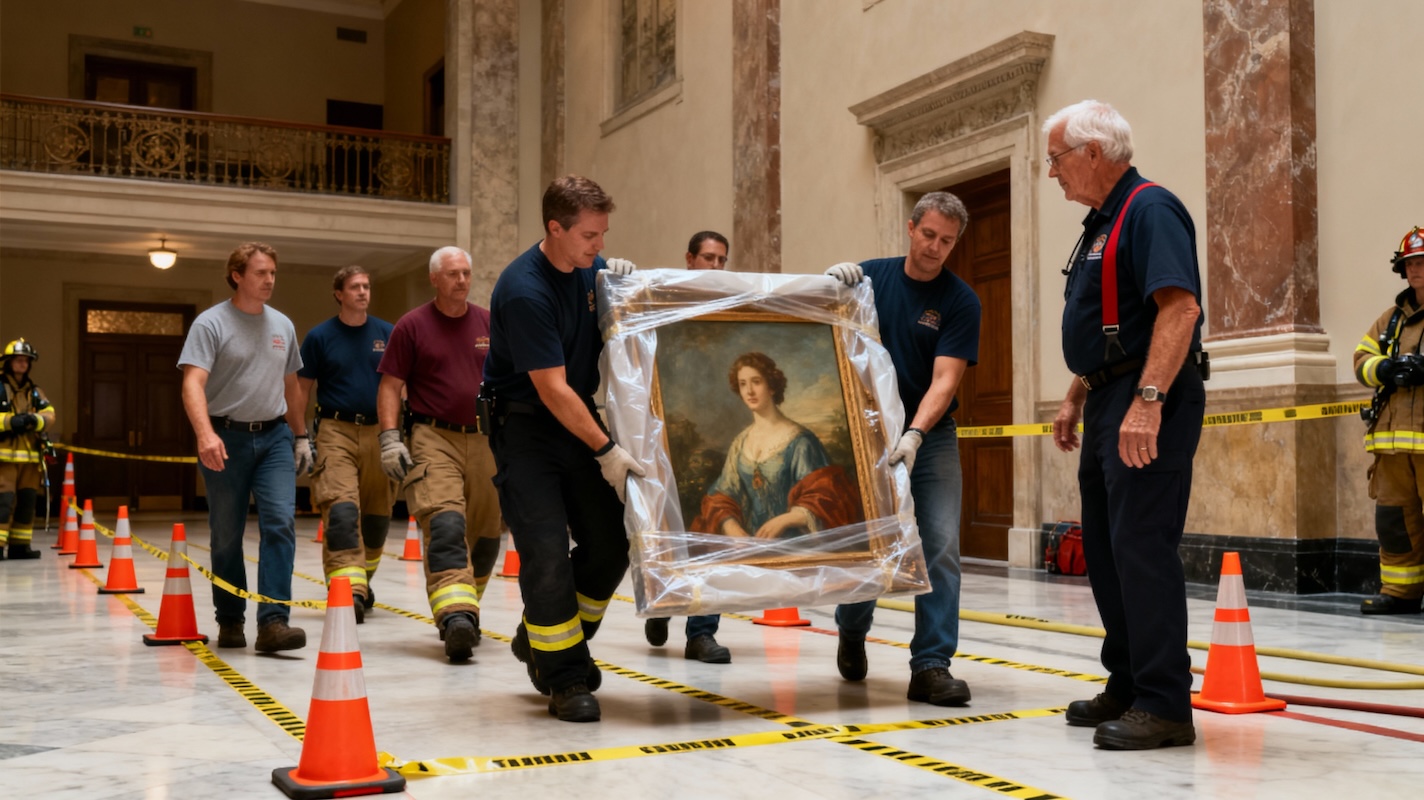
While major museums can afford dedicated emergency response teams and costly suppression systems, smaller heritage sites necessitate creative and cost-effective approaches to fire damage mitigation.
A Damage Limitation Team (DLT) in the context of cultural heritage is a trained group of staff and volunteers dedicated to mitigating damage to irreplaceable artifacts and architectural features in the event of an emergency, such as a fire.
It is important to understand what the team is and, crucially, what it is not a Primary Mission of a Damage Limitation Team: the DLT’s mission is not to extinguish fires like a professional firefighting brigade.
Instead, their focus is on the critical gap between fire detection and the arrival of professional emergency services, when minutes can prevent catastrophic loss.
Their core duties include:
- Early Detection and Alert: Detecting fires early and immediately alerting authorities.
- Salvage: Executing the immediate salvage of artifacts and decorative elements deemed high-priority.
- Protection: Protecting vulnerable materials from collateral damage caused by smoke, heat, and water.
- Coordination: Coordinating with emergency responders to minimize secondary damage.
- Stabilization: Implementing post-fire stabilization measures.
Context for Resource-Constrained Sites
This concept is especially relevant for smaller cultural heritage sites that operate with limited budgets. While major museums have the financial means for dedicated, professional emergency response teams, smaller sites rely on innovative and cost-effective approaches to protect their irreplaceable collections.
A key principle is that personal commitment to the site and the ability to remain calm under pressure are prioritized over prior technical expertise, which can be developed through training
This guide presents a realistic framework for constructing, training, and maintaining a damage limitation team when financial resources are constrained.
Summarising the publication, this guide details how to establish a Building Damage Limitation Team to minimize losses following an emergency, such as a fire. It emphasizes proactive preparation before an incident occurs, including building relationships with local fire services by inviting them for site tours and discussing expectations. Key areas covered include establishing clear communication protocols, documenting plans, and defining the team’s role – which specifically excludes firefighting.
The guide outlines an organizational structure with defined roles like Team Leader, Salvage Coordinators, and Documentation Officer. It also addresses legal and insurance considerations, recommending consultation with insurance providers regarding volunteer liability and the use of waivers.
Training is a crucial component, with an initial 8-12 hour program covering theory, practical handling of artifacts, and scenario exercises. Ongoing monthly and quarterly training is also recommended to maintain skills and update priority lists. The guide stresses the importance of rotating roles during training to ensure backup knowledge within the team.
Download “Building a Damage Limitation Team for Resource-Constrained Heritage Sites: A Practical Guide“