Strikes Damage UNESCO Golestan Palace: Shockwave Impacts on Tehran’s Historic Jewel
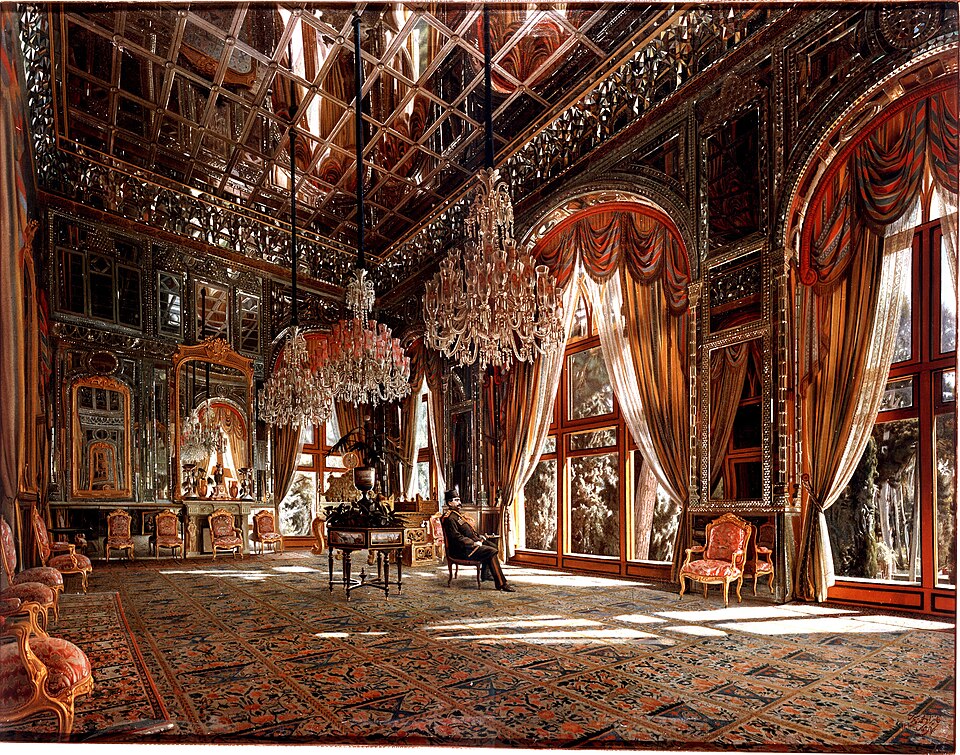
The mirror room of the Golestan palace (Tehran) in a 1876 painting of Artist Kamal-ol-Molk - Public domain, via Wikimedia Commons
The Golestan Palace in Tehran, a UNESCO World Heritage Site since 2013, suffered significant damage from shockwaves and debris caused by US-Israeli airstrikes on nearby targets on February 28, 2026, with no direct fire reported.
Damaged Golestan Palace mirror hall
The reported damage to Tehran’s Golestan Palace in March 2026 shows how cultural heritage can suffer severe loss even when there is no direct fire and no total structural collapse. UNESCO said the World Heritage property was reportedly damaged by debris and shockwaves following a nearby strike on 2 March, underlining the vulnerability of historic monuments in dense urban settings exposed to armed conflict.
Golestan Palace is one of Iran’s most significant historic complexes and one of the most symbolically important monuments in Tehran. UNESCO recognizes the site for its Qajar-era architecture and decoration, reflecting a period in which Persian artistic traditions engaged with new European influences in architecture, ornament, and court culture.
What appears to have happened at Golestan Palace is especially important for heritage professionals because the damage was not defined by flames, but by blast effects. Reports from the site described broken glazing, damaged ceilings, displaced decorative elements, shattered mirrorwork, and impacts to doors, windows, and architectural finishes, while preliminary assessments suggested that there had been no major structural collapse.
This is a crucial distinction. In public debate, the destruction of heritage is often imagined as a building burning or collapsing, yet many of the most serious losses occur through pressure waves, debris impact, vibration, and the failure of delicate decorative systems. At Golestan Palace, those fragile elements are not secondary details; they are part of the site’s essential heritage value.
The palace’s mirrorwork, ornamental woodwork, historic windows, tiled surfaces, and ceremonial interiors are central to its cultural meaning. When such materials are fractured, detached, or dispersed across the floor, the loss is not merely cosmetic. Even where restoration is possible, the original fabric, craftsmanship, and historical authenticity may be permanently diminished.
One notable aspect of the incident is that some movable objects were reportedly secured in advance. Multiple reports indicated that artefacts inside the palace had already been transferred to secure storage before the strike damage occurred, and the palace’s director later said that the objects in storage were not damaged. That precaution appears to have reduced losses to movable heritage, even though the building and its fixed decorative elements still suffered significant harm.
The case therefore offers a double lesson in emergency preparedness. On one hand, advance protective action can make a real difference for museum collections and removable objects. On the other, evacuation of artefacts alone cannot protect a monument whose significance is embedded in site-specific interiors, original surfaces, handcrafted architectural details, and historic spatial composition.
Decorations and immovable artefacts matter
This is why Golestan Palace matters well beyond the immediate news cycle. It illustrates a broader problem in heritage risk management: highly significant sites are often vulnerable to hazards that fall outside ordinary fire planning, yet those same hazards can quickly create secondary fire and life-safety issues. Blast damage can impair glazing, weaken partitions, damage electrical systems, obstruct routes, expose interiors to weather, and complicate emergency response in ways that increase overall risk after the initial event.
For the cultural heritage fire safety community, this is a clear example of why a multi-hazard approach is necessary. Sites of high historical value cannot be protected adequately if emergency planning is limited to conventional fire scenarios alone. Heritage protection strategies increasingly need to consider overlapping threats, including armed conflict, blast effects, vandalism, wildfire, earthquake, and infrastructure disruption, especially where a single event can trigger cascading damage.
UNESCO responded by expressing concern over the protection of cultural heritage sites amid escalating violence and noted that it had shared the coordinates of World Heritage properties with the relevant parties. The organization also reiterated the obligation to protect cultural property under international law, including in situations of armed conflict. These statements are important, but the Golestan case also shows the limits of designation and notification when military activity occurs near historic urban centres.
The significance of the damage is heightened by the nature of the site itself. Golestan Palace is not simply an old building; it is a ceremonial, artistic, and museum complex that embodies centuries of Persian royal history. Reports from journalists and heritage commentators emphasized damage to rooms known for mirror mosaics, decorative ceilings, carved and painted woodwork, and other highly crafted elements that are difficult or impossible to replace authentically.
There is also a conservation lesson here. When a monument remains standing, outside observers may underestimate the seriousness of the event. Yet in richly decorated heritage interiors, losses to non-structural fabric can be culturally devastating, particularly where recent conservation work, original artisan materials, or historically significant finishes are affected. Reports indicated that renovation work in the Hall of Mirrors had recently been completed, making the damage even more striking from a conservation perspective.
The immediate priority after such an event is not only debris removal but disciplined heritage triage. That includes documentation of damage, stabilization of loose materials, protection from further breakage and environmental exposure, careful salvage of fallen elements where possible, and rapid assessment by conservation specialists familiar with the building’s materials and significance.
Golestan Palace should therefore be understood not only as a news story from a conflict zone, but as a warning for professionals concerned with the protection of historic buildings worldwide. The event demonstrates that heritage can be seriously harmed by shockwaves alone, and that the absence of fire does not mean the absence of disaster.
Preparedness must go beyond
For FireRiskHeritage readers, the central lesson is straightforward: preparedness for historic sites must go beyond fire in the narrow sense and address the full spectrum of threats capable of causing irreversible cultural loss. Where heritage value resides in fragile interiors, handcrafted finishes, and irreplaceable original material, even a nearby blast can leave lasting damage long after the headlines fade