STORM: an Horizon 2020 Research Project on Heritage and Environmental Changes

Project logo image: © STORM Consortium 2016-2019. Source: STORM project website (http://www.storm-project.eu/)
STORM (Safeguarding Cultural Heritage through Technical and Organisational Resources Management) represents one of the European Union’s most ambitious efforts to address the intersection of climate change and cultural heritage protection.
Funded under the Horizon 2020 program (Grant Agreement No. 700191), the project ran from May 2016 to April 2019, delivering integrated methodologies, innovative technologies, and training frameworks that continue to influence heritage risk management across Europe.
The STORM Project
STORM was initiated in response to the European Commission’s DRS-11-2015 call on “Disaster Resilience & Climate Change,” specifically addressing Topic 3: “Mitigating the impacts of climate change and natural hazards on Cultural Heritage sites, structures and artefacts”. The project focused on three strategic intervention areas:
- Prevention: Developing innovative environmental assessment methodologies to accurately process, analyze, and map environmental changes and natural hazards affecting cultural heritage sites.
- Intervention: Creating practical tools and protocols for emergency response, including rapid damage assessment techniques and first aid procedures for collections and structures.
- Policies, Planning and Processes: Establishing a cooperative platform to enhance knowledge sharing, decision-making processes, and sustainable management methodologies for European cultural heritage.
- Technical Innovation and Integrated Systems
STORM’s technological framework integrated multiple cutting-edge systems into a unified cloud-based platform:
- Sensor Networks and detection. In the Sensor Networks and Detection Systems area, STORM have considered the use of Intra-fluorescent sensors for detecting material degradation and environmental stress indicators, Wireless acoustic sensors for structural health monitoring and early warning of material failure and Environmental monitoring systems tracking temperature, humidity, pollutants, and particulate matter.
- UAV (Unmanned Aerial Vehicle) platforms enabling rapid aerial surveys of inaccessible or dangerous heritage sites
- LiDAR (Light Detection and Ranging) for high-precision 3D documentation and damage assessment
- Ground-penetrating radar (GPR) for subsurface structural evaluation without invasive intervention
- Crowdsourcing and Collaborative Data Collection. The platform incorporated crowdsourcing techniques allowing citizens, visitors, and local stakeholders to contribute real-time observations and documentation during both routine monitoring and emergency events. This participatory approach enhanced early detection capabilities while fostering public engagement in heritage protection.
- Predictive Modeling Capabilities. STORM developed novel predictive models for environmental changes specific to cultural heritage vulnerability, considering both anthropogenic and natural hazard scenarios. The system utilized Complex Events Processing to integrate multiple data streams and provide actionable risk assessments.
Case Study Sites and Testing
The project’s methodologies were validated across five pilot sites representing diverse European heritage typologies and climate zones:
- Italy: Terme di Diocleziano (Baths of Diocletian), Rome – assessing structural integrity using laser scanning and GPR technologies
- Greece: Archaeological and architectural sites facing seismic and environmental risks
- United Kingdom: Heritage buildings threatened by increasing precipitation and flood events
- Portugal: Coastal heritage sites experiencing erosion, salt intrusion, and water damage
- Türkiye: Earthquake-prone historic structures requiring advanced structural health monitoring
This geographic distribution ensured the STORM framework’s applicability across Mediterranean, Atlantic, and Continental climate regimes, addressing region-specific vulnerabilities including seismic activity, flooding, vegetation fires, extreme temperatures, and coastal erosion.
Training Needs for Heritage Fire Safety
A critical insight from the STORM project was the significant disparity in training, preparedness, and operational procedures among European heritage professionals, emergency responders, and cultural heritage managers. This gap poses serious risks during multi-hazard scenarios where fire, flood, earthquake, or extreme weather events threaten irreplaceable cultural assets.
The Training Gap Identified by STORM
The project recognized that effective cultural heritage protection during emergencies requires interdisciplinary competencies rarely found within single professional communities:
- Heritage managers understand collection value and conservation priorities but often lack emergency response training
- First responders (firefighters, civil protection) possess life-safety and structural stabilization expertise but may lack knowledge of heritage-specific salvage protocols
- Conservation professionals understand material vulnerabilities but may not be trained in rapid triage or emergency decision-making under time pressure.
This fragmentation results in coordination failures, delayed interventions, and preventable losses during actual emergency events.
Fire Safety Training Requirements
While STORM addressed multiple hazards, the training framework has particular relevance for heritage fire safety professionals:
Pre-incident preparedness:
- Data collection methodologies for documenting heritage assets before disasters occur
- Building vulnerability assessment incorporating fire load, compartmentation, and egress analysis
- Integration of fire detection systems with heritage monitoring platforms
Emergency response protocols:
- Rapid structural damage assessment using LiDAR and thermal imaging following fire events
- Salvage prioritization based on heritage significance and material vulnerability
- Coordination procedures between fire brigades and cultural heritage protection authorities
Post-incident recovery:
- Emergency stabilization of fire-damaged masonry and timber structures
- Smoke and soot damage assessment for collections and interior finishes
- Documentation requirements for insurance claims and reconstruction planning
STORM Summer School 2017: First Aid to Cultural Heritage
As a direct outcome of the project’s training objectives, STORM organized its inaugural Summer School on September 11-13, 2017 at the Istituto Superiore Antincendi (National Fire Academy) in Rome, Italy.
Course Structure and Content
The 2.5-day intensive program combined theoretical lectures with practical field demonstrations, delivered by an interdisciplinary faculty from six countries:
- Climate Change and Heritage Vulnerability:
- Climate change observations and predictions for Europe (University of Stuttgart)
- New and emerging threats to cultural heritage from extreme weather events
- Risk assessment methodologies integrating environmental and anthropogenic factors
- Emergency Preparedness and Data Management:
- STORM platform architecture and sensor technologies (Technological Educational Institute of Piraeus)
- Pre-disaster data collection protocols for heritage buildings and collections
- Information sharing frameworks between rescue services and heritage authorities (Soprintendenza Speciale per il Colosseo)
- Hazard-Specific Protection Strategies:
- Protection of cultural buildings and sites from vegetation fires (Italian National Fire Corps)
- Structural fire protection for heritage buildings and artifacts
- Water and environmental damage: protection procedures in emergency (Município de Grândola, Portugal)
- Earthquake risk management principles for cultural heritage (Bogazici University, Turkey) First Aid and Emergency Intervention:
- Emergency stabilization and shoring of earthquake-damaged masonry structures
- Rapid damage assessment using geo-radar and laser scanning technologies
- Salvage techniques for flooded books and water-damaged collections
- Emergency detachment and stabilization of damaged frescoes
- Institutional and Financial Frameworks:
- Roles and responsibilities in cultural heritage resilience (KPeople, UK)
- Cost estimation methodologies for emergency interventions
- Volunteer engagement strategies and organizational models
- Field Demonstrations and Practical Exercises. Five hands-on exercises provided participants with direct experience in emergency response techniques:
- Pre-disaster data collection: Systematic documentation methodologies for heritage assets in preparedness phase
- Book salvage after flooding: Stabilization, drying, and transport techniques for water-damaged archival materials
- Masonry arch shoring: Italian Fire Corps protocols for emergency structural reinforcement using timber framing systems
- Fresco detachment: Conservation emergency procedures for saving damaged wall paintings
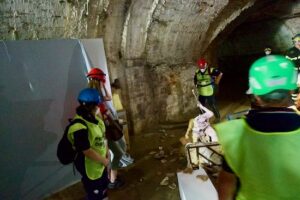
- Rapid structural assessment: LiDAR and GPR technologies demonstrated at Terme di Diocleziano pilot site, comparing pre-event 3D scans with post-damage surveys to quantify structural displacement
Course Outcomes and Participant Feedback
The 2017 Summer School was explicitly designed as a pilot edition to test content, methodology, and stakeholder engagement before launching a larger-scale 2018 program.
Validation Objectives Achieved. The course successfully verified several critical assumptions about heritage emergency training needs:
- Interdisciplinary format validation: The combination of climate science, building physics, conservation science, and emergency response protocols proved effective for participants from diverse professional backgrounds
- Practical demonstration value: Field exercises consistently received positive feedback, with participants noting the essential difference between theoretical knowledge and hands-on emergency procedures
- International knowledge transfer: Cross-border exchange of operational protocols (Italian, Portuguese, Greek, Turkish approaches) enriched the learning experience and revealed significant national variations in emergency management frameworks
Refinements for 2018 and Beyond. Based on 2017 outcomes, STORM planners identified several enhancements for subsequent editions:
- Expanded stakeholder participation beyond project partners to include museum directors, site managers, and regional civil protection authorities
- Extended program duration to allow deeper engagement with complex topics
- Additional case studies from recent heritage emergencies
- Enhanced integration of the STORM digital platform into hands-on exercises
STORM Academy 2019: The Culminating Training Program. Building on the 2017-2018 Summer School experiences, the project delivered its final training program as the STORM Academy in 2019.
Advanced Content Based on Project Outcomes. The Academy represented the direct translation of three years of research into operational training, incorporating lessons from all five pilot sites and integrating the fully developed STORM platform. Key topics included:
- Relations between climate change and heritage risk: Updated with 2017-2019 data on extreme events
- Technologies for predicting hazardous events and limiting damages: Sensor networks, predictive algorithms, and early warning systems validated during the project
- Operational procedures in case of emergency: Refined protocols tested in pilot sites
- STORM platform methodology and applications: Hands-on training with the integrated knowledge management and decision support system
- Protection of cultural buildings from vegetation fires: Enhanced content reflecting 2017-2018 wildfire seasons in Europe
- Toolkit for supporting heritage users during prevention and intervention: Practical resources developed through the project
- Earthquake damage and emergency shoring procedures: Advanced structural stabilization techniques demonstrated at Terme di Diocleziano
- Data gathering and sharing in emergency: Interoperability protocols between rescue services and cultural heritage authorities
- Integrated platform and sensor benefits: Technical training on deployment and interpretation
- Structural health monitoring and earthquake risk management: The STORM approach for historic structures
- Identification of gaps in cultural heritage policies: Recommendations for regulatory improvements at national and EU levels
Interdisciplinary Value Proposition. The Academy’s defining characteristic was its integration of different knowledge fields previously isolated in separate professional communities. Conservation specialists, structural engineers, emergency responders, climatologists, and heritage administrators collaborated within a unified framework—a training model rarely achieved in heritage protection education.
Training Needs for Heritage Fire Safety: The STORM Legacy
The STORM project revealed critical gaps that persist in fire safety training for heritage professionals, gaps that directly contribute to preventable losses during fire events.
Competency Gaps Identified
1. Technical integration deficiencies:
Modern fire safety strategies increasingly rely on integrated building systems (detection, suppression, HVAC, access control). Heritage professionals often lack the technical literacy to evaluate how these systems interact with historic fabric and conservation objectives.
2. Emergency decision-making under uncertainty:
Fire incidents at heritage sites require instantaneous triage decisions: Which collections to evacuate first? When is structural collapse imminent? When does water damage from suppression outweigh fire damage? Training programs rarely simulate the cognitive load and time pressure of actual emergencies.
3. Interdisciplinary communication failures:
Fire brigades and heritage authorities use different terminology, operate under different legal frameworks, and prioritize different objectives (life safety vs. cultural value). STORM demonstrated that joint training exercises are essential but remain rare in most European countries.
4. Climate-fire nexus understanding:
Heritage fire safety professionals must now incorporate climate change impacts: extended wildfire seasons, extreme heat affecting detection systems, drought-induced structural vulnerabilities, and smoke infiltration events from regional fires. Traditional fire engineering curricula have not adapted to these emerging risks.
Recommended Training Framework for Heritage Fire Safety
Based on STORM’s interdisciplinary model, an effective training framework for heritage fire safety professionals should include:
Foundation competencies:
- Building physics and fire dynamics in historic structures (timber framing, masonry, hybrid construction)
- Fire detection and suppression technologies compatible with heritage conservation
- Legal and regulatory frameworks governing heritage protection and life safety
Operational procedures:
- Pre-incident planning and heritage asset documentation methodologies
- Salvage prioritization protocols integrating cultural significance with material vulnerability
- Post-fire damage assessment and emergency stabilization techniques
Integrated emergency response:
- Joint training exercises with fire brigades, civil protection, and conservation authorities
- Simulation scenarios incorporating multi-hazard conditions (fire during earthquake, wildfire smoke infiltration)
- Communication protocols and information management systems for emergency coordination
Emerging threats:
- Climate change impacts on heritage fire risk (heat waves, wildfires, drought)
- Advanced monitoring technologies (thermal imaging, acoustic sensors, IoT platforms)
- Performance-based fire safety design for historic buildings
Course Materials and Resources
Available Documentation. While the STORM project website (http://www.storm-project.eu/) was the primary repository for training materials, accessibility has varied since project conclusion in 2019. The publicly accessible STORM resources are:
- CORDIS project database: Official EU reporting including deliverables, publications, and final reports available at: https://cordis.europa.eu/project/id/700191/reporting/en
- Academic publications: Peer-reviewed papers on STORM methodologies published in heritage science journals
- Conference presentations: Results presented at international heritage and disaster risk reduction conferences
- Heritage Research Hub: Project summary and outcomes archived at: https://www.heritageresearch-hub.eu/project/storm/[heritageresearch-hub
Training-specific materials. The STORM Summer School and Academy materials were originally designed for registered participants and included:
- Lecture presentations from 30+ international experts
- Field exercise protocols and demonstration videos
- STORM platform user manuals and training modules
- Case study documentation from five pilot sites (https://cordis.europa.eu/project/id/700191)
Accessing Legacy Materials. Professionals seeking STORM training resources should consider:
- CORDIS deliverables: Search the official project page for public deliverables including training methodologies
- Partner institution repositories: Several consortium members (Italian Fire Corps, ICCROM, University of Stuttgart) maintain archives of project outputs
- Follow-on projects: STORM methodologies have been incorporated into subsequent EU initiatives including ARCH (Advancing Resilience of Cultural Heritage) and SHELTER (Sustainable Historic Environments through Heritage-Led Regeneration)
- National fire academies: The Italian National Fire Corps (CNVVF) integrated STORM protocols into ongoing training programs
Post-Project Developments and Legacy (2019-2026)
Although the project did not have any follow-ups funded by the European Commission, some of the project’s consequences and legacies can be summarised in the following points:
- Integration into European Heritage Policy. STORM’s risk assessment framework and integrated platform concept have influenced several subsequent policy developments:
- EU Cultural Heritage Action Plan: The 2023-2024 update explicitly references STORM methodologies for climate adaptation planning.
- ICCROM training programs: The International Centre for the Study of the Preservation and Restoration of Cultural Property adapted STORM’s interdisciplinary training model into its READY (Risk Preparedness and Response) curriculum.
- National civil protection integration: Italy, Portugal, and Greece incorporated STORM protocols into national emergency response plans for cultural heritage.
- Technology Evolution. Several STORM technological innovations have reached operational deployment:
- LiDAR-based damage assessment is now standard procedure for Italian Fire Corps in earthquake and fire-damaged heritage buildings
- Wireless sensor networks for structural health monitoring have been installed in dozens of European heritage sites
- Cloud-based collaboration platforms for emergency data sharing continue to evolve, with improved interoperability between national systems
- Climate-Heritage Risk Escalation. Events since STORM’s conclusion underscore the urgency of its findings:
- 2019 Notre-Dame Cathedral fire: Demonstrated the necessity for integrated detection systems and pre-event 3D documentation
- 2020-2023 European wildfire seasons: Mediterranean heritage sites experienced unprecedented vegetation fire threats, validating STORM’s wildfire protection module
- 2021 German flood events: Destroyed or damaged numerous cultural heritage sites, highlighting the need for flood early warning systems STORM advocated
- 2022-2023 extreme heat waves: Indoor museum temperatures exceeding 40°C affected collection stability and fire system performance
Critical Assessment: STORM’s Strengths and Limitations
Enduring Contributions
- Integrated risk framework: STORM’s most significant legacy is demonstrating that cultural heritage protection requires simultaneous consideration of multiple hazards, stakeholder perspectives, and intervention timeframes (prevention-response-recovery). This holistic approach contrasts with earlier single-hazard, single-discipline projects.
- Technology validation: The project successfully moved advanced technologies (LiDAR, UAVs, wireless sensors) from research labs into operational heritage protection practice.
- Training model: The interdisciplinary Summer School format, combining lectures with hands-on field exercises and international expert collaboration, established a gold standard for heritage emergency training.
Implementation Challenges
- Platform sustainability: Like many EU research projects, STORM struggled with post-project sustainability of its digital platform and data systems. Without continued funding, maintenance and updates proved difficult.
- Adoption disparities: Implementation has been uneven across Europe, with countries having established civil protection systems (Italy, Portugal) integrating STORM methodologies more successfully than regions with limited heritage emergency frameworks.[
- Fire safety depth: While STORM addressed vegetation fires and structural fire risks, it did not fully develop fire-specific protocols with the same depth as earthquake and flood responses—a gap highlighted by subsequent major heritage fires (Notre-Dame, Glasgow School of Art).
Implications for Fire Safety Professionals
STORM’s interdisciplinary approach offers critical lessons for the heritage fire safety community:
- Integration is non-negotiable: Fire safety cannot be designed or managed in isolation from climate adaptation, seismic resilience, flood protection, and conservation objectives. Integrated risk management frameworks must replace siloed approaches.
- Technology enables better decisions: Real-time monitoring, 3D documentation, and predictive modeling significantly improve emergency response outcomes. Fire safety professionals should advocate for integrated sensor networks and digital twins of heritage buildings.
- Training must be interdisciplinary: Effective heritage fire protection requires professionals who can communicate across disciplines and coordinate between life-safety priorities and conservation values. Joint training with conservation specialists, structural engineers, and emergency responders should be mandatory.
- Climate change multiplies fire risk: STORM’s climate-heritage nexus analysis demonstrates that traditional fire risk assessments are increasingly obsolete without incorporating climate projections for temperature extremes, drought, and wildfire exposure.
- Preparedness determines outcomes: Pre-event documentation, stakeholder coordination protocols, and salvage prioritization plans are the difference between successful emergency response and catastrophic loss. Fire safety strategy must extend beyond code compliance to comprehensive preparedness planning.
Conclusion
Ten years after its initiation, STORM remains a landmark achievement in European cultural heritage protection research. Its integrated methodology, technological innovations, and training frameworks continue to influence policy, practice, and professional development across the continent.
For the fire safety community, STORM’s most important contribution may be its demonstration that effective heritage protection is fundamentally collaborative. Fire engineers, conservation scientists, emergency responders, climate specialists, and heritage managers must work together throughout the risk management lifecycle—from prevention and preparedness through response and recovery.
As climate change accelerates and heritage fire incidents increase in frequency and severity, STORM’s vision of integrated, technology-enabled, interdisciplinary protection becomes not merely aspirational but essential. The project provided the tools, methodologies, and training frameworks; implementation now depends on sustained commitment from heritage institutions, fire safety professionals, and policymakers across Europe.
The fire safety community needs more initiatives of STORM’s caliber—ambitious, interdisciplinary, and willing to bridge the traditionally separate worlds of heritage conservation and emergency response. As the sector confronts unprecedented climate-driven risks, STORM’s legacy offers both inspiration and practical guidance for protecting Europe’s irreplaceable cultural heritage.
Further Reading and Resources
- Official STORM CORDIS page: https://cordis.europa.eu/project/id/700191[cordis.europa]
- Heritage Research Hub STORM summary: https://www.heritageresearch-hub.eu/project/storm/[heritageresearch-hub]
- ARCH project (STORM successor): Good Practices in Building Cultural Heritage Resilience (2020)[savingculturalheritage]
- Related FireRiskHeritage.net articles:
- STORM Summer School 2017: First Aid to Cultural Heritage[fireriskheritage]
- Forest Fire Risks to Cultural Heritage: STORM Project Presentation[fireriskheritage], [heritageresearch-hub]