Hail and Heritage Roofs: What FM’s Global Hail Map Means for Fire and Water Risk
Hail rarely appears in heritage risk assessments. It is brief, local and usually remembered as a nuisance for cars and crops. Yet a hailstorm attacks the one element on which every other protection measure depends: the roof and its openings. A new worldwide hazard map published by the insurer FM in May 2026 is a good reason to look at the problem again, and to ask what a broken roof means for the fire safety of a historic building.
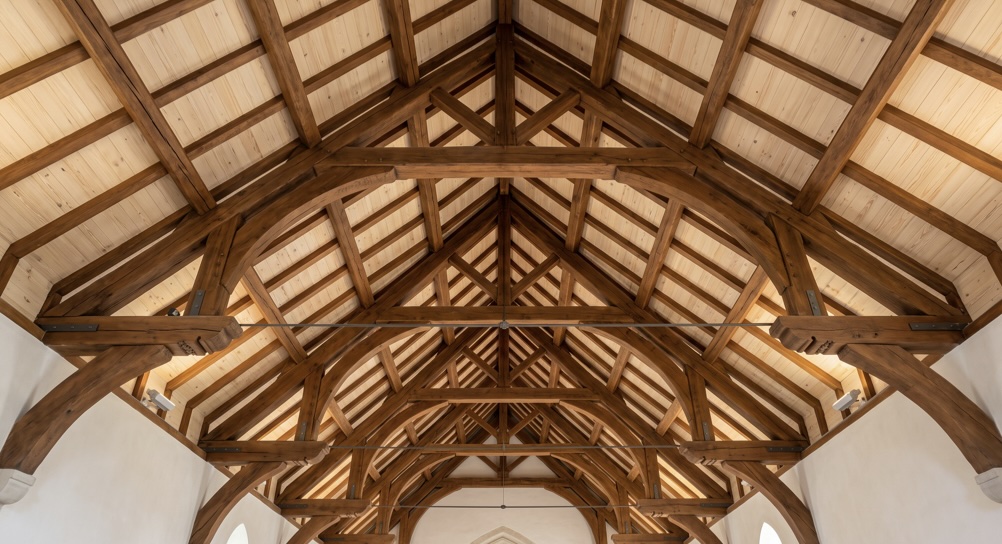
AI generated image of a roof.
Hail is another important water-related threat to cultural heritage. We have already examined how water damage can affect historic buildings; hail adds a sudden, high-impact dimension to that risk.
According to FM’s feature article, Mapping the Growing Threat of Hail, the company’s Worldwide Hail Hazard Map combines more than 500,000 ground observations collected between 1955 and 2024 with reanalysis and satellite data, processed through a machine-learning framework. Until now, FM’s hail mapping had covered only the United States and Australia.
Two features of the map are especially relevant to anyone outside the insurance sector, including heritage professionals, building owners and conservation teams. First, it ranks locations by damage potential—expressed in terms of hailstone size and kinetic energy—rather than simply by how often hail falls. Second, it classifies the world into three hazard zones: Moderate, Severe and Very Severe, based on a 15-year mean recurrence interval.
The article’s central argument is that losses are increasing not only because of the hazard itself, but also because exposure and vulnerability have grown. It cites industry estimates of US$42 billion in insured severe-thunderstorm losses in the first half of 2024, representing about 70% of all insured natural-catastrophe losses in that period.
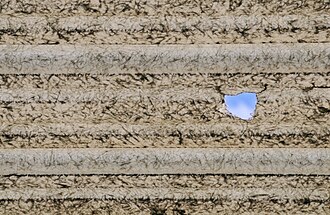
Europe, and northern Italy in particular
FM points to recent research indicating that very large hail is increasing faster in Europe than elsewhere, with hotspots close to mountain ranges in north-eastern Spain, south-western France and northern Italy. The Po Valley is singled out.
The events of July 2023 show what this means in practice. The European Severe Storms Laboratory confirmed a 16 cm hailstone at Carmignano di Brenta on 19 July and a 19 cm stone at Azzano Decimo on 24 July, a European record not far from the 20.3 cm world record. In Lombardy alone, the regional environment agency reported total damage of about €1.7 billion for the month, across more than 500 municipalities.
The same plains and foothills hold some of the densest concentrations of historic centres, churches, villas and museums on the continent.
Why a fire-risk site should care
Hail does not start fires, but can lead to severe damage of the buildings and contents, and degrades, in a few minutes, the conditions under which fire protection works.
Five mechanisms deserve attention.
- Envelope breach and water. Broken tiles, slates, skylights and leaded glazing open the building to the rain that follows. We discussed how a single weak point in a roof light can expose a collection in our note on the Uffizi water infiltration.
- Impaired detection and electrical systems. Water in roof voids reaches detectors, cabling and control equipment. Faults, false alarms and disabled zones are the likely result, at the moment when supervision is most needed.
- Rooftop photovoltaics. Hail can crack cells without breaking the glass. The US Department of Energy’s guidance on hail and PV notes that such hidden micro-cracks can spread over time and raise the risk of hot spots and fire. The standard certification test uses 25 mm ice balls, far smaller than the stones recorded in 2023.
- Emergency repairs. Temporary coverings, urgent roofing work and hot works turn the building into a construction site overnight. The risks of that phase are the subject of our article on the Miller Mansion fire.
- Response capacity. Severe convective storms bring wind and lightning with the hail and generate a very large number of simultaneous calls. A heritage site should plan on slower external assistance than usual.
What the map does not tell us
The FM map is a tool built for commercial and industrial property insurance, and it should be read as such.
- Its zones follow FM’s own engineering criteria. The article deals with value-engineered roofs, modern facades, glazing, rooftop plant and solar panels. It says nothing about handmade clay tiles, stone slates, lead sheet or historic glass, for which damage thresholds are poorly documented.
- Older construction is not necessarily weaker. Swiss data cited by Munich Re show a lower share of damaged buildings among those from the 1940s (about 8%) than among those built after 2000 (15%). For heritage, however, the issue is not the repair bill but the irreplaceable fabric and contents beneath the roof.
- Hail is highly localised. A zone defined on a 15-year recurrence says little about an individual site, and FM’s own hail specialist warns that local memory of past events is unreliable.
- Observed trends depend partly on how densely events are reported, which has improved greatly in recent decades.
Practical steps for site managers
- Add hail to the multi-hazard risk assessment and check the site against available hazard maps and severe-weather records.
- Survey the roof for fragile elements: skylights, lanterns, stained glass, rooftop plant and PV arrays. Consider protective glazing or guards where conservation rules allow.
- Keep gutters and outlets clear and accessible. Accumulated hail blocks drainage and causes ponding.
- After any significant hail, inspect roof voids, test detection and alarm systems, and have PV arrays checked by thermography before relying on them.
- Pre-arrange covering materials and a contractor, and apply hot-work permit rules to emergency repairs as strictly as to planned works.
- Give priority in the salvage plan to objects on top floors and under roof lights, and use severe-thunderstorm warnings as a trigger for simple precautions.
Conclusion
FM’s map does not describe heritage buildings, and it was not designed to. Its value for our field is the message behind it: hail is a recurring, mappable hazard in regions rich in historic buildings, and its consequences reach well beyond broken tiles. A roof opened by hail is a water problem within minutes and can become a fire-protection problem within hours. Treating the two together is the practical lesson.