Fire in Historic District in Netherlands
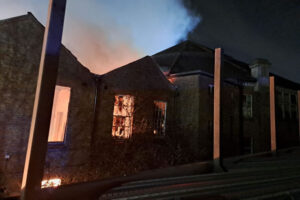
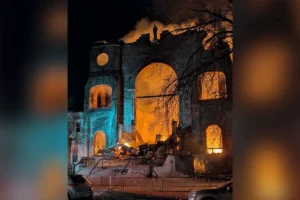
A major fire broke out in the historic centre of Leeuwarden (West Frisian, Netherlands) between 12 and 13 January 2026.
The incident exposed two recurring and closely related patterns documented by Fire Risk Heritage for years: the vulnerability of vacant buildings (in this case units in mixed-use buildings) and the systemic fragility of historic urban fabrics.
The incident also demonstrates the necessity of a rigorous cost-benefit perspective when assessing fire safety measures for heritage contexts and the businesses that operate within them.

The incident: vacant flat above a pizzeria
According to sources, the fire began around 4:00 a.m. in an unoccupied apartment located above a pizzeria in Grote Hoogstraat, in the historic city centre of Leeuwarden.
The upper floor and roof of the two-storey building were rapidly engulfed in flames and the blaze was soon classified as a “very large fire” due to its location in the dense historic core of the Frisian capital.
Within minutes, the roof had collapsed and the upper storey was completely gutted, while the building as a whole is now considered a total loss and at risk of further collapse.
Over 60 firefighters and at least two aerial platforms were deployed to fight the fire from above and prevent lateral spread to contiguous structures.
Thanks to the rapid response, the fire did not extend to the neighbouring blocks and no asbestos release was detected, but the adjacent dwellings still suffered fire, smoke and water damage.
In total, nearly 40 residents from surrounding buildings were evacuated, many of whom had to be temporarily accommodated in a hotel, and Grote Hoogstraat was cordoned off because of collapse
Causes
Initial reports don’t specify the exact origin, only confirming a large blaze and collapse, with structural experts assessing damages.
The recurring patterns: vacant units and historic centres
From the perspective of heritage fire risk, this case clearly reproduces two patterns that emerge repeatedly in international incident analysis:
- Vacant units as ignition and propagation nodes
The fire originated in an unoccupied apartment above the restaurant, confirming how vacant or under‑used spaces inside historic or mixed‑use buildings can become critical “dark zones” in terms of prevention, detection, and early suppression. Where occupancy is discontinuous, maintenance may be delayed, unauthorized uses can occur, and the absence of prompt human detection amplifies the consequences of any ignition.nltimes+1 - Historic centres as amplifiers of systemic impact
Even when firefighters are able to contain the flames to a single property, the combination of narrow streets, continuous façades and mixed functions typical of historic cores means that each fire event has the potential to become a systemic disruption. In Leeuwarden, the protection effort focused on avoiding an urban‑scale disaster, but the price has been the total loss of the primary building, damage to adjoining dwellings, long‑lasting access restrictions and temporary displacement for dozens of residents.dutchnews+1
These elements align closely with the recurrent vulnerabilities highlighted by Fire Risk Heritage: heritage districts are not just collections of individual buildings, but interdependent systems where vacant spaces, obsolete plant systems, and multi‑use configurations interact with tight public spaces and evacuation constraints.
Indirect losses and the need for cost–benefit thinking
An aspect that deserves particular attention in this incident is the difference between direct damage and indirect loss of opportunities.
The pizzeria operating at street level did not suffer direct structural destruction from the fire itself. However, it now faces a prolonged period of business interruption due to:
- access restrictions and cordons in the historic street;
- structural instability and demolition or consolidation works on the building;
- reduced attractiveness and perceived safety of the surrounding area for both residents and tourists.
This disconnect between “no direct damage” and “high indirect impact” is precisely where a cost–benefit approach to fire safety in heritage environments becomes crucial.
Investments in prevention (detection and suppression systems also in vacant units, enhanced compartmentation in mixed‑use buildings, targeted inspection of empty flats) are often evaluated only against the expected reduction of direct fire damage.
The Leeuwarden case shows that, in historic contexts, the true economic and social cost includes:
- lost revenues for businesses that survive physically but become inaccessible;
- displacement and assistance costs for evacuated residents;
- reputational impact on the historic area and its tourism‑related activities;
- long‑term effects on the perception of safety and on local investment decisions.nltimes+1
This article reports on the Sardinian-owned pizzeria ‘Sardegna’, located in the affected building. While it did not sustain direct fire damage, it is nonetheless severely impacted by the aftermath of the fire and the damage inflicted on the historic street where it is situated.
This case serves as an emblematic example for fire safety professionals and heritage managers: a business with no direct fire damage can be fully exposed to the economic and social consequences of a single incident in a vulnerable historic fabric.