Hidden Fires: The Unseen Cultural Heritage Losses in Latin America, Asia & Africa
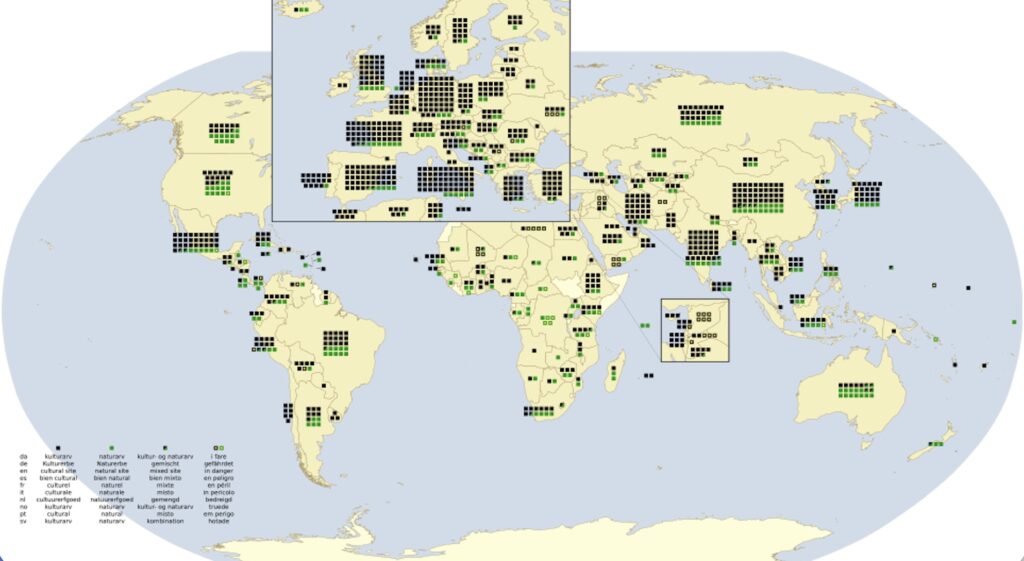
UNESCO World Heritage - https://en.wikipedia.org/wiki/File:UNESCO_World_Heritage.svg#globalusage
Latin America, Asia, and Africa together hold over 60% of UNESCO World Heritage sites, yet fire damage reports from these regions barely register compared to Europe and North America. This data gap stems from language barriers, weak reporting infrastructure, and competing local priorities that leave global risk assessments dangerously incomplete.
Summary
Few fires affecting thousands of sites in Latin America (~150 cultural sites), Asia (~500), and Africa (~100) reach international news, despite high vulnerability from wildfires, arson, and electrical faults.
Underreporting hides multi-hazard risks at 91% of sites, blocking prevention funding and strategies. Regional hubs, satellite monitoring, and multilingual journalism could fill the void.
Read full analysis below →
The Scale of the Silence
Asia and Africa alone account for over half of UNESCO’s cultural heritage sites, with Latin America adding dozens more colonial missions, pyramids, and indigenous landmarks.
Yet global databases like EFFIS and UNESCO fire trackers show Europe dominating reports—48% of high-risk sites meticulously monitored—while these regions contribute fragments.
China officially logs about 5 fires per year across 4,296 relics, but India, Indonesia, Brazil, and remote African parks barely appear despite seasonal wildfires and urban sprawl threatening ancient temples and tombs.
Latin America: Jungle and Mission Fires
In Brazil, Amazon wildfires regularly scorch Jesuit missions and indigenous petroglyphs, but English-language coverage stays minimal. Bolivia’s Chiquitos missions and Chile’s colonial churches face similar agricultural fire threats, while Peru and Mexico see adobe haciendas and pyramids burn with reports confined to local Spanish-language outlets. Remote access, indigenous community priorities, and eco-disasters overshadowing heritage news create a perfect storm of invisibility.
Asia: State-Controlled Data Silos
China’s National Administration meticulously tracked 45 fires from 2009-2018—mostly arson (42%) and electrical faults (29%)—but this data rarely crosses borders.
Southeast Asia’s colonial temples and stupas (Sarawak Cultural Village 2025 fire) surface sporadically in regional media, while Japan and Korea lose wooden temples to wildfires (Gounsa Temple 2025 destroyed) with 60% of such sites lacking protection.
Government-controlled reporting, absence of an Asian EFFIS equivalent, and fires dismissed as “local incidents” keep the full picture hidden.
Africa: Remote Sites in the Shadows
Uganda’s Kasubi Tombs and Mali’s Ahmed Baba Institute have suffered devastating losses, yet follow-up data evaporates. Ethiopia’s rock art and South Africa’s palaces burn amid annual savannah fires, preserved more in oral histories than news archives.
Without roads, fire brigades, or centralized registries, community-led responses rarely generate global headlines.
Barriers to Visibility
Language silos lock reports in Spanish, Portuguese, Mandarin, Hindi, and local dialects.
Weak infrastructure means no national fire registries for heritage, while satellites often miss small structural blazes amid vast wildfires. Poverty, conflicts, and climate crises consistently trump cultural reporting in resource-strapped media outlets. Western bias further marginalizes non-English sources.
Global Consequences
This underreporting creates blind spots for the 91% of sites facing multi-hazards such as fire-plus-flood or earthquake. EU funding streams like Horizon Europe favour well-documented European risks leaving Latin America, Asia and Africa under-resourced despite greater exposure.
Path Forward
UNESCO and ICCROM should improve capacity to aggregate local inputs on fires via APIs and partnerships.
FireRiskHeritage invites contributions to crowdsource incidents through our multilingual form to build the global map of heritage desperately needed. Transparent data not only documents loss but also prevents the next fire.