Notre Dame Fire: What we Know About
Notre-Dame fire: what happened, what was lost, how the cathedral was restored, and what the event teaches us about fire safety in cultural heritage buildings.
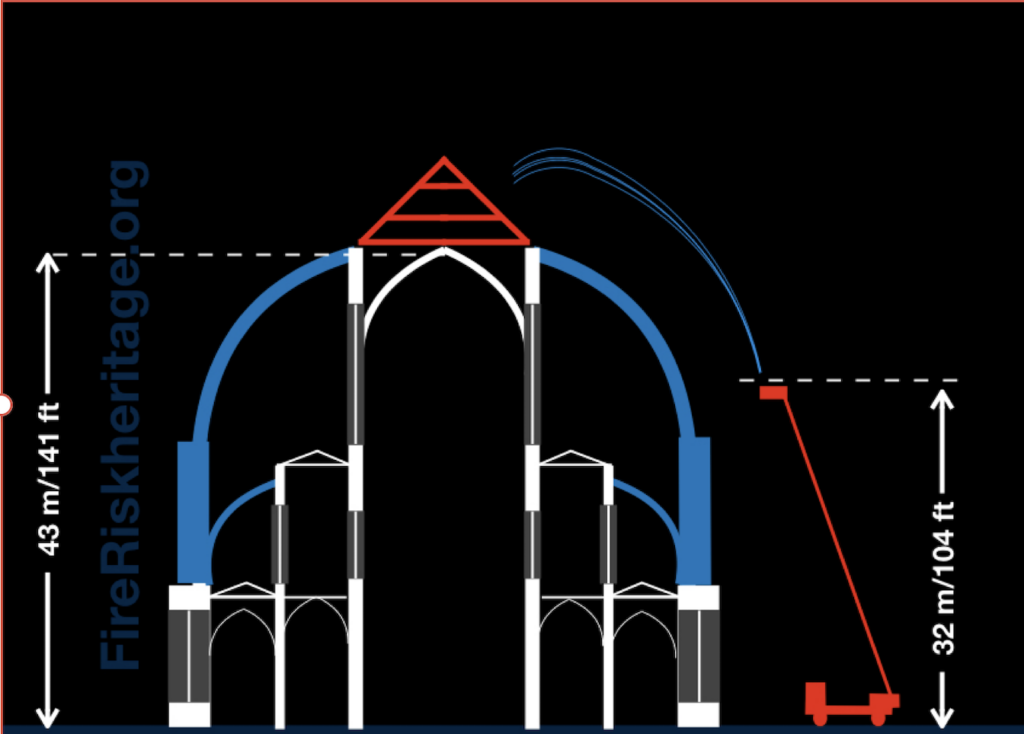
Max height of firefighting vehicles vs building height. Proportions and shapes are approximated. Image: Fireriskheritage.net
The fire at Notre-Dame de Paris on 15 April 2019 remains one of the most significant heritage losses of the last decades, not only for its cultural impact but also for what it revealed about fire risk in major historic buildings. Since the cathedral reopened in December 2024, the event can now be examined both as a disaster and as a case study in emergency response, reconstruction, and heritage fire safety.
This article summarizes what is publicly known about the fire, the building conditions that shaped its development, the damage that occurred, and the main lessons for the protection of cultural heritage.
The Building
Notre-Dame is a Gothic cathedral whose stone structure is combined with an extensive timber roof system, a combination that creates both architectural value and serious fire vulnerability. The “forest,” as the historic timber frame was often called, supported a lead-covered roof and contributed to the building’s long-term structural balance.
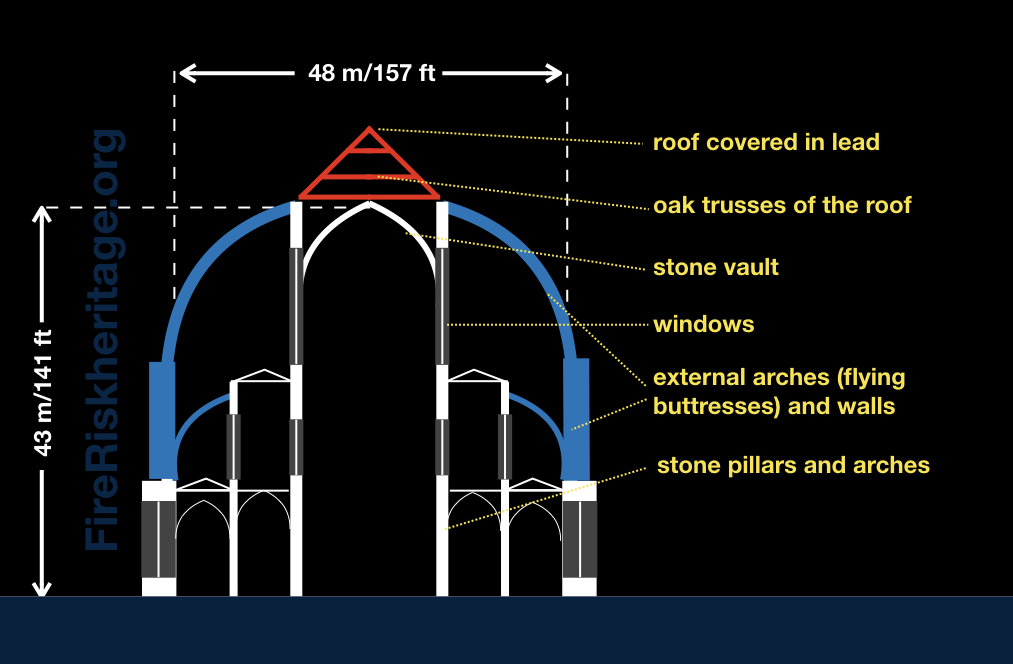
The construction scheme of the building (fig. 1) has a relevant part of what has happened during the fire. Like most of the gothic cathedrals, the slender stone structure is covered by a wooden (oak) structure. As widely known by firefighters, a fire that occurs in a wood poses serious problems during extinguishing operations, both to their safety and to the building integrity. In simple terms, the problem is related to the impossibility of fighting the flames throwing water from above, since one of the main functions of a roof is avoiding that water gets inside the building. That implies that a roof fire should be fought from the inside.
In the cathedral fire, the stone vault below the wooden roof would have prevented to extinguish the fire from the ground level, even if adequate appliances capable of pumping water to 43 m/141 ft would have been available in the early phases of the fire. But normally, as happened in Notre Dame fire, the roof structure is not designed to let smoke and heat flowing outside, keeping temperature and visibility within a certain range that allows first responders to do their job in relatively safe conditions.
On the contrary, the limited volume, in case of fire, makes temperature grow fastly, compromising also the stability of the structural elements. This is the condition that has been described for the 15th April 2019 fire, with one more specific problem. According to the website of the Paris Fire Brigade, the vehicles available to the Brigade that can be used in this kind operation can reach at most 32 m /104 ft with a remarkable 3.000 l/min water flow rate.
Since the roof is located at more than 40 m /131 ft above the ground level, it’s reasonable to think that the operations were not easy for the firefighters working from the outside, while the operations form the inside must have been dangerous (because of the high temperatures, the smoke and the risk of structural collapse) and extremely challenging, due to the need of climbing to the roof level carrying the needed equipments.
What Happened
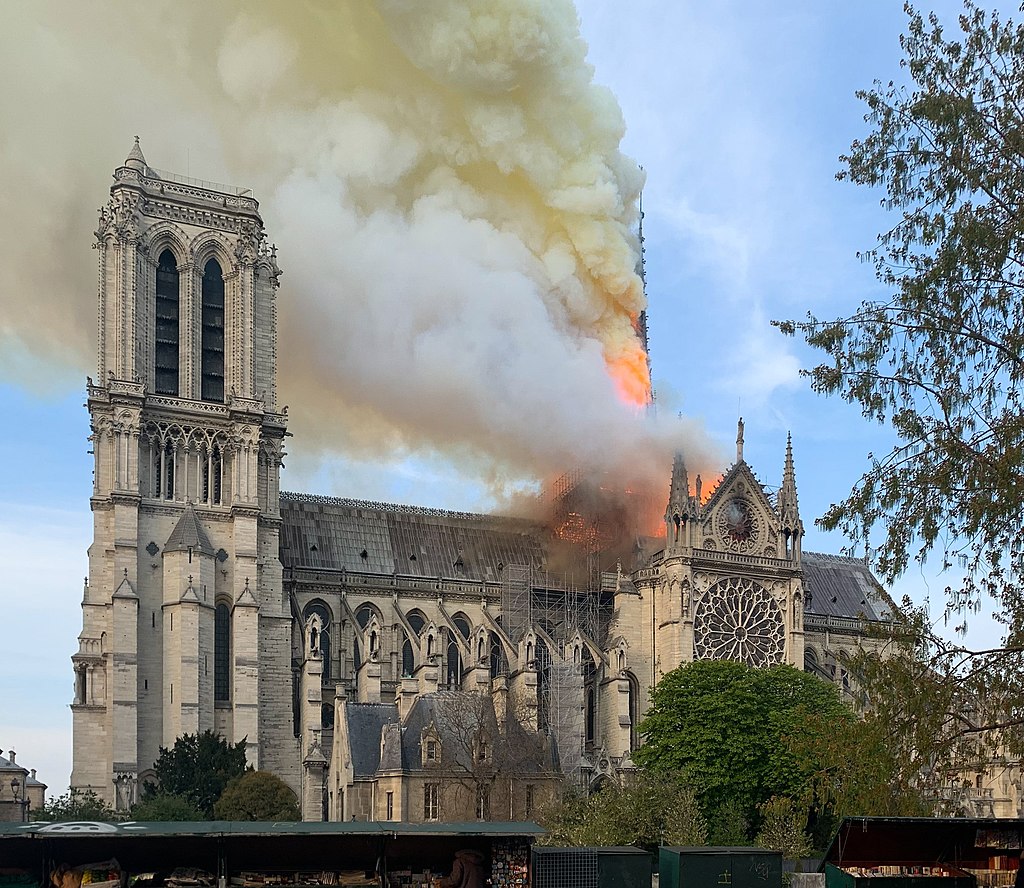
The fire began in the roof area on 15 April 2019 and spread rapidly through the timber structure. By the time the blaze was brought under control, the spire had collapsed, large parts of the roof had been destroyed, and the upper masonry had suffered serious heat damage.
Although the building’s main stone shell survived, the fire caused major losses to the roof, spire, vaults, and interior finishes. The event exposed how a fire in a historic monument can escalate quickly even when the primary structure remains standing.
Firefighting Challenges
The firefighting operation was shaped by the cathedral’s height, geometry, and internal compartmentation. Water application was constrained by access limitations and by the need to protect the stone vaults below the roof space. At the same time, the fire developed in a tight volume where heat and smoke accumulated rapidly, worsening visibility and structural conditions for firefighters.
This is one of the key lessons from the event: in heritage buildings, the very features that make the architecture distinctive can also make fire suppression far more difficult. In Notre-Dame’s case, the operation was a race against collapse as much as a conventional fire attack.
Damage And Salvage
The most visible losses were the 19th-century spire, much of the timber roof, and portions of the vaulted ceiling. Heat also affected surrounding limestone elements, with implications for the stability of the upper walls, arches, and buttresses. Lead contamination from the roof added another layer of complexity to the post-fire recovery.
At the same time, many important objects and artworks were saved through evacuation efforts and emergency action. The survival of the stone shell and many interior elements allowed reconstruction to proceed on the basis of a highly detailed restoration strategy rather than full rebuilding..
Investigation Status
The exact cause of the fire has never been definitively established in public reporting. Early investigative reporting and official statements pointed toward accidental causes, with possibilities including an electrical fault or a cigarette-related ignition, but no criminal origin was confirmed.
By late 2024, French reporting still described the cause as unresolved, despite continued investigative attention. For that reason, the most accurate public wording remains that the fire was likely accidental, but not conclusively explained
Lessons For Heritage Fire Safety
Notre-Dame demonstrates that major heritage buildings need more than passive preservation; they need active fire-risk management, careful control of renovation works, and emergency planning tailored to complex historic structures. The fire also showed how quickly a building can be lost when timber roofs, hidden voids, and limited access combine in a single incident.
The event has since become an important reference point in discussions about fire safety engineering for cultural heritage, especially for roof spaces, temporary works, and construction-site risk control. It is now a landmark case for understanding how prevention, detection, suppression, and response should be adapted to historic monuments.
A book about the Fire
In the 2023 book Notre-Dame une affaire d’Etat Didier Rykne, Art historian, journalist and founder of the website La Tribune de l’art, has published his investigation into the Notre-Dame fire. The authors denounces the fact that adequate efforts had not been made to clarify the cause of the fire and that the documents which highlighted the reduced level of safety in the event of fire of the Basilica, like many other historic buildings of a religious nature in France, have been neglected.
The Rykner’s Report is an analysis of all the events that led to the accidental fire of Notre-Dame in April 2019 in which the author questions the real causes of the disaster, particularly the renovation site, which remains a factor in the event that it was not the only cause.
The report also discusses the controversies and lessons that the Ministry of Culture was able to draw from them to avoid a similar accident.
Closing Note
The available public evidence still points to an accidental origin, but the exact cause has not been definitively established. French investigators have continued to explore the most plausible scenarios, including an electrical fault or a cigarette-related ignition, and no criminal cause has been confirmed.
Read here about the fire investigation: The Notre-Dame de Paris Fire Investigations
Published on April, 29, 2019, last updated April, 2026.