Buffer Zones: War vs. Wildland Fire Protection
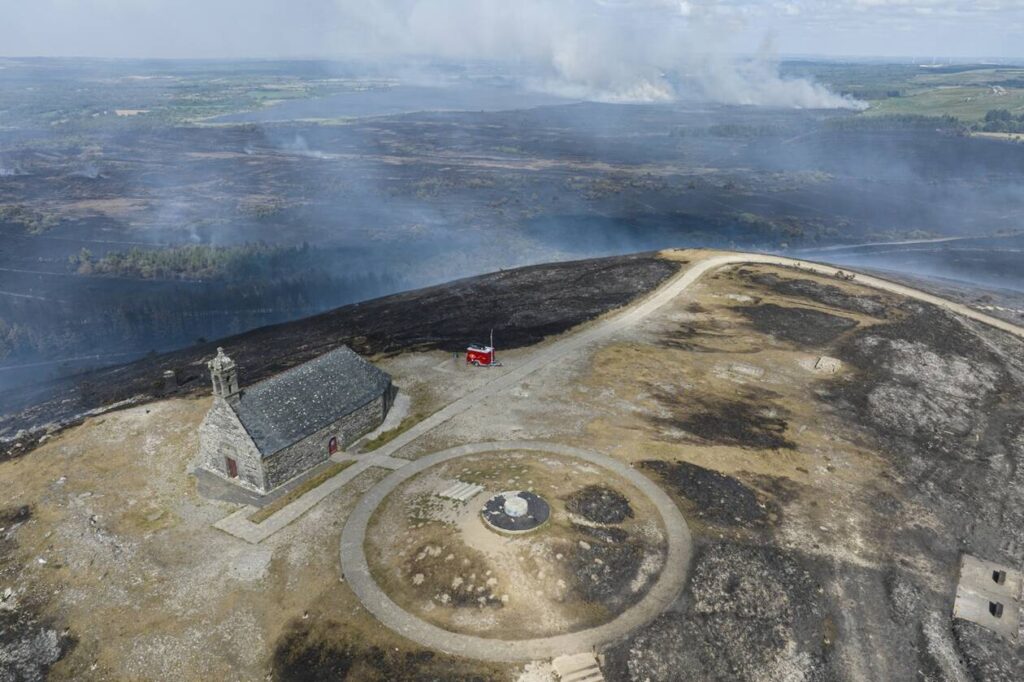
Chapelle Saint-Michel de Brasparts survives Monts d'Arrée wildfire (1,725 ha, July 2022). Flames halted meters away by rocky buffer and slate roof. . Photo Vincent Michel / Ouest-France
The UNESCO-listed Golestan Palace sustained damage from airstrikes, which shattered precious mirrors. This occurred despite the target of the attacks being outside the core site boundary but within its 26.2-hectare urban buffer zone.
This incident highlights a critical distinction between buffer zones designed for armed conflict and those for wildland fire protection.
Buffer Zone in Armed Conflict (UNESCO Framework)
Under UNESCO World Heritage guidelines and the 1954 Hague Convention, buffer zones are administrative areas surrounding a site to preserve its Outstanding Universal Value (OUV).
They regulate land use, development, and visual integrity but offer no physical protection against blast waves or shrapnel.
- Definition: Perimeter based on visual catchment, urban context, and management plans.
- Mechanism: Legal restraint – parties must avoid military actions that foreseeably damage cultural property (Article 4, Hague).
- Golestan Example: Arag Square targets were within the buffer zone; pressure waves propagated unimpeded, fracturing fragile Qajar-era decorations. The zone served as a jurisdictional reference for post-strike UNESCO condemnation, not a blast-absorbing barrier.
An evident limitation of this approach is that it relies on compliance and has been demonstrated to be ineffective against intentional or collateral high-explosive impacts.
Buffer Zone for Wildland Fires (Defensible Space)
Wildland-urban interface (WUI) buffer zones, or “defensible space,” are engineered perimeters calibrated to radiant/convective heat and ember attack, following NFPA 1144 and FEMA guidelines.
- Definition: Concentric zones (0–5m, 5–30m, 30–100m+) with fuel load reduction based on fire behavior models (e.g., Rothermel equations).
- Mechanism: Physical attenuation – clear vegetation continuity, non-combustible hardscaping, ember-resistant roofing to extend ignition time beyond fire front passage.
- Example – Chapelle Saint-Michel de Brasparts (Brittany, France, 2022): Survived a 1,725-ha wildfire in Monts d’Arrée; flames stopped meters away due to rocky clearing, slate roof, and firefighting efforts.
[Image: Defensible space zones for historic structures (NFPA/FEMA standards).
Key Differences
| Parameter | War Buffer Zone | Wildfire Buffer Zone |
|---|---|---|
| Purpose | Legal/urban protection | Physical fire attenuation |
| Design Basis | OUV, visual integrity | Fuel models, heat flux thresholds (i.e. >12.5 kW/m² ignition) |
| Metrics | Area in m²/km², no-load specs | Fuel moisture, flame length, clearance distances |
| Implementation | Management plans, State Party commitments | Site-specific engineering, annual maintenance |
Implications for Heritage Sites
The recent case of Golestan or many other, as the Russian raids on the Odesa city center that hit buffer zones and nearby sites (the Hague Archaeological, Maritime, and Literary Museums),with severe damage despite coordinates transmitted to Russia by UNESCO), underscores the need for hybrid strategies:
- in case of war, the importance of enhancing with blast-resistant glazing/façades (e.g., Iranian sites post-1980s war).
- in case of fire, the consideration of establishing mandatory WUI buffers in nomination dossiers, integrated with fire modeling for ember plumes.
In any case, data gaps persist: fewer than 20% of the 1,200+ World Heritage sites have quantified wildfire buffers, while armed conflict zones lack blast modelling entirely.
The recent case of Golestan and many others, such as the Russian raids on the Odesa city centre that damaged buffer zones and nearby sites including the Hague Archaeological Maritime and Literary Museums, despite coordinates being transmitted to Russia by UNESCO, highlights the need for hybrid strategies.
- In the event of war, the importance of enhancing with blast-resistant glazing and façades (as seen at Iranian sites post-1980s war) is paramount.
- In the event of fire, the consideration of establishing mandatory WUI buffers in nomination dossiers and integrating fire modelling for ember plumes is crucial.
In any case, data gaps persist: less than 20% of over 1,200 World Heritage sites have quantified wildfire buffers while armed conflict zones lack blast modelling.
FireRiskHeritage.net tracks global heritage fire losses –submit incidents or research gaps: mail to info@fireriskheritage.net