Wildfire at Monte Grifone: a Case of Historic and Cultural Heritage Under Wildfire Threat

The external parts of St. Maria di Gesù Church before the 2023 fire. Image: Bocachete, Public domain, via Wikimedia Commons
On 25 July 2023, a destructive wildfire swept down the slopes of Monte Grifone near Palermo, severely damaging the Church and Convent of Santa Maria di Gesù, a 15th-century Franciscan sanctuary and one of Sicily’s most treasured historic pilgrimage sites.
The blaze formed part of a larger wave of fires that ravaged the Palermo hills during an extreme heatwave, with some of the broader outbreaks linked to suspected arson or negligence.
Sicily’s wildfire risk has intensified in recent years due to prolonged heatwaves, strong winds, and insufficient vegetation management around heritage zones. When the fire reached the Monte Grifone complex, dry foliage and embers provided ready ignition points, allowing rapid spread toward the historic structures.
The Church of Santa Maria di Gesù, founded in 1426 and long associated with the incorrupt body of St. Benedict the Moor (a beloved patron saint), features significant Renaissance elements including a historic wooden coffered ceiling.
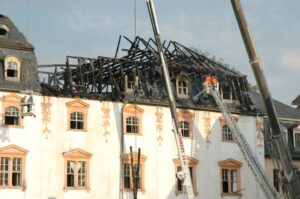
The wildfire inflicted heavy damage: the roof collapsed, the Renaissance ceiling was destroyed, and precious artworks—such as a 15th-century wooden sculpture of the Madonna and Child—were lost. Intense heat and smoke further compromised the interior, while the saint’s relics were severely damaged or disappeared in the flames.
Fire propagation followed a classic heritage-site pattern. Radiant heat from the approaching front ignited external wooden elements and dry vegetation. Ember transport (firebrands carried by wind) created multiple spot ignitions ahead of the main fire; and once inside, convection and direct flame contact exploited combustible finishes and air currents within the historic fabric, leading to rapid internal spread.
This incident underscores the urgent need to treat wildfire protection as essential to cultural heritage preservation. Historic sites at the wildland–urban interface must adopt preventive strategies: vegetation control, improved surveillance, fire-resistant maintenance, and emergency planning tailored to historical structures.
The Monte Grifone wildfire is not an isolated tragedy. Just weeks later, on 8 August 2023, the catastrophic Maui wildfires in Hawaii destroyed the hall of Waiola Church in Lahaina—one of the oldest Christian churches in the islands (established 1823) and a cornerstone of Native Hawaiian cultural and royal history.
The fire also engulfed the nearby Lahaina Hongwanji Mission and a Hawaiian-language immersion school, erasing irreplaceable layers of indigenous and missionary heritage amid similar conditions of drought, high winds, and uncontrolled vegetation.
Like Monte Grifone, the Lahaina disaster highlighted how quickly wildfire can consume sites where natural and cultural landscapes intertwine.
The Monte Grifone and Maui wildfires together serve as a warning signal for Mediterranean and global heritage under a changing climate and evolving risk landscape.
More on Wildfires&Cultural Heritage