EU Funding for Cultural Heritage Safety Research: A Strategic Overview (2021–2026)
How European investment in fire risk, multi-hazard resilience, and emergency coordination is shaping heritage protection—and why it’s still not enough.
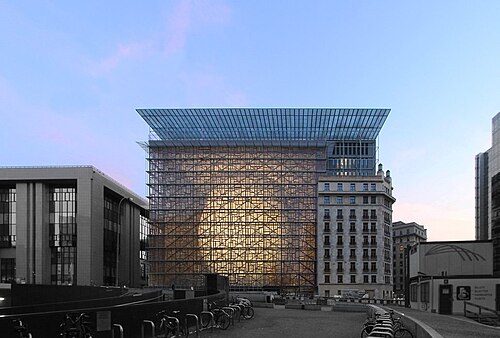
The Europa building, seat of the European Council and Council of the European Union in Brussels - Image: Samynandpartners, CC BY-SA 4.0 <https://creativecommons.org/licenses/by-sa/4.0>, via Wikimedia Commons
How European investment in fire risk, multi-hazard resilience, and emergency coordination is shaping heritage protection—and why it’s still not enough.
Article 33 of the Treaty on European Union mandates safeguarding Europe’s cultural heritage while respecting diversity, echoed in Article 167 TFEU’s call for conservation cooperation. The European Framework for Action on Cultural Heritage structures innovation, sustainability, and inclusion efforts, reinforced by the European Committee of the Regions’ opinion highlighting heritage’s economic and social role.
This analysis examines EU research funding for heritage safety prevention and protection.
The Research Gap: Why Cultural Heritage Safety Demands More Attention
Cultural heritage sites face converging threats that standard building codes ignore: combustible materials, poor compartmentation, complex layouts challenging suppression, and growing wildfire exposure from climate shifts. Current frameworks prioritize structural integrity and occupant egress, neglecting movable heritage, decorative finishes, archives, and interiors that define cultural value—a cathedral surviving structurally but losing its medieval roof and manuscripts has lost its essence. See FireRiskHeritage gap analysis.
Holistic models lack data on combustion by-products, suppression damage (water/foam/chemicals), and cascading tangible/intangible losses. Interdisciplinary tools must unite fire engineers, conservators, materials experts, planners, and managers with shared metrics. Heritage belongs in mainstream DRM—not siloed in culture/tourism—not wildfire zoning, UCPM protocols, and adaptation plans.
Performance-based guidance requires fire behavior data in historic fabrics, balancing preservation ethics with life-safety. Fragmented standards (ICOMOS/ICCROM/CEN/ISO) need NFPA-like enforceability backed by research. Multi-hazard convergence (floods, quakes, arson) demands infrastructure-level treatment.
EU Investment in Heritage Fire Risk Research (2021–2026)
The European Commission—via REA (Horizon Europe) and DG ECHO (UCPM)—funds a strategic but modest portfolio advancing fire-risk assessment, resilience, and preparedness.
Fire-focused projects integrate AI, GIS, indices, living labs, economic valuation, and artistic inquiry through stakeholder co-design beyond top-down models. Yet transferability lags: European case studies rarely influence national codes or strategies outside consortia. Aggregate 2021–2026 investment: <€25M (0.026% of Horizon’s €95.5B; <<1% Cluster 2).
UCPM Coordination Actions: Building Operational Capacity
PROMEDHE (2016–2018) forged Mediterranean networks (Italy lead) training responders in triage/SOPs, proving heritage response fits civil protection structures.
PROCULTHER (2019–2021) delivered the European Methodology (€599K), defining multi-hazard roles/training/module foundations via Italy/France/Spain/Turkey/ICCROM.
PROCULTHER-NET (2022–2023) institutionalized outputs (€800K) in the Knowledge Network, preventing “evaporation” through repositories and advocacy.
Wildfire Technology Precursors
GEO-SAFE (2015–2019) advanced geospatial wildfire tools (EU-Australia), aiding heritage-prone regions via Italian expertise—but lacking heritage layers/UCPM adaptation.
Multi-Hazard Expansion
MYRIAD-EU links flood/fire/energy/tourism risks with dashboards/pathways. ARCH (2019–2022) baselines climate resilience toolkits. HERITAGE-01-01 deploys sensors/monitoring. READY (€1.5M) builds capacity. Resilient CH Partnership targets €60M multi-risk innovation.
The Funding Reality
Cluster 2: €2.5–3B (4–5% total); heritage safety: €25–50M. UCPM modest vs. CBRN/pandemics. Health >€7B; Climate/Digital >€15B each.
Heritage: 0.05%. Practitioners must piggyback: FIRE-RES resilience, MYRIAD adaptation, PROCULTHER capacity.
Strategic Recommendations
Embed heritage in DRM (zoning/UCPM/adaptation/codes) via inter-ministerial funding. Sustain networks (DG ECHO lines/training/JRC). Build ISO/CEN standards/charters. Holistic indices (contents/suppression/intangibles). Global expansion (non-EU testbeds/South-North).
Conclusion: From Pilots to Policy
Horizon seeds tools (FIRE-RESILIENT/FIRECULT); UCPM builds capacity (PROCULTHER). Yet investment is microscopic vs. threats. Scale or lose gains—2028+ must prioritize.
Not exhaustive—comment missing projects! Next: UCPM post-emergency interventions.
Further Reading
Fire Safety Engineering | Risk Indexes |