Temporary use and events in heritage buildings: hidden fire risks before, during, and after opening
The Cappella della Sindone fire serves as a primary case study, as it illustrates how temporary conditions and restoration work can converge to create a catastrophic event.
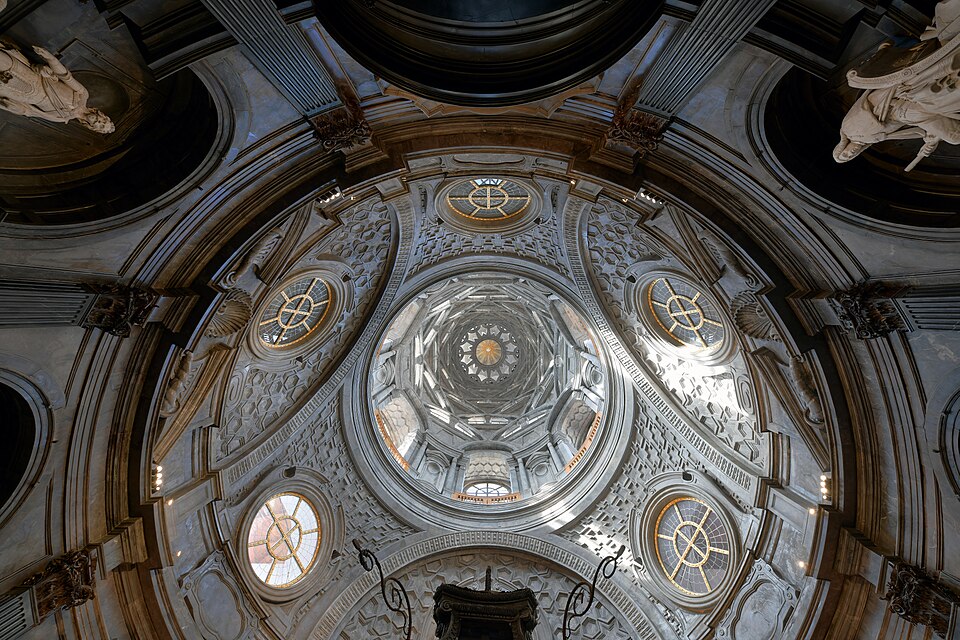
The chapel of the Shroud in Turin (Italy) after the restoration carried out following the fire of 1997. Image: Paris Orlando, CC BY-SA 4.0 <https://creativecommons.org/licenses/by-sa/4.0>, via Wikimedia Commons
Why temporary use is a distinct fire-risk phase
The Cappella della Sindone fire is the clearest case to quote because it is a heritage fire connected to temporary conditions and restoration work; the official fire service account says the blaze began on the wooden scaffolding outside the cupola and then spread into the chapel and Palazzo Reale. The Sindone site itself describes the fire as occurring on the night of 11–12 April 1997 in the chapel between Turin Cathedral and Palazzo Reale, with severe damage to the baroque structure.
Moreover, on the evening of Friday, April 11, 1997, a gala dinner for 130 guests was held in the Salone degli Svizzeri of the Royal Palace in Turin in honor of UN Secretary General Kofi Annan, who was on an official visit to the Piedmontese capital. The dinner had just concluded, and the staff were tidying up the rooms for tourist visits the following day. Around 11:00 PM, one of the Royal Palace’s caretakers saw a light on the Savoy residence’s smoke alarm go off, but after an inspection, he found nothing abnormal.
Around 11:30 PM, a second alarm went off, and this time the flames were real. At the same time, numerous other calls from residents reporting the presence of smoke and reddish glows around the Chapel of the Shroud were received by the fire department. The fire started on the wooden scaffolding surrounding the dome and then spread to the Chapel of the Shroud and to the top floor, used as a storage area, of the southwest tower of the Royal Palace, where furniture and paintings awaiting restoration were destroyed. Fortunately, there were no casualties.
Risk-management chain
Before a fire alarm becomes a fire response, a heritage event already passes through a sequence of operational decisions: whether the event is authorized, whether temporary layouts and power loads are acceptable, whether ignition sources such as catering equipment are controlled, and whether staff are trained to react immediately. In Turin, these issues were not abstract: the 1997 fire at the Cappella della Sindone occurred while the Royal Palace was hosting a gala dinner, and contemporary reporting and later heritage analyses connect the disaster to temporary electrical and restoration conditions, including scaffoldings and possible overload from catering equipment.
Technical controls
Temporary use changes the building’s fire profile long before the public arrives. In heritage spaces, the main technical priority is therefore not only permanent protection, but the compatibility between the historic fabric and all temporary systems introduced for the event: electrical supply, lighting, catering equipment, stage elements, decorative materials, temporary partitions, cabling, and access arrangements.
A first control is the temporary layout review. Every event should be checked against escape routes, door widths, protected stairs, smoke movement paths, firefighter access, and the position of detection and alarm devices. Temporary furnishings or installations that appear harmless in normal venue planning can become dangerous in heritage buildings because they obstruct narrow circulation spaces, conceal fire development, or delay evacuation in buildings that already have geometric and material constraints.
A second control is strict management of temporary electrical systems. Temporary events often add portable lighting, sound systems, refrigeration, catering appliances, chargers, extension leads, and distribution boards. In heritage buildings, these loads can create local overheating, cable damage, ad hoc wiring, and poorly supervised connections in spaces never designed for such equipment. As a technical standard, all temporary electrical installations must be designed, checked and load-limited before the event, with no informal additions during set-up.
A third control is the segregation of ignition sources from vulnerable fabric and contents. Historic England’s guidance is very clear that heat-producing work should be avoided in historic buildings wherever possible, and when it cannot be avoided it must be controlled by a permit-to-work system, area checks, and post-completion inspections. The same logic should be extended to temporary events: catering equipment, candles, scenic lighting, and any heat source should be treated as exceptional hazards when they are introduced into decorated interiors, timber roofs, concealed voids, draperies, or scaffolded zones.
A fourth control is monitoring after apparent closure of the activity. One of the most useful lessons from technical guidance on hot work in historic buildings is that the danger may continue after the visible activity has ended; Historic England recommends monitoring the area for at least one hour after completion and revisiting it two hours later. That principle is highly transferable to heritage events, because the risk often persists after guests leave, during cleaning, dismantling, electrical shutdown, and waste removal.
A fifth control is the protection of critical heritage assets during the event phase. This does not mean improvising salvage under fire conditions; it means identifying in advance which objects, reliquaries, archives, furnishings, or fittings require special protection, restricted access, or a predefined relocation strategy. In Turin, the rescue of the Shroud became possible only through an extreme intervention under severe conditions, which underlines the need to plan asset protection before an emergency occurs rather than during it.
Organizational controls
Technical measures are necessary, but temporary use in heritage buildings is often governed by organizational weaknesses rather than by a lack of devices. The critical issue is that event management, conservation management, building operations, contractors, caterers, and emergency planning are often handled by different actors with different priorities. If responsibilities are not integrated, the building may appear ready while the fire risk is actually fragmented.
The first organizational control is a single authorization chain. No temporary event should be treated as a normal booking. Approval should be conditional on a fire-safety review covering occupancy, ignition sources, temporary equipment, staff deployment, restricted areas, emergency access, and the status of any ongoing works. This point is strengthened by the Turin case, where parliamentary discussion after the fire questioned both the authorization of the gala dinner and the compatibility of the conditions present that night with the vulnerability of the site.
The second control is the designation of a clearly identified responsible person for the temporary use. Historic England’s guidance stresses that exceptional hazardous activities in historic buildings must be authorized by those with assigned authority and supported by risk assessment, method statement, and auditing provisions. For events, the equivalent should be an event fire coordinator with authority over set-up, occupation, and dismantling, rather than a purely ceremonial or logistical event manager.
The third control is the integration of briefing, supervision, and escalation rules. Staff, security, ushers, custodians, technical crews, and external suppliers need a short but precise briefing on alarm recognition, first actions, who calls the fire brigade, who orders evacuation, which areas are checked first, and which spaces remain prohibited. The Turin account is particularly instructive because an initial alarm indication was followed by a check that did not identify an anomaly, whereas the second alarm corresponded to a fully developed fire condition, suggesting how dangerous delay or uncertainty can be in complex heritage settings. When analyzing this 1997 event through the lens of modern technology, it is important to note that while today’s detection systems are more sophisticated, the human tendency to dismiss early warnings remains a critical vulnerability. However, the security/technical personnel performed a visual or procedural check that did not lead to the immediate identification of the fire. In many historic buildings, the alarm is often interpreted as a “false positive” (caused by dust, humidity, or electrical malfunctions), leading to an underestimation of the risk. When the fire reached a stage where it generated large amounts of visible smoke and heat, the alarm became unequivocal. By that point, however, the fire had already compromised much of the ceiling structure and the area below.
The fourth control is a formal handover procedure between phases. Heritage events do not have only one operational moment; they have at least three: set-up, live occupation, and post-event closure. Each phase should have a sign-off: systems enabled, routes clear, combustibles removed, temporary power isolated where required, waste cleared, and sensitive areas inspected. Without this discipline, the highest-risk moment may occur after the audience has gone home, when supervision is reduced but ignition sources or latent heat remain present.
The fifth control is a link between event management and heritage priority. In ordinary venues, event continuity can become the dominant objective. In heritage venues, however, the priority must shift: business continuity and public hospitality are secondary to life safety and preservation of irreplaceable fabric. That means the threshold for cancelling, relocating, scaling down, or delaying an event should be lower than in conventional buildings when protection systems are impaired, works are ongoing, or temporary loads cannot be justified.
Lessons from incidents
Real incidents show that fire in heritage buildings is rarely the result of a single isolated failure. More often, it is the product of an altered operational context: temporary works, temporary use, temporary power, temporary materials, or temporary relaxation of normal controls. This is why special events deserve their own fire-risk assessment logic rather than being treated as ordinary occupation.
The Turin fire of 11–12 April 1997 is a particularly instructive case because it combines several temporary conditions in one event chain. According to the official Vigili del Fuoco historical account, a gala dinner for 130 guests in honour of UN Secretary-General Kofi Annan had taken place that evening in the Salone degli Svizzeri of the Royal Palace; shortly after the dinner, while staff were restoring the spaces for tourist visits the next day, a first smoke-alarm warning was checked without finding an anomaly, and about half an hour later a second alarm coincided with a real fire that had originated on the wooden scaffolding surrounding the dome and then spread into the chapel and other palace areas. This sequence is valuable because it shows not just ignition and spread, but the overlap between event use, post-event operations, and a vulnerable restoration environment.
The first lesson from Turin is that temporary use amplifies the consequences of temporary works. The event itself did not need to be the sole cause of the fire to matter analytically; what matters is that a prestigious occupied function was taking place in a building already exposed to restoration-related vulnerability, including combustible scaffolding and complex access conditions. In article terms, this supports a key argument: when heritage spaces host exceptional events during periods of impairment, the risk is not additive but compounded.
The second lesson is that the first alarm signal may be ambiguous, but the decision window is short. In Turin, the first warning did not immediately reveal the scale of the danger, while the second alarm came when the fire was already real and visible. For heritage venues, this means alarm procedures during temporary events must be conservative: uncertain indications should trigger escalation, localized re-checks by trained personnel, and rapid readiness for evacuation rather than informal reassurance.
The third lesson is that access and salvage become far more difficult once fire develops in a heritage structure. The Turin account describes difficult access, intense heat, dense smoke, and collapse risk, all of which complicated intervention even for a large firefighting deployment. This underlines why salvage planning, protected zones, and predefined asset priorities should be addressed before the event, not improvised after ignition.
A final lesson is that symbolic or high-profile events can distort risk perception. Ceremonial importance, diplomatic status, media attention, or prestige may encourage organizers to treat the event as exceptional in a positive sense, when from a safety perspective it is exceptional in a hazardous sense. The Turin case demonstrates that high-profile use does not neutralize vulnerability; on the contrary, it can coexist with restoration works, temporary occupation, and emergency complexity in a way that demands stricter, not lighter, controls.