Why Cultural Heritage Safety Engineering Still Struggles to Be Recognised
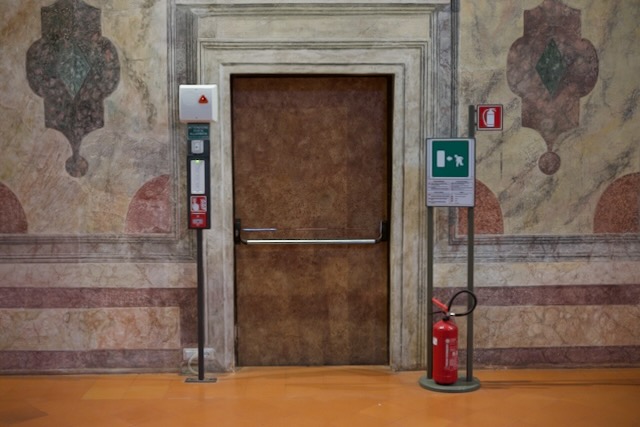
Integrating fire safety measures in a historic building requires a careful balance between preserving the aesthetic of the rooms and ensuring the easy identification of safety devices such as fire extinguishers - image: Fireriskheritage.net
Why universities, heritage institutions, and project governance still fail to treat it as a discipline in its own right
In documenting the failures, achievements, and limitations of technical technical activities that can mitigate damage to cultural and listed buildings, this platform has often overlooked one critical factor: the ‘cultural gap’ that defines a wide and autonomous discipline—‘cultural heritage safety engineering.’
This discipline remains trapped in a paradox: its necessity is widely acknowledged after every major disaster yet its disciplinary identity is still weak in academia, public administration and professional practice. Historic buildings, museums, archives, sacred places and archaeological sites are exposed to distinctive combinations of fire, structural, operational and evacuation risk but the methods used to protect them are still too often borrowed from generic fire safety frameworks or reduced to ordinary compliance exercises.
This is one reason the field continues to be misunderstood. Too many institutions still treat heritage safety as a matter of adaptation rather than as a domain of knowledge with its own concepts, priorities, and methods. The result is predictable: fragmented responsibility, inconsistent decisions, and interventions that oscillate between excessive technical simplification and excessive cultural hesitation.
A field without full academic recognition
One of the main reasons for this weak recognition is the absence of stable academic pathways. Universities may teach fire engineering, architecture, conservation, structural assessment, or emergency management, but very few treat cultural heritage safety engineering as a coherent specialisation. In most curricula, students are trained to deal with modern buildings and standard regulatory environments, while the peculiar logic of irreplaceable assets is addressed only marginally, if at all.
That gap matters because heritage safety is not simply fire engineering applied to old masonry or timber. It involves questions that are qualitatively different: reversibility of interventions, compatibility of materials, tolerance for visible change, cultural significance, symbolic value, and the practical impossibility of accepting loss as a normal design outcome. Once these issues are recognised, the argument for a dedicated field becomes much stronger.
Why generic risk assessment is not enough
Generic risk assessment tools remain essential, but they are rarely sufficient on their own. Conventional approaches are usually centred on life safety, property protection, and code compliance, whereas heritage contexts also require the protection of authenticity, continuity, and cultural meaning. A destroyed warehouse can be rebuilt; a lost medieval roof, archive, fresco, or ritual space often cannot be reconstructed in any meaningful sense.
This is precisely where a heritage-specific engineering approach becomes indispensable. Performance-based analysis can help reconcile safety objectives with conservation constraints when prescriptive solutions would be physically invasive, visually unacceptable, or technically inappropriate. Without this engineering capacity, institutions are pushed toward false choices: either rigid compliance that damages heritage character, or informal compromise that leaves critical vulnerabilities unresolved.
The governance problem
Another obstacle is the way decisions are often distributed in practice. In many heritage projects, safety questions are not governed by a specialist with explicit responsibility for heritage-specific risk strategy, but are dispersed among designers, consultants, contractors, maintenance actors, and approving authorities. This encourages a reactive model in which protective measures are selected late, piecemeal, and under budgetary pressure.
When this happens, technical decisions can slide toward what is easiest to install rather than what is most appropriate to the site. Detection, suppression, compartmentation, evacuation planning, and temporary worksite controls may all be treated as separate technical packages rather than as parts of an integrated safety concept. In heritage settings, that fragmentation is especially dangerous because the building fabric, visitor patterns, collections, and conservation constraints are tightly interconnected.
The contractor-led drift
A related issue is the persistent tendency to leave major practical decisions to contractors or to site-based actors operating under schedule time, and cost pressures. Contractors are indispensable to implementation, but they should not be expected to define the conceptual framework of heritage safety strategy. When specialist guidance is weak or absent, the logic of execution can overpower the logic of conservation and risk analysis.
This becomes particularly critical during restoration and adaptive reuse works, when ignition sources increase, fire loads change, compartmentation is disrupted, and temporary arrangements multiply. The lesson from major heritage fires is not only that historic buildings are vulnerable, but that they may become most vulnerable precisely during phases of intervention, when responsibility is diffuse and technical control is uneven.
A cultural bias inside heritage institutions
There is also a more delicate issue that deserves open discussion. In some heritage institutions, especially at senior decision-making level, authority is still shaped predominantly by educational backgrounds in classical studies, literature, art history, archival studies, or traditional conservation culture. These backgrounds are fundamental to understanding value, meaning, and historical context, but they do not automatically generate confidence in engineering and scientific methods.
This can produce an institutional bias in which the engineer-scientific approach is viewed as secondary, overly technical, or even as a source of additional problems. Under this vision, engineering appears mainly as something that imposes constraints, introduces intrusive systems, complicates restoration, or threatens aesthetic integrity. Yet this framing is misleading: where heritage assets are exposed to fire, crowd risk, structural uncertainty, or complex emergency conditions, rigorous technical analysis is not an optional add-on but a precondition for responsible conservation.
The issue, then, is not a conflict between culture and engineering. The real problem is a hierarchy of legitimacy in which interpretive authority is granted full prestige while technical authority is admitted only reluctantly, often after a crisis or under regulatory pressure. In those conditions, the engineer is invited to solve problems after key strategic choices have already been made, rather than participating at the stage where those choices should be framed.
What Notre-Dame revealed
The 2019 fire at Notre-Dame de Paris remains the most powerful recent illustration of the stakes involved. The catastrophe destroyed the cathedral’s spire and roof and exposed how devastating heritage fire can be even in globally celebrated monuments. It also reinforced a difficult but necessary lesson: prestige, symbolism, and historical importance do not in themselves produce adequate risk governance.
Subsequent reflection on the event has highlighted the importance of stronger fire-prevention measures during restoration, improved detection, tighter control of temporary works, and a more explicit integration of technical strategy into conservation management. In other words, Notre-Dame did not simply demonstrate the fragility of heritage. It demonstrated the need for heritage safety engineering to be embedded structurally in decision-making rather than appended administratively after the fact.
Everyday heritage, everyday vulnerability
The same lesson applies beyond iconic monuments. Many churches, historic libraries, civic buildings, theatres, monasteries, and museum complexes remain in active use and operate with changing occupancy patterns, ageing infrastructure, constrained access, and delicate interiors. Their risks are often quieter than those of major restoration sites, but no less real.
For these buildings, the challenge is not only to install devices. It is to understand how management, maintenance, visitor flow, staff readiness, emergency procedures, and minimally invasive protection measures work together as a system. That systems perspective is one of the clearest markers of a mature discipline, and it is exactly what is lost when heritage safety is reduced to generic forms or isolated technical prescriptions.
What universities should teach
If cultural heritage safety engineering is to gain real recognition, university programmes need to move beyond occasional modules and create dedicated educational tracks. These should integrate fire dynamics, smoke movement, structural response, risk analysis, human behaviour, emergency planning, conservation ethics, and the evaluation of intervention compatibility in heritage settings. Students should also learn how to deal with uncertainty, temporary works, multidisciplinary negotiation, and the governance tensions that shape real-world projects.
This is not an argument for academic inflation or for creating labels without substance. It is an argument for naming an existing professional reality that already demands specialist competence. A field that protects irreplaceable assets under complex technical and cultural constraints cannot be left indefinitely in a grey zone between disciplines.
Recognition is also a matter of responsibility
Ultimately, the struggle for recognition is not about prestige. It is about responsibility. If cultural heritage is genuinely considered irreplaceable, then its protection cannot rely only on generic risk assessments, contractor-led pragmatism, or the assumption that conservation values alone will guide good technical decisions.
Cultural heritage safety engineering deserves recognition because it addresses a distinct class of problems for which neither ordinary compliance nor purely interpretive approaches are enough. Until universities, public bodies, and heritage institutions accept that reality more explicitly, the field will remain under-taught, under-defined, and too often activated only after damage has already occurred.