Heritage Safety in the Age of Compound Risk
Historic buildings face a unique set of vulnerabilities that make them susceptible to compound risks—situations where two or more hazards interact to amplify potential loss. This article analyzes the recurring patterns of failure in heritage sites and proposes a multi-hazard framework for safety engineering, moving beyond simple compliance toward integrated operational resilience.
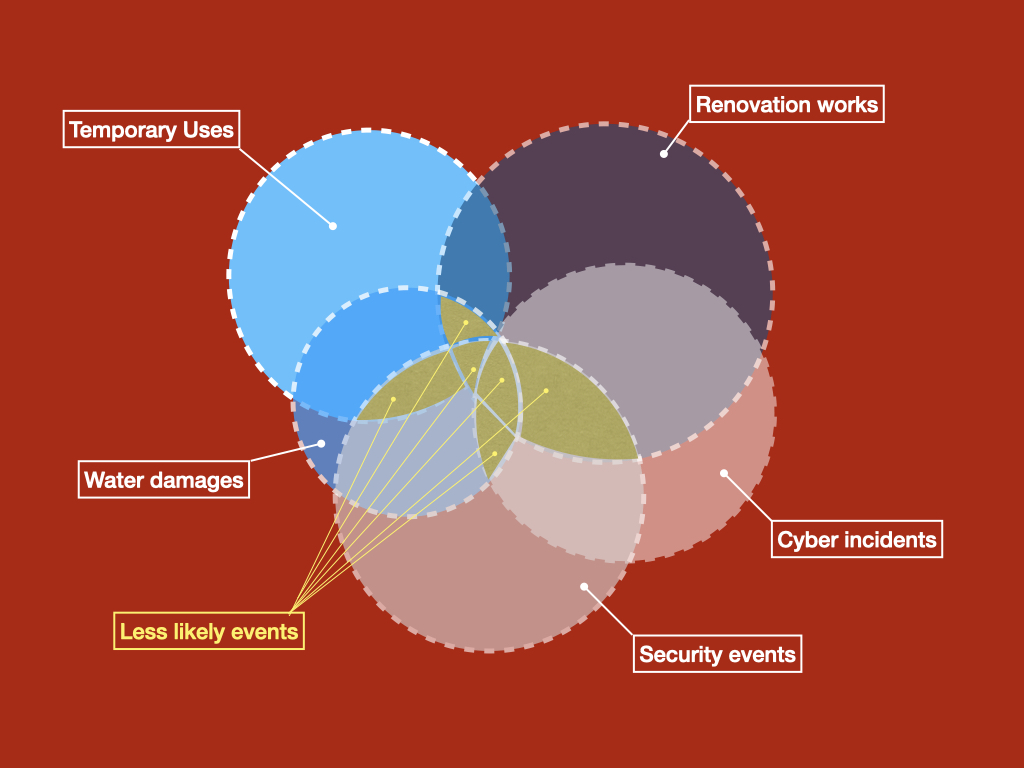
Historic buildings face a unique set of vulnerabilities that make them susceptible to compound risks—situations where two or more hazards interact, overlap in time, or amplify each other. This article analyzes the recurring patterns of failure in heritage sites and proposes a multi-hazard framework for safety engineering, moving beyond single-hazard thinking and simple compliance toward integrated operational resilience. Image: Fireriskheritage.net
Historic buildings and cultural sites are no longer exposed to one dominant threat at a time. In recent months, this platform has covered fires during renovation, temporary-use risks, cyber incidents affecting heritage infrastructure, water damage and security failures at historical sites, showing that cultural heritage safety now has to deal with overlapping hazards rather than isolated events.
Why heritage sites are especially exposed
Historic buildings tend to accumulate vulnerability. Their materials may be combustible or fragile, their geometry may hinder evacuation and firefighting, and conservation constraints may delay upgrades or limit invasive interventions. In addition, responsibilities are often distributed across owners, curators, contractors, event organisers, security staff, and public authorities, making coordination harder exactly when fast decisions are needed.
That combination means compound risk is not just an added layer of complexity; it is a structural condition of many heritage sites. A site may appear compliant on paper while still being operationally unprepared for interacting hazards.
Why compound risk matters
Compound risk describes situations in which two or more hazards interact, overlap in time, or amplify each other. In the heritage field, this can mean a fire occurring during renovation, a cyberattack affecting protective infrastructure, a violent incident disrupting emergency response, or water damage increasing the vulnerability of collections and structures already weakened by poor maintenance.
This is not only a theoretical issue. Temporary uses frequently create hidden fire loads and management gaps, how cyber incidents can affect site operations, and how water remains a persistent source of damage that often interacts with emergency response choices and existing building fragility.
From single hazard to interacting hazards
Traditional safety planning often treats risks separately: fire prevention in one document, physical security in another, flood response somewhere else, and digital resilience barely considered at all. That fragmented approach is increasingly inadequate for historic buildings, where architectural constraints, limited compartmentation (the ability to isolate fire or smoke within a specific area), fragile materials, and complex governance already make emergency management difficult.
A heritage site hosting an event offers a simple example. Temporary electrical systems, increased occupancy, restricted escape routes, contractors, catering equipment, and pressure to preserve aesthetics can combine to create a risk profile very different from ordinary daily use. If a security incident, power failure, or communication breakdown occurs at the same time, the emergency becomes much harder to control.
Recent lessons from the site
Analysis of recent events suggest at least five recurring patterns:
- Renovation creates a high-risk phase because detection and suppression systems may be impaired, spaces may be partially occupied, and contractors may introduce ignition sources.
- Temporary use changes the building faster than managers adapt procedures, especially when heritage spaces are opened for events, exhibitions, or exceptional access.
- Water damage is not separate from fire safety; drainage failure, firefighting water, humidity, and poor recovery planning can all multiply losses.[
- Cyber incidents can become heritage-safety incidents when digital systems support flood protection, access control, monitoring, or continuity of operations.
- Security events at heritage sites show that crowd management, staff readiness, and inter-agency coordination belong inside the same protection framework, not outside it.
Taken together, these examples support a broader conclusion: the real weakness in many heritage sites is not the absence of individual measures, but the absence of an integrated view of how failures cascade across systems.
What a multi-hazard approach should include
A more realistic protection strategy for historic buildings should start from interactions, not categories. Instead of asking only whether a site has fire detection or a security plan, managers should ask what happens if one protection layer fails while another hazard is already underway.
A practical multi-hazard framework for heritage sites should include:
- Scenario-based planning (the process of simulating specific ‘what-if’ narratives) for combined events, such as fire during renovation, flood during closure, or cyber disruption during extreme weather.
- Identification of critical dependencies, including pumps, alarms, electrical supply, communications, access control, and staff availability.
- Operational protocols for temporary uses, contractors, and exceptional openings, with clear authority and stop-work criteria.
- Salvage priorities that consider both life safety and the protection of high-value collections, interiors, archives, and symbolic spaces.
- Post-incident recovery planning, because secondary damage after the event often determines the final scale of heritage loss.
Toward heritage safety engineering
This is one reason the recent Fire Risk Heritage post on the weak recognition of cultural heritage safety engineering is important. If safety in heritage continues to be treated as a secondary concern or a narrow compliance exercise, institutions will keep underestimating the need for professionals able to connect fire safety, security, conservation, digital systems, emergency planning, and organisational resilience.
The next step is cultural as much as technical. Heritage institutions need to move from a preservation-only mindset to a protection mindset in which safety is understood as part of conservation itself.
Three immediate priorities
Three actions deserve attention now.
- First, heritage organisations should review their sites for interacting vulnerabilities rather than isolated hazards, especially where renovation, temporary use, or digital infrastructure are involved.
- Second, emergency plans should be tested through realistic scenarios involving cascading failures, not only routine evacuation drills.
- Third, site managers should define in advance which assets, spaces, and systems are critical to protect in the first minutes and first hours of an incident.
Closing point
The age of compound risk does not mean every heritage site faces every threat at once. It means that the most serious losses increasingly emerge when hazards intersect with weak management, fragmented responsibilities, and systems that were never designed to fail together.
For historic buildings and cultural sites, safety can no longer be organised in separate silos. The real task now is to understand connections: between hazards, between systems, and between conservation and emergency management.