Works Hazard: The Miller Mansion Fire and Fire Risk in Historic Buildings Under Conversion
A historic building is rarely more exposed to fire than in the months when people are working to save it. Restoration and conversion sites combine three things that rarely coexist in normal use: hot work and temporary electrics, large quantities of combustible materials, and a building whose detection systems, compartmentation and occupants have all been removed or limited.
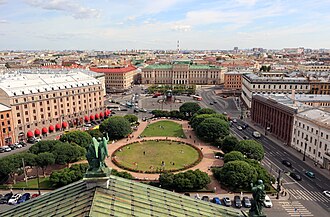
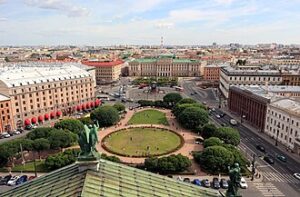
The ensemble of St Isaac's Square before the October 2026 fire of the Miller Mansion (on the left) - Wikipedia (https://commons.wikimedia.org/wiki/File:SPb_СПб._Исаакий._Крыша._Вид_на_памятник_Николаю_I_и_пл_IMG6007.3_e1CR3b.jpg
The fire that severely damaged the Miller Mansion on St Isaac’s Square in St Petersburg on 1 October 2026 is a typical example. An empty building, stripped for a conversion into luxury apartments.
The fire of 1 October 2026
The alarm reached the emergency services at 20:11 Moscow time on 1 October, for a fire at 3 St Isaac’s Square. The Ministry of Emergency Situations described open burning across a four-storey building, with flames on every floor and a threat to neighbouring buildings.
Eyewitnesses reported that the flames ran through the vacated building in a matter of minutes.
At its peak 165 firefighters and 37 units of equipment were committed. The fire reached the adjoining building which houses apartments, a hotel and commercial premises; its residents were evacuated. Nobody was injured.
Most of the decisive work was invisible from the square. Crews operated from inside the adjoining building, wetting the shared structures to stop the fire crossing over.
The outcome of the fire is the almost complete destruction of the mansion’s interior.
The Investigative Committee opened a criminal case for the breach of safety rules during construction or other works, with welding carried out in breach of safety requirements as the main hypothesis.
The heritage authority KGIOP (Committee for State Control, Use, and Protection of Historical and Cultural Monuments) asked for further proceedings for damage to cultural heritage sites and on breach of heritage-protection requirements.
The building and the conversion project
The mansion belongs to a protected ensemble, the “Mansion and Apartment House of K. L. Miller”, listed as a cultural heritage site of regional significance. The complex took shape from the second half of the 18th century and was reworked in an eclectic style.
In March 2026 the developer TAS obtained a credit line of 768 million roubles for the restoration and conversion of the building into an exclusive apartment house, with completion planned for the end of 2027. By October the building had been vacated and was effectively out of use.
Two facts limited the cultural loss, and both deserve attention:
- Salvage before the fire. The owner had already dismantled the most valuable interior elements and removed them for restoration.
- Documentation. KGIOP stated that the measured survey and the restoration project survive, and that interiors will be reconstructed from the remaining stucco work.
KGIOP’s head argued that the loss of historic interiors was limited: only about 20% of the rooms retained fragments of decoration, most of it lost in the Soviet period.
He now expects restoration to end in late 2028 and said the contractor will answer for what happened. That assessment is contested in local debate, but it highlights a point often missed: in a works phase, removing and recording movable and detachable heritage is itself a fire protection measure.
Why buildings under works burn
The official cause will come from the fire-technical examination, but a slowly developing concealed fire seems to be the most likely scenario: building materials smouldering after a spark or careless hot work, for hours or even days, until a sudden inflow of air turns the accumulated combustion gases into an almost instantaneous flare-up.
A failing window could explain both the bang and the speed witnesses described.
The Miller Mansion displays almost every factor that makes the works phase so dangerous:
- No one to notice. A vacated building has no occupants to smell smoke or see sparks. The mansion seems to have had no fire alarm, no automatic suppression and no smoke control during the works, so the first call probably came when the fire was already well developed.
- Hot work. Frequently, welding, cutting, grinding and torch-applied roofing produce sparks and hot fragments that lodge in cracks, voids and debris. They can smoulder long after the crew has gone home.
- Temporary fire load. Packaging, timber, insulation, solvents and accumulated debris add fuel that the building was never designed to hold, often stored where it is most convenient rather than safest.
- Combustible hidden voids. Old timber floors, pugging and “black floors” dried for over a century, plus decades of dust in floor and wall voids, let fire travel unseen. Firefighting water from outside often fails to reach it.
- Opened compartmentation. Stripping out doors, ceilings and partitions, and opening service shafts, removes the barriers that would normally confine a fire to one room or floor.
- Disabled or missing protection. Existing detection is often switched off to avoid false alarms from dust, and new systems are commissioned only at the end of the project.
- Fragmented responsibility. Owner, main contractor, subcontractors and heritage authority each manage part of the site, and fire safety can fall between them.
None of these factors is exotic. The problem is their combination, during a phase that can last years, in buildings whose fabric is irreplaceable.
A long list of precedents
St Petersburg is not an isolated case. Some of the best-known heritage fires of the last 40 years started, or became catastrophic, during works (not necessarily caused by them, but with the ongoing work as an accelerator).
| Year | Building | Works context | Lesson |
| 2019 | Notre-Dame de Paris | Spire and roof restoration, scaffolding in place | Detection worked, but the time to confirm the alarm and locate the fire in a vast roof void was decisive; investigators point to an accidental cause |
| 2018 | Glasgow School of Art (Mackintosh Building) | Restoration after the 2014 fire; the new mist suppression system was not yet operational | A building was lost a second time while being made safer; the cause remained undetermined |
| 1997 | Chapel of the Holy Shroud, Turin | Restoration with scaffolding inside Guarini’s dome | The cause was never conclusively established; the chapel reopened only in 2018 |
| 1996 | La Fenice, Venice | Renovation; the adjacent canal drained for maintenance | Arson by two contractor electricians facing delay penalties; works also cut the firefighting water supply |
| 1992 | Windsor Castle | Refurbishment of the Private Chapel area | A work lamp left against a curtain; fire spread through roof voids to over 100 rooms |
| 1989 | Uppark, West Sussex | Lead roof repairs | A contractor’s blowtorch ignited the roof structure; prepared salvage plans saved most contents |
What reduces the risk
The measures are well known and largely codified, for example in NFPA 241 on construction, alteration and demolition operations, in NFPA 51B on hot work, and in the UK Joint Code of Practice on fire prevention on construction sites.
What fails is usually their application to a heritage building, where the stakes are higher and the fabric more vulnerable. Five principles matter most.
- A fire strategy for the works phase, written before the tender. The works phase needs its own fire risk assessment, updated as the site changes, and its cost belongs in the contract, not in the contractor’s goodwill. One person must own fire safety across owner, contractor and subcontractors.
- Hot work as the exception. Where cold alternatives exist (mechanical fixing, cold cutting, adhesives), they should be required. Where hot work is unavoidable, a written permit, removal or shielding of combustibles, an extinguisher at hand and a fire watch continuing well after the work ends are the minimum. Hot work should never be the last task of the day.
- Temporary detection, never a dark building. If permanent systems are disabled, wireless or aspirating detection should cover roof spaces, floor voids and stores, connected to a monitored alarm receiving centre. Our earlier post on micro-sensor networks discusses solutions that do not damage historic fabric. In a vacated building, out-of-hours patrols or remote video analytics replace the occupants who would otherwise raise the alarm.
- Control of fuel and fire paths. Daily removal of debris, storage of materials and gas cylinders outside or in protected areas, and certified temporary electrics. Openings in floors and walls should be closed with temporary fire-resisting barriers at the end of each shift, and voids sealed as soon as works allow.
- Preparing for the fire that still happens. Salvage and documentation of movable and detachable elements before works start, as the Miller Mansion owner did. Firefighting access and water supply must be maintained throughout, and the local fire service briefed on the site layout as it changes.
The Miller case also reminds us of a less technical point. Breach of safety rules during works is a criminal matter in Russia, as it is in most jurisdictions. Prosecution after the event does not restore a building; inspection during works might have saved this one.
Conclusions
The Miller Mansion burned in a few hours, in the most monumental square of St Petersburg, while it was being prepared for a new life. Restoration and conversion are how heritage survives, so the answer cannot be to avoid works. It is to treat the works phase as a distinct and higher-risk condition of the building, with its own fire strategy, its own protection and a clearly assigned owner.
Several questions remain open and are worth following:
- What will the fire-technical examination conclude about the ignition source and the duration of the concealed phase?
- Was any temporary detection or out-of-hours surveillance required by the works permit, and by whom?
- How will the “restoration to the original state” promised by the city deal with the authenticity of a largely reconstructed interior?