Fire at the Marché des Enfants-Rouges — Paris Loses Its Oldest Covered Market
In the early hours of Monday, 12 October 2026, flames tore through the Marché des Enfants-Rouges in Paris’s 3rd arrondissement, reducing the city’s oldest covered food market to ash and scorched metal in a matter of hours. The fire, described by officials as “violent,” completely engulfed the 1,000 square metres of the historic covered pavilion. By dawn, one of Europe’s most storied urban markets — in continuous operation for over four centuries — was gone.

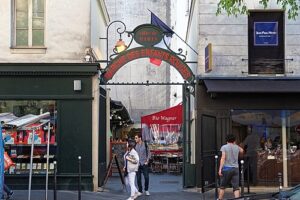
Image of the March des Enfants Rouge (besopha, CC BY 2.0 <https://creativecommons.org/licenses/by/2.0>, via Wikimedia Commons)
Few markets anywhere in Europe carry so dense a history. The Marché des Enfants-Rouges was established in 1615, during the reign of Louis XIII, initially under the name Petit Marché du Marais, to supply food to the growing Marais neighbourhood.
Its distinctive name derives from a nearby establishment: the Hospice des Enfants-Rouges, an orphanage founded in the 16th century whose charges were clothed in red — the colour of Christian charity — giving the market a name that would endure long after the orphanage closed in 1772.
For four centuries, the market served as a living crossroads of Parisian daily life. Under its covered timber and wrought-iron pavilion at 39 rue de Bretagne, generations of Parisians filled their baskets with cheeses, breads, wine, and vegetables.
In more recent decades it evolved into a celebrated food destination, with around 20 vendor stalls offering cuisines from Morocco, Japan, Lebanon, Italy and beyond. Food & Wine magazine had ranked it fifth worldwide for street food in 2026, while Time Out described it as simply “the coolest market in Paris.”
Crucially for its legal protection, the market was classified as a monument historique — a listed historic monument — in 1982, placing it under the guardianship of French heritage law and the Ministry of Culture.
Fire Timeline and Emergency Response
The fire broke out at approximately 3:00 a.m. on Sunday night into Monday, 12 October 2026. By around 4:15 a.m., the Brigade des Sapeurs-Pompiers de Paris (BSPP) had been mobilised and was engaging the blaze in force. More than 150 firefighters were deployed to the scene on Rue de Bretagne.
The fire spread rapidly through the market’s covered structure. The building’s materials — centuries-old timber framing, a metal roof, and dense wooden vendor stalls packed closely together — created conditions under which the fire intensified quickly and proved extremely difficult to contain. The blaze “completely engulfed” the entire 1,000 square metres of the covered market.
Nine hoses were deployed, including two high-powered ones, in the effort to bring the disaster under control.
By early morning, the fire was declared under control, approximately two hours after the main mobilisation. Crucially, no neighbouring buildings were affected, a significant operational achievement given the density of the Marais neighbourhood. One person sustained minor injuries.
An AFP journalist on the scene reported a thick layer of firefighting foam covering the pavement in front of the market’s entrances, and a pervasive smell of charred wood hanging over the street.
The market was sealed off alongside two adjoining municipal parks, and engineers and heritage architects began structural assessments of the site.
Cause: Under Investigation
As of the time of writing, the cause of the fire remains officially unknown. An investigation has been launched by French authorities to determine the origin of the blaze. The Mayor confirmed this publicly, stating that an inquiry was underway.
The fire broke out in the middle of the night, when the market was closed and the building unoccupied. This rules out several common causes associated with daytime market fires, though it does not in itself clarify origin. The midnight-to-dawn window is consistent with both accidental causes (electrical faults, residual heat sources from food preparation equipment, etc.) and deliberate ignition — possibilities that investigators will be weighing.
For the heritage fire-risk community, the pattern has a familiar shape. As one authoritative analysis of construction and renovation fires has noted, historic buildings with mixed timber-and-metal structures are among the most vulnerable to rapid fire spread precisely because heritage listing frequently limits modernisation of electrical systems and the installation of sprinkler networks, whose pipes and fittings would alter the fabric of protected interiors.
The Marché des Enfants-Rouges had no sprinkler system. This is not exceptional — the overwhelming majority of France’s listed market buildings do not — but it meant that once ignition occurred in the dry wood of the stalls, there was nothing to slow the fire before the fire brigade arrived.
This case will likely become a reference point in ongoing debates about fire-suppression retrofitting in classified heritage structures. FuRe Risk Heritage will update this post as investigative findings are published.
What Comes Next: Reconstruction, Heritage Law, and Risk Lessons
Reconstruction. Both City Hall and the French State have committed to rebuilding. However, reconstruction of a classified historic monument in France is a legally complex and slow process.
Under French heritage law, any rebuild must satisfy the requirements of the Architectes des Bâtiments de France, whose mandate is to ensure that work on listed structures respects their historical character.
This is not a process that lends itself to speed. In the short term, the city has pledged to find temporary commercial locations for the around 20 displaced vendors; the longer-term question of what a rebuilt market should look like — and whether it can ever replicate what was lost — remains entirely open.
Heritage fire risk: the broader lesson. The fire at the Marché des Enfants-Rouges is a case study in a set of vulnerabilities that affect thousands of listed market buildings, covered passages, and historic commercial structures across Europe.
- No active suppression. The absence of a fire detection or an automatic extinguishing system meant that a fire starting in an unoccupied building at 3 a.m. could burn unchecked for over an hour before suppression began in force. The wood-and-iron covered structure was highly combustible and offered minimal compartmentalisation.
- Night-time ignition window. Covered markets are busy by day and empty by night. The gap between closing and opening represents a sustained period when ignition can go undetected and small fires grow large.
- Heritage listing as a barrier to fire-safety retrofitting. This is the structural tension at the heart of heritage fire risk. Measures that would materially reduce fire risk — sprinkler systems, modern electrical re-wiring, fire-rated partitioning — often conflict with the fabric protection obligations that come with listed status. Resolving this tension requires heritage authorities, fire services, and building owners to work together before a fire, not after.
- Absence of early-warning systems. There is no indication from early reports that a smoke or heat detection system triggered an alarm before the fire had spread significantly. For covered market buildings with combustible structures, early detection is the single most impactful intervention available, even where suppression systems cannot be installed.
The destruction of the Marché des Enfants-Rouges is a reminder that heritage listing is a cultural and legal status, not a physical protection. A monument can be listed and still burn.
What the fire-risk community can learn from this event — and what must be urgently examined in comparable historic market structures across France and Europe — is how to close the gap between a building’s protected status on paper and its actual resilience against fire on the ground.