Active Surveillance: Leveraging AI Video-Analytics for the Protection of Understaffed Cultural Heritage Sites
Explore the transition from passive CCTV to active AI video-analytics in understaffed cultural heritage sites. This technical brief analyzes the feasibility of retrofitting existing systems, the critical balance between CAPEX and OPEX, and the essential role of human training in preventing fire and vandalism.

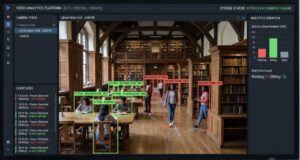
Conceptual illustration of an AI-driven video analytics interface. Image generated via AI to demonstrate real-time activity classification.
Cultural heritage sites, particularly churches and historic monuments, face a unique security paradox. They are often open to the public to ensure accessibility and spiritual or cultural engagement, yet they remain critically understaffed. This vulnerability makes them prime targets for both accidental fires and intentional acts of vandalism.
For decades, CCTV has been the standard response. However, traditional surveillance is largely passive: it provides a “digital autopsy” after a disaster has occurred but does little to prevent it in real-time. To bridge this gap, we must transition toward Active Video-Analytics.
1. The Transition: From Passive Recording to Active Detection
The core of the shift lies in integrating Artificial Intelligence (AI) into the video stream. Instead of a human operator watching dozens of screens, AI algorithms monitor the environment 24/7 for specific triggers:
- Fire & Smoke Detection: Identifying flames or smoke patterns in high-ceilinged environments where traditional heat detectors are often too slow to trigger.
- Behavioral Analysis: Detecting “loitering” in restricted areas, sudden aggressive movements, or the crossing of virtual boundaries (e.g., an intruder approaching a main altar).
2. Technical Feasibility and Retrofitting
One of the primary questions for heritage managers is whether existing infrastructure can be utilized.
- The Retrofitting Challenge: If a site already has IP-based cameras with high resolution, AI analytics can often be added via software updates or server-side integration. However, older analog systems usually require a hardware upgrade to ensure the AI has sufficient data quality to avoid errors.
- Aesthetic Constraints: In listed buildings, installation is never simple. The challenge is to integrate modern sensors and cabling without compromising the architectural integrity of the site, often requiring close coordination with heritage boards and superintendencies.
3. Economic Analysis: CAPEX vs. OPEX
Implementing AI surveillance requires a shift in how we view security budgets. It is not a one-time purchase, but a continuous service.
- CAPEX (Capital Expenditure): This includes the initial investment in high-resolution cameras, AI servers or Edge-computing hardware, and the complex installation process inherent to historic sites.
- OPEX (Operational Expenditure): This is where many projects fail. AI systems require ongoing calibration to minimize the alarm fatigue, one of the worst enemies of automatic alarm systems. In a church, variables such as incense smoke, shifting light through stained glass, or large tourist groups can trigger false positives. Without a dedicated maintenance budget for software tuning and hardware cleaning, the system becomes a nuisance rather than a tool.
4. The Human Factor: Training and Protocol
Technology is a force multiplier, but it is not a replacement for human judgment. The effectiveness of AI is entirely dependent on the response chain.
- Training Complexity: the challenge is not teaching staff how to use the software (which is usually intuitive) but training them on emergency protocols.
- The Response Gap: in understaffed sites, an alert sent to a volunteer’s smartphone is only useful if there is a clear, pre-defined procedure on how to intervene safely. Moreover, training must specifically address the psychological trap of alert fatigue; operators must be taught to distinguish between system noise and genuine threats, ensuring that when a real emergency occurs, the response is immediate rather than hesitant.
5. Critical Considerations: Privacy and Integration
Beyond the technical and financial aspects, two final pillars must be addressed:
- GDPR & Privacy: Implementing behavioral analytics in public spaces requires a rigorous Data Protection Impact Assessment (DPIA) to ensure that security does not infringe upon the privacy rights of visitors.
- System Synergy: Video-analytics should not exist in a vacuum. For maximum resilience, it must be integrated with existing fire alarm systems and access control, creating a unified “security ecosystem.”
Conclusion
Protecting our shared history requires us to move beyond paper-based security and passive recording. By combining AI video-analytics with rigorous human training and a sustainable maintenance model, we can transform vulnerable heritage sites into resilient environments—ensuring that these treasures are preserved not just for the record, but for future generations.