Saving the Soul of a Nation: Multi-Agency Coordination in Heritage Recovery Following the Central Italy Earthquakes
The seismic sequence that struck Central Italy between 2016 and 2017 was not merely a natural disaster — it was a direct threat to a piece of Europe’s cultural identity. Beginning on 24 August 2016 with a magnitude 6.0 shock near Amatrice, and followed by a magnitude 6.5 event near Norcia on 30 October, the sequence affected four regions — Abruzzo, Lazio, Marche, and Umbria — and 138 municipalities.
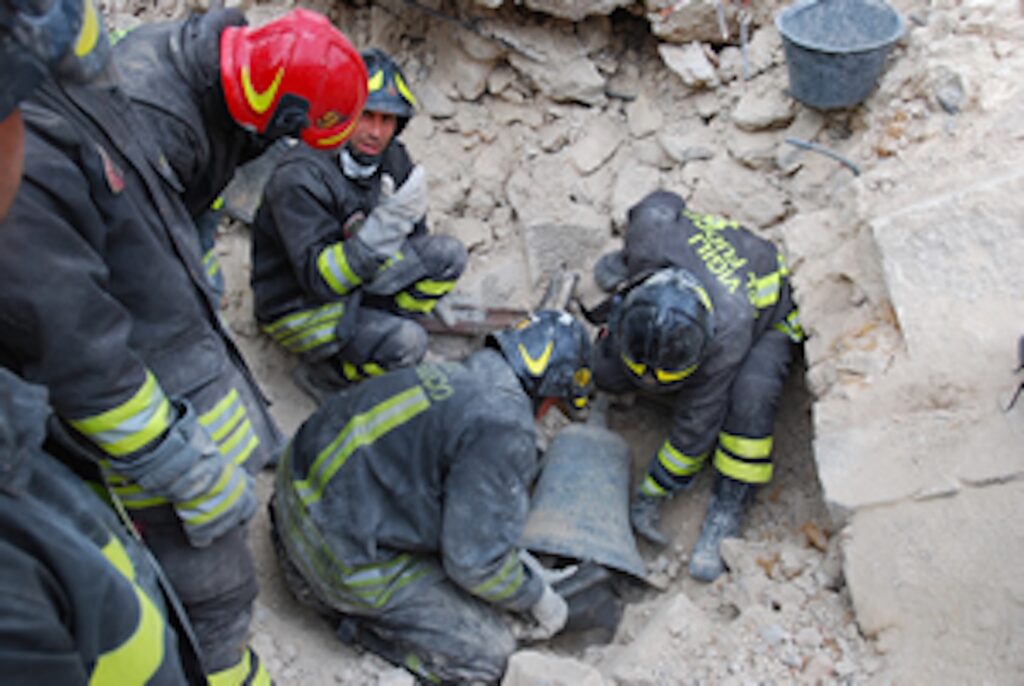
The image shows Italian firefighters working to secure cultural heritage, recovering a bell immediately after the 2009 earthquake in Abruzzo. Image: vigilfuoco.it
By Luca Nassi – Senior Official of the Italian National Fire and Rescue Service
Having led operations on the front line during both this sequence and the earlier L’Aquila earthquake, I can say with confidence that the recovery of cultural heritage (CH) is one of the most organizationally complex challenges any fire and rescue service can face.
This article sets out, from an operational commander’s perspective, why that complexity exists, where coordination breaks down, and what a fire service needs from its partners — before the ground ever shakes.
From Search and Rescue to Heritage Triage
The Italian National Fire and Rescue Service (Vigili del Fuoco – VVF) is structured unlike most of its international counterparts: although it is a national body under the Ministry of the Interior and focused on rescue, it integrates highly qualified technical personnel — engineers and architects — directly into its operational ranks. This allows the Corps to design and execute complex structural interventions internally, but effectiveness in the field still depends entirely on its ability to operate within a multi-agency interoperability framework.
In the first 24 hours after the Amatrice earthquake, over 1,000 responders were deployed on 24-hour shifts, organized into self-sufficient operational sections. At the peak of the emergency, our commitment reached nearly 2,300 firefighters and 1,200 vehicles, supported by specialized USAR (Urban Search and Rescue), SAF (high-angle rope rescue), Dog Search and Drone teams.Once the search-and-rescue phase concludes, the mission does not end — it shifts. Personnel must move from saving lives to safeguarding what gives a territory its identity: its churches, palaces, bell towers, and works of art. This is where the scenario becomes dramatically more articulated, and where the real coordination challenges begin.
The Red Zone Dilemma
The central operational bottleneck is the management of so-called “Red Zones” — areas where collapse risk is so severe that access is legally restricted to VVF personnel, or to those accompanied by them. A large share of Italy’s historic heritage sits inside these zones. This produces a structural paradox that every heritage-recovery operation must resolve:
- Entry authority rests exclusively with the fire service — only firefighters can physically access damaged heritage buildings.
- Decision authority over what to save, and by which techniques, rests exclusively with heritage conservation specialists from the Ministry of Culture (MiC) and the regional Soprintendenze.
- The resolution: without clear priorities issued by the heritage authorities, recovery operations risk critical delays — no matter how ready the fire teams are to act.
The structural response to this paradox was the creation of a joint management table bringing together the Ministry of Culture, Civil Protection, the fire service (for safety), local government, university structural engineering experts. Every technical decision — down to the smallest change made mid-worksite to an already-approved provisional structure — must be re-discussed and re-authorized at this table, which increases the administrative load precisely when speed matters most.
What Happens Inside the Red Zone
Once access and priorities are agreed, VVF personnel operate physically inside damaged buildings to recover movable heritage — paintings, statues, sacred furnishings — which are then handed over to conservation specialists. In parallel, teams design and build provisional works (shoring, temporary bracing, controlled partial demolition) to prevent the definitive collapse of monumental structuresTwo things distinguish this from ordinary structural rescue work:
• The non-standard nature of the object. Every historic building has its own geometry, materials, and construction technique, so operational solutions must be highly customized and often executed quickly, with minimal margin for error. Damage assessment cannot be purely structural: teams must distinguish between structural damage, damage to decorative apparatus, loss of masonry connections, and instability of vaults, façades, and bell towers — each of which carries different risk to both people and the asset itself.
• The reversibility requirement. Provisional interventions on churches, towers, bell towers, and monumental façades must be reversible, materially compatible, and fully documented. The objective is not only to prevent collapse, but to avoid compromising the restoration that will follow — a constraint that has no equivalent in ordinary post-earthquake structural triage.
Systemic Hurdles
Three recurring hurdles shaped the entire recovery effort:
The “seismic swarm” effect. Unlike a single-event disaster, a prolonged seismic sequence means every stability assessment can be rendered obsolete by the next major shock, forcing teams to restart damage evaluations from zero — sometimes after months of work.
Administrative fragmentation. Coordinating recovery across 138 municipalities, with varying technical capacities and multiple, often overlapping owners (municipalities, dioceses, private owners), produced significant bureaucratic delay. Without a single point of command, assessments become fragmented, priorities misaligned, and provisional works or movable-asset recovery procedures stall — a problem that is amplified in historic centers, where damage to one building routinely affects an entire block, its access routes, and the surrounding urban fabric.
• The technology gap. To manage the resulting flow of information, a georeferenced, web-based information systems was critical, to share in real time the status of hundreds of worksites, standardized damage-assessment forms for churches and palaces, and the geolocation of monuments already secured.
A Discipline That Requires Its Own Supply Chain
From a technical standpoint, cultural heritage cannot simply be folded into general post-earthquake structural response — it requires its own management chain, run in parallel with and integrated into the broader emergency structure.
The correct operational sequence is: damage recognition, priority-setting, securing of the structure, recovery of movable assets, provisional consolidation, and finally restoration planning.
When agencies do not share protocols, technical language, and a single decision-making chain, this sequence breaks down and the entire intervention slows. For a fire service, this translates into at least four standing operational requirements:
- Damage-assessment and classification forms shared in a common format with heritage technicians.
- Defined procedures for safe access and movable-asset recovery.
- Rapid design capability for provisional works that are compatible with future conservation.
- Continuous coordination with the Soprintendenze and with the ecclesiastical or civil bodies that own the property.
A Global Necessity for Pre-Planning
None of this is unique to Italy. International frameworks such as the Common Alerting Protocol (CAP), adopted by the U.S. Federal Emergency Management Agency (FEMA), confirm that interoperability is a universal challenge for emergency management, not a national peculiarity.
In the heat of an emergency, the informal motto is often: “Everyone asks for coordination, but no one wants to be coordinated.” The only way past this is pre-planning done before the event, defining in advance:
- a preventive census of exposed cultural assets;
- pre-agreed access and recovery plans for historic buildings and collections;
- joint procedures with the Soprintendenze and diocesan authorities;
- shared training on the typical vulnerabilities of historic construction;
- multi-agency exercises simulating partial collapse and movable-asset recovery.
The value of this planning rises directly with the complexity of the scenario. Institutional isolation — not lack of technical skill — is the greater risk.
Conclusion
The recovery of the Basilica of San Benedetto in Norcia, of the bell towers across the Abruzzo region and of many others, proved the same lesson: technical competence is necessary but not sufficient without institutional synergy.
The fire service brings entry authority, structural expertise, and operational capacity to a Red Zone; heritage authorities bring the historical and conservation judgment that determines what is actually worth saving, and how.
Neither can substitute for the other, and the interface between them — defined in advance, not improvised under the rubble — is what determines whether a nation’s cultural identity survives its next earthquake.
We must be prepared, and we must be coordinated.