Miyajima’s Reikado Hall Fire: What the Loss of a Sacred Wooden Landmark Reveals About Heritage Risk
The destruction of Reikado Hall on Miyajima Island is a reminder that sacred wooden heritage remains highly vulnerable, especially when ritual fire, symbolism, and combustible construction converge.
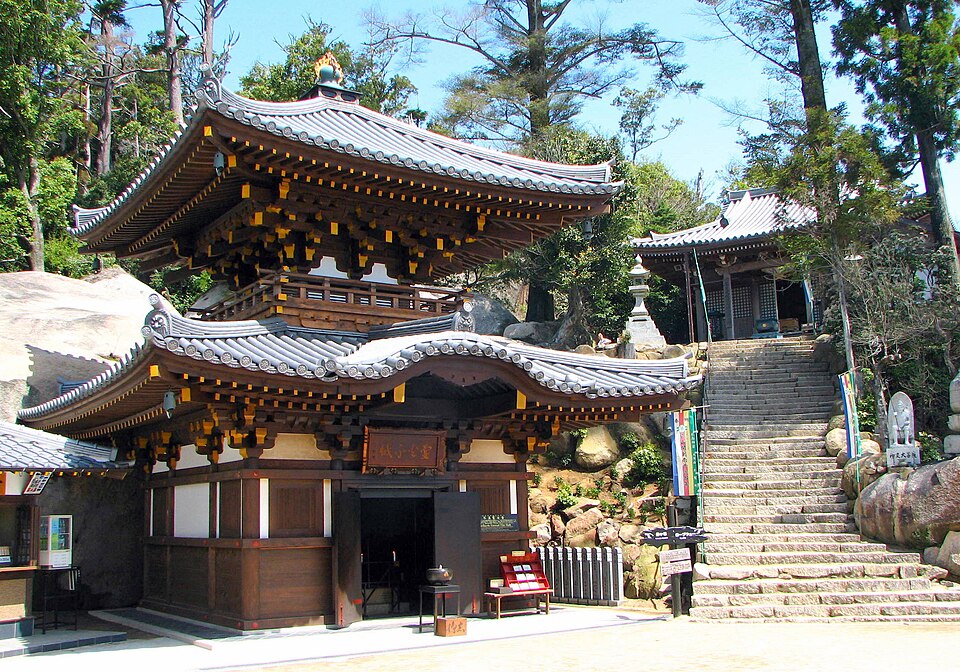
Image of the Reika-do Hall (Miyajima, Japan) before the May 2026 fire, via Wikimedia Commons, Bernard Gagnon, BY-SA 3.0.
This event is more than a local incident: it is a case study in the fragility of sacred wooden heritage, the operational complexity of managing ritual fire, and the continuing gap between cultural value and fire resilience.
On 20 May 2026, fire destroyed Reikado Hall at Daishō-in Temple on Miyajima Island, Hiroshima Prefecture. The hall, associated with Kūkai and known for its sacred flame, was reduced to ruins in an incident that has prompted renewed attention to fire risk in wooden religious heritage. The cause remains under investigation; as of this writing, the definitive origin of the fire has not been confirmed.
The hall is associated with the Buddhist monk Kūkai and is known for housing the “Eternal Flame,” a religious element with deep spiritual and memorial significance. The incident immediately drew attention not only because of the architectural loss, but because it involved a site where ritual continuity and fire safety coexist in a particularly delicate balance.
From a heritage-risk perspective, the event is significant for three reasons. First, it confirms that timber religious buildings are exceptionally vulnerable to rapid fire growth. Second, it shows how even a carefully managed sacred flame can coexist with a combustible building envelope that may not tolerate a single ignition failure. Third, it reminds us that fire at cultural heritage sites is not only a matter of suppression and response, but of long-term governance, maintenance, and operational discipline.
A fragile typology
Wooden temples and shrines are among the most exposed forms of built heritage. Their materiality is inseparable from their historical authenticity, yet the same materiality creates a low margin of safety when fire starts. In a structure like Reikado Hall, combustible framing, cladding, finishes, and decorative elements can support rapid flame spread once ignition occurs. The result is often a very short window for intervention, especially if the fire begins in a concealed or difficult-to-access area.
This is why the loss of such a hall should not be interpreted as an isolated accident. It is better understood as an example of structural and operational vulnerability converging. In heritage fire management, the most dangerous conditions are often not dramatic or exceptional; they are ordinary conditions in which traditional materials, symbolic functions, and limited intrusive retrofitting coexist.
Ritual fire and operational risk
One of the most interesting aspects of the Miyajima incident is the relationship between the building and its sacred flame. Religious fire is not merely a hazard; it is also an object of veneration, continuity, and identity. That makes risk management more complex than in ordinary occupancies. The challenge is not simply to remove fire from the site, but to contain and govern it in a way that preserves ritual meaning while reducing exposure and managing the localized fire load created by ritual elements.
This requires more than a symbolic acknowledgment of risk. It demands robust separation between flame sources and combustible construction, strict housekeeping, controlled access, clear emergency procedures, and staff trained to respond under stress without hesitation. Where a sacred flame is part of the heritage narrative, the fire-safety strategy must be designed around the ritual rather than against it.
Why this matters beyond Miyajima
The broader importance of the fire lies in its relevance to many other heritage sites, especially in East Asia but also in Europe and elsewhere. Historic temples, monasteries, churches, and chapels often include spaces where candles, lamps, incense, or ceremonial flames are integral to religious practice. These elements are culturally essential, but they also create persistent ignition sources in buildings that may have limited compartmentation or outdated protection systems.
For conservation professionals, the lesson is clear: authenticity cannot be treated as an excuse for underprotection. Nor can protection be reduced to visible firefighting equipment alone. A serious strategy for heritage resilience must combine passive protection, operational controls, maintenance planning, monitoring, and emergency readiness.
Often, the most effective interventions are those that remain discreet yet decisive, such as separation of flame-bearing elements, improved detection, hidden suppression measures, and better management of surrounding vegetation and access routes.
The memory dimension
The symbolic resonance of the Miyajima fire is amplified by the meaning attached to the “Eternal Flame.” Reports describing its connection to the Hiroshima “Flame of Peace” add another layer of memory and commemoration to the event. That matters because heritage fires are rarely only material losses. They also affect rituals, narratives, and public identity. When a structure linked to remembrance burns, the fire is experienced not just as damage, but as a rupture in continuity.
This is one reason why incident communication matters so much. In heritage emergencies, the immediate technical facts are important, but so is the framing. Public understanding should make clear that preserving meaning does not require accepting avoidable risk. In fact, the most respectful response to sacred heritage is often the one that takes prevention most seriously.
Practical lessons for heritage fire safety
The Miyajima fire suggests several practical lessons for managers of historic and sacred buildings:
- Treat ritual fire as a managed operational hazard, not as a fixed background condition.
- Separate sacred flame sources from combustible fabric wherever possible.
- Review detection coverage, response time, and staff roles for early-stage fire recognition.
- Limit hidden ignition pathways, especially near altars, lamps, electrical systems, and storage areas.
- Integrate vegetation management and perimeter control into the fire strategy.
- Document emergency procedures in a way that respects both the building’s function and its conservation status.
These measures do not eliminate risk, but they reduce the chance that a small incident becomes a total loss. In heritage protection, that difference is crucial.
A final reflection
Reikado Hall’s destruction is a painful reminder that sacred heritage is often most vulnerable where it is most meaningful. The challenge for fire safety engineers, conservationists, and religious custodians is to preserve that meaning without allowing symbolic value to become operational complacency. Miyajima should now be read not only as a site of loss, but as a case study in how cultural continuity depends on practical prevention.