Worship Centers Under Fire: From Japan’s Atago Shrine to Mozambique’s St. Louis de Montfort Church
Recent events, though unfolding thousands of kilometres apart, point to a troubling pattern. On 6 May 2026, the 300-year-old Atago Shrine in Niigata City, Japan, was completely destroyed and added to the Fire Risk Heritage 2026 loss list. Just days earlier, on 30 April, the historic St. Louis de Montfort Church in Meza, northern Mozambique, was destroyed in a terrorist attack linked to Islamic State extremists. Alongside the recent attacks on synagogues in London, these incidents underline the growing threat facing religious heritage sites worldwide.
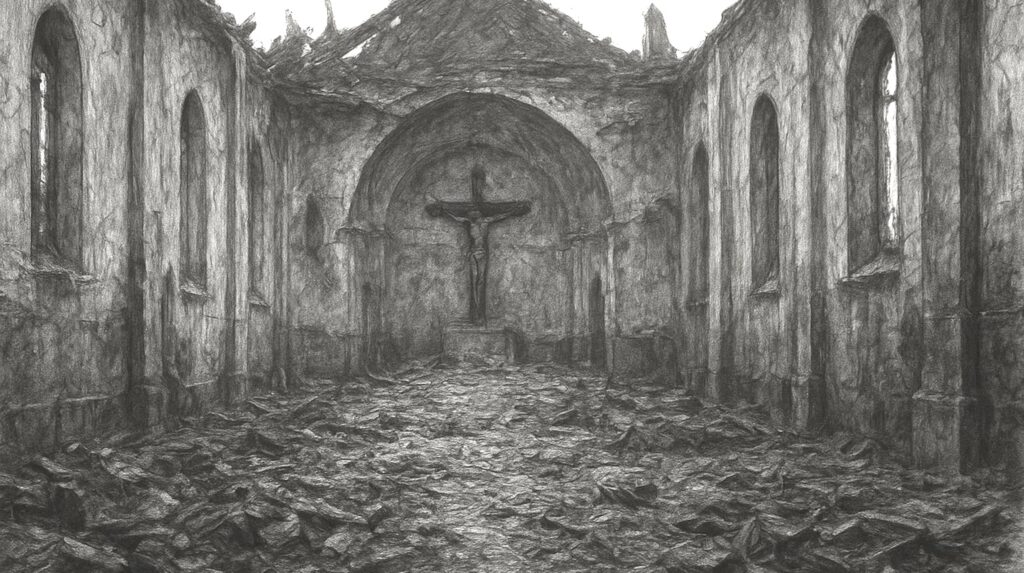
[Image generated with AI to illustrate the destruction of St. Louis de Montfort Church in Meza, Mozambique, due to restrictions on publishing available fire-scene photos and a lack of suitable pre-fire imagery.] Note: This reliance on AI highlights a critical broader issue: the systemic under-documentation of cultural heritage sites in less-resourced regions. It underscores the urgent need for better record-keeping and greater international awareness of threats to places of worship.
Fire is arguably the greatest single threat facing cultural heritage. In 2026, this risk is increasingly concentrated in worship centers: historic churches, mosques, synagogues, temples, and shrines that embody centuries of collective memory, craftsmanship, and spiritual life (Fire Risk Heritage 2026 loss list).
These losses are not merely architectural tragedies; they are symptoms of a global crisis. While the causes vary—from suspected arson in urban Japan to targeted terrorism in Mozambique—the result is a devastating erasure of cultural identity. When we examine these events alongside recent attacks on synagogues in London, a clear and concerning trajectory emerges: worship centers have become primary targets for fire-related destruction.
These are not isolated incidents. They are part of a broader pattern: worship centers are increasingly exposed to fire, arson, and deliberate violence, often in contexts where protection, evacuation, and emergency response are severely constrained.
Niigata City and the destruction of Atago Shrine
In the crowded Furumachi district of Niigata City, a massive fire broke out late on the night of 6 May 2026 (around 23:30) at the historic Atago Shrine. Firefighters battled the blaze for nearly 3.5 hours before bringing it under control, but the shrine’s main hall and worship hall were completely destroyed.
Key facts about this loss:
- It was dedicated to Homusubi-no-Mikoto, the Shinto deity believed to protect against fire—adding a profound irony to its destruction by fire.
- An elderly woman in her 90s was injured while evacuating, and at least three nearby buildings were damaged.
- Because the fire erupted late at night and the shrine was empty at the time, public speculation about possible arson has spread rapidly online. This incident is now documented in the Fire Risk Heritage 2026 loss list as a key example of worship center vulnerability.
This incident is part of a disturbing pattern in 2026: seven historic shrines from Fukuoka to Niigata have burned down in just four months. While Japanese authorities have not officially connected these fires, many in the Japanese public no longer accept that they are unrelated.
What makes Atago Shrine especially significant for fire risk heritage is not just its age, but its location: a dense urban district where fire can spread quickly from one wooden structure to another, and where evacuation and firefighting are constrained by narrow streets and limited access.
Mozambique: St. Louis de Montfort Church destroyed in “scene of terror”
In northern Mozambique, a different but equally devastating pattern is unfolding. On 30 April 2026, insurgents linked to Islamic State–Mozambique attacked the parish of St. Louis de Montfort in Meza, Cabo Delgado province, completely burning it down.
Key facts about this loss:
- The church was founded in 1946 and had been a symbol of Catholic presence in the region for 80 years.
- The jihadist attack also destroyed parish offices, the missionaries’ residence, and vandalised a church-run kindergarten.
- Bishop António Juliasse Ferreira Sandramo of Pemba described the aftermath as “a scene of terror”: homes and infrastructure destroyed, civilians captured and forced to listen to hate speeches delivered by the assailants.
- Since the insurgency began in October 2017, at least 117 churches and chapels have been destroyed in the Pemba Diocese alone, including 23 in 2025.
- Islamic State–Mozambique claimed responsibility for the attack on 1 May 2026.
- Unlike the Atago Shrine fire, this was not an accidental or suspected arson fire in a secondary city: it was a deliberate terrorist attack aimed at destroying a religious landmark and demoralizing a community.
Yet the outcome is the same: a historic worship center reduced to ashes, and a community left in shock.
London Synagogues
London Synagogues In recent months, London has experienced a series of arson-related incidents targeting Jewish community sites. These include an attack on a former synagogue in East London and an attempted fire attack on an active synagogue in Finchley. Additionally, an incident involving ambulances belonging to a Jewish community service near a synagogue in Golders Green further underscores the volatility of the current climate.
While these sites vary in their heritage status—ranging from active houses of worship to former community buildings—the common thread is the symbolic nature of the target. These are not random fires: they are attacks aimed at places associated with identity, memory, and faith. This highlights a critical vulnerability: when a building becomes a symbol of a specific community, its risk profile shifts from “accidental fire hazard” to “deliberate target,” requiring a fusion of both fire safety and high-level security.
Why worship centers are uniquely vulnerable
These cases highlight a common set of vulnerabilities that make worship centers uniquely exposed to fire and violence:
Historic construction and combustible materials. Many historic churches, shrines, and temples are built primarily of wood, timber roofs, and traditional materials that burn rapidly and are extremely difficult to protect without compromising their historic fabric. The Atago Shrine, like many Japanese shrines, was almost entirely wooden; the Mozambique church, despite being from 1946, was built in a colonial style that is now equally vulnerable.
Concentrated occupancy and ritual activity. Worship centers often host large gatherings during festivals, masses, and ceremonies. In Niigata, shrines are central to local festivals and community life. in Mozambique, the church was a focal point for Catholic life in a largely Muslim province. When a fire occurs during or near such events, the risk to life and to the building itself increases dramatically.
Urban density and limited access. In crowded urban districts like Niigata’s Furumachi, narrow streets and tightly packed buildings constrain firefighting access and allow fire to spread rapidly. A fire that starts in one building can quickly engulf neighboring structures, including other historic properties.
Deliberate targeting in conflict zones. In conflict-affected regions, worship centers are increasingly deliberately targeted as symbols of identity, faith, and community. The destruction of St. Louis de Montfort Church fits a broader pattern in Cabo Delgado, where churches, mosques, and other religious sites have been systematically attacked since 2017.
Underreporting and limited international attention. Both cases are examples of underreporting in international media. The Atago Shrine fire is documented mainly through Japanese-language local TV, social media, and niche Japan-culture accounts, with almost no coverage in major English-language news outlets. The Mozambique church attack, while covered by Catholic and human rights organizations, remains little known outside those communities.
What this means for fire risk heritage
The growing risk to worship centers such as Atago Shrine and St. Louis de Montfort Church has three key implications for heritage safety:
Multi-hazard protection is no longer optional. Protection strategies for worship centers must now combine:
- Fire safety: detection, suppression, hot-work controls during renovation, and fire-resistant interventions that respect historic fabric.
- Security and crisis management: protection against deliberate attacks, crowd control, and coordination with local security forces.
- Emergency planning: evacuation routes, community drills, and salvage priorities for objects, archives, and sacred items.
Treating fire and security as separate issues is no longer sufficient when the same building can be destroyed by accident, arson, or deliberate violence. This is exactly why Fire Risk Heritage now documents worship center losses in its 2026 loss list, connecting accidental fires, arson, and conflict-related destruction.
Documentation and monitoring are essential
Many heritage losses remain undocumented or poorly documented in English, even when they are major local events. The Atago Shrine fire, for example, is visible mainly through social media and Japanese-language reports. This underlines the importance of systematic documentation of losses, as Fire Risk Heritage has been doing for years in its annual lists of cultural and historic heritage losses.
Community-centered protection is critical
In both Niigata and Meza, worship centers are not just buildings: they are centers of community identity. The loss of Atago Shrine erased a 300-year-old local landmark. The destruction of St. Louis de Montfort Church shook a community that had already endured years of violence and displacement.
Effective protection must therefore be community-centered: involving local parishioners, shrine keepers, and residents in prevention, monitoring, and emergency response, rather than treating protection as a top-down, technical exercise.
Concluding point: worship centers at the front line
The destruction of Atago Shrine in Niigata and St. Louis de Montfort Church in Mozambique are not just two tragic losses among many. They are symptoms of a broader trend: worship centers are increasingly at the front line of fire risk, arson, and conflict-related violence. In the early 2026, historic worship centers are exposed to:
- Accidental fires in wooden structures in dense urban settings.
- Suspected arson and rigging with explosives, especially in secondary cities.
- Deliberate attacks in conflict zones, where religious landmarks are targeted as symbols of identity.
- Underreporting and limited international attention, even when the loss is catastrophic for local communities.
For Fire Risk Heritage, this means that the next step in heritage safety is to place worship centers at the center of the conversation, not as a special case, but as a priority.
These buildings are where fire, faith, memory, and community converge, and where the cost of loss is measured not only in heritage value, but in identities, rituals, and collective histories.
More on arson of historic places of worship: The Growing Threat of Arson Against Historic Places of Worship
More about Japan historic temples fires: Nine Japanese Shrines and Temples Lost to Fire in First Five Months of 2026: Context and Ongoing Protection Efforts