Fire Effects on Heritage Stone: Temperature Thresholds and Assessment
The technical knowledge compiled in this analysis becomes increasingly vital for the global heritage preservation community.

Introduction
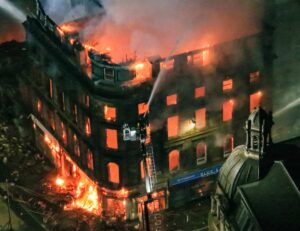
Stone has long been considered one of the most fire-resistant building materials in architectural history, providing inherent protection to countless heritage structures across centuries. However, as demonstrated by catastrophic fires at Notre Dame Cathedral and the Chapel of the Holy Shroud in Turin, even substantial stone construction can suffer devastating structural damage when exposed to intense fires.
Our previous article, Fire Threat to Cultural Heritage Stone Buildings, established the fundamental vulnerability of historic stone structures to fire and examined key case studies including the 1997 Turin Chapel fire. This technical companion document expands that analysis with detailed engineering guidance on fire-induced deterioration mechanisms, material-specific temperature thresholds, and post-fire structural assessment methodologies.
Understanding the precise mechanisms by which fire damages stone—and the critical temperature thresholds that distinguish repairable damage from catastrophic failure—is essential for both fire risk assessment and post-incident response planning. For heritage professionals conducting fire risk assessments, facilities managers developing emergency response protocols, and conservators planning post-fire restoration, this technical analysis provides the scientific foundation necessary for evidence-based decision-making.
The research synthesized here draws from recent studies on limestone thermal decomposition, comparative analysis of major heritage fires, and evolving post-fire assessment methodologies developed specifically for historic masonry structures. These findings have direct implications for prevention strategies, emergency response planning, and restoration approaches for stone heritage buildings worldwide.
Fire-Induced Stone Deterioration: Mechanisms
Stone materials undergo complex physical and chemical transformations when exposed to fire temperatures. The deterioration mechanisms vary significantly depending on stone composition, but several universal processes occur:
Thermal Decomposition: Limestone and marble, primarily composed of calcium carbonate (CaCO₃), undergo calcination above 600°C, decomposing into calcium oxide (CaO) and releasing carbon dioxide. This transformation results in a mass loss of approximately 42-44% and fundamentally alters the stone’s structural integrity. Complete thermal metamorphism occurs around 900°C.
Microstructural Damage: Fire-induced thermal shock causes progressive microcracking and pore enlargement within the stone matrix. These microfractures propagate through the material, increasing open porosity and creating pathways for further deterioration. Even stones that initially exhibit dense, compact structures experience significant cracking at elevated temperatures.
Thermal Shock Effects: Rapid temperature changes, particularly during firefighting operations when water contacts heated stone, induce severe thermal stress. This thermal shock can cause surface spalling, explosive failure, and disintegration of stone elements, especially when temperatures exceed 600-800°C.
Mechanical Property Degradation: High-temperature exposure causes measurable reductions in compressive strength, hardness, and ultrasonic pulse velocity. For example, certain limestones experience up to 33% strength reduction at 600°C. The mechanical decay kinetics are influenced by the stone’s initial porosity and mineral composition.
Color and Visual Changes: Thermal decomposition and oxidation of minerals, including iron oxides, iron sulphides, and organic matter, cause visible color alterations. These changes can serve as visual indicators of thermal damage severity, with whitening effects particularly noticeable after exposure to 600°C temperatures.[
Temperature Thresholds for Stone Materials
Different stone types exhibit varying resistance to thermal damage, with critical temperature thresholds that define when significant structural degradation occurs:
| Stone Type | Critical Temperature Range | Key Effects | Structural Impact |
| Limestone | 300-500°C | Initial calcite decomposition begins; minor strength reduction | Moderate damage; structure may remain serviceable |
| Limestone | 600°C | Significant calcination; 33% strength loss; increased porosity | Severe structural weakening; replacement often required |
| Limestone | 800-900°C | Complete thermal metamorphism; 42-44% mass loss | Catastrophic failure; total structural collapse likely |
| Marble | 300-500°C | Critical threshold range for thermal damage initiation | Progressive deterioration begins |
| Marble | 600-800°C | Severe strength degradation; potential disintegration | Major structural compromise |
| Sandstone | Variable (depends on cementing) | Behavior determined by cementing mineral, grain size, and cement ratio | Highly variable; requires case-specific assessment |
| General Natural Stone | 300°C (concrete) | Baseline damage threshold for comparison purposes | Concrete typically deemed significantly damaged above this point |
| Masonry Mortar | 600-800°C | Serious strength reduction; thermal shock disintegration risk | Structural joints compromised |
Research indicates that 300-500°C represents a critical threshold range where thermal damage transitions from minor to significant for most limestone and marble types. Beyond 600°C, most natural stones experience irreversible structural damage that typically requires element replacement rather than repair.
Comparative Analysis: Major Stone Building Fires
| Fire Event | Date | Stone Type | Peak Temperature | Primary Damage Mechanisms | Structural Outcome | Restoration Approach |
| Chapel of the Holy Shroud, Turin | April 11, 1997 | Local quarry limestone | Estimated 800°C+ | Thermal shock, calcination, microcracking | Numerous blocks destroyed; loss of load-bearing capacity | Complete stone replacement from reopened historic quarry; traditional jointing techniques reconstructed |
| Notre Dame Cathedral, Paris | April 15, 2019 | Lutetian limestone | 800-1000°C (roof), lower in vaults | Rapid thermal stress, structural failure of arches, extensive microcracking | Central nave arches failed; entire length compromised | Ongoing assessment using hybrid FEM-DEM modeling |
| Cologne Cathedral (WWII bombing comparison) | 1944-1945 | Various stone types | Varied | Explosion and fire combined | Structure remained largely intact despite bombardment | Demonstrates superior structural redundancy of Gothic design |
| Mycenae Archaeological Site | August 31, 2020 | Bronze Age limestone/stone | Wildfire temperatures (400-800°C) | Surface exposure, thermal shock from firefighting | Wall surface damage, risk of spalling | Prevention focus: vegetation clearance |
Key Observations: The Turin Chapel fire demonstrated that even relatively short-duration fires can cause catastrophic damage requiring complete stone replacement when temperatures exceed 800°C. The Notre Dame fire revealed the vulnerability of Gothic limestone vaults to thermal-induced structural failure along entire structural spans, despite the general robustness of the Gothic structural system. Both cases highlight that prevention of combustible material contact with stone is more effective than relying on the inherent fire resistance of masonry.
Engineering Guidance for Post-Fire Structural Assessment
Professional assessment of fire-damaged stone structures should follow a systematic methodology that combines visual inspection, non-destructive testing, and analytical evaluation:
Stage 1: Preliminary Inspection and Safety Assessment
- Document visible damage indicators including color changes (whitening, darkening), surface spalling, and visible cracking
- Establish safety zones and temporary structural support where necessary
- Collect debris samples for temperature profile analysis
Stage 2: Damage Classification and Temperature Estimation
- Develop site-specific damage classification schemes based on visual indicators and material testing[
- Use color changes as preliminary temperature indicators: whitening typically indicates >600°C exposure in limestone
- Apply numerical evaluation methods to estimate peak temperatures experienced by structural elements
Stage 3: Non-Destructive Testing (NDT) Program
Multiple complementary NDT techniques should be employed for masonry assessment:
- Schmidt (rebound) hammer testing for surface hardness evaluation
- Ultrasonic pulse velocity measurements to detect internal microcracking
- Penetration resistance testing for material integrity assessment
- Drilling resistance tests to evaluate depth of damage penetration.
Stage 4: Residual Strength Evaluation
- Calculate residual compressive strength based on NDT results and laboratory testing of extracted cores
- For limestone, assume significant strength reduction if temperatures exceeded 300-500°C, with potential 30%+ loss above 600°C
- Assess load-bearing capacity using thermo-mechanical characterization and finite element analysis.
Stage 5: Structural Analysis and Modeling
The DEMMEFI project methodology for heritage structures recommends hybrid FEM-DEM (Finite Element Method – Discrete Element Method) analysis for Gothic and historic masonry. This approach combines advantages of both methods to simulate mechanical behavior under fire-induced damage conditions.
Critical Assessment Criteria
- Stone elements exposed to >600°C typically require replacement rather than repair
- Thermal shock effects from firefighting water may have caused additional damage beyond direct fire exposure
- Each structural element requires individual assessment due to unique stress histories
- Conservative load capacity assumptions should be applied to fire-exposed elements pending detailed testing.
Documentation Requirements
Post-fire assessment should produce a comprehensive damage classification document that categorizes all structural elements and informs repair strategy selection. Regular monitoring programs should be established, as fire-damaged stone may continue to deteriorate over time due to increased permeability and environmental exposure.
Conclusion
The scientific evidence demonstrates that stone, despite its reputation for fire resistance, undergoes irreversible structural degradation when exposed to temperatures exceeding 600°C—conditions readily achieved in fires involving combustible building elements such as timber roofs, furnishings, or structural members.
The 42-44% mass loss experienced by limestone at 900°C and the 33% strength reduction documented at 600°C represent catastrophic thresholds that typically necessitate complete element replacement rather than repair.
For heritage site managers and fire safety professionals, these findings emphasize three critical priorities:
- Prevention remains paramount: Eliminating or isolating combustible materials from contact with historic stone elements is more effective than relying on the inherent fire resistance of masonry construction. Both the Turin Chapel and Notre Dame fires demonstrate that even brief exposure to intense fire can destroy stone elements that have survived centuries.
- Early intervention reduces damage: The temperature-dependent nature of stone deterioration means that rapid fire suppression, despite the thermal shock risks associated with water application, generally produces better outcomes than allowing fires to develop fully. Structural damage accelerates dramatically as temperatures transition from 300°C to 600°C and beyond.
- Post-fire assessment requires specialized expertise: Visual inspection alone cannot reliably determine the extent of internal microcracking and strength reduction in fire-exposed stone. Comprehensive NDT programs combining multiple techniques (ultrasonic testing, rebound hammer, drilling resistance) are essential for developing safe and effective restoration strategies.
The comparative analysis of stone building fires reveals that structural outcomes depend not only on peak temperatures but also on fire duration, structural system redundancy, and the specific thermal properties of local stone materials. The successful restoration of the Turin Chapel, achieved through meticulous documentation and reopening of the original historic quarry, demonstrates that even severely fire-damaged stone heritage can be authentically reconstructed when adequate resources and expertise are committed to the project.
As climate change increases wildfire risks to archaeological sites and urban heritage districts, and as aging electrical systems in historic buildings present ongoing ignition hazards, the technical knowledge compiled in this analysis becomes increasingly vital for the global heritage preservation community. Understanding precisely how fire destroys stone—and at what temperature thresholds damage becomes irreversible—enables more effective risk assessment, better-informed prevention strategies, and more successful post-fire recovery of our irreplaceable architectural heritage.
This introduction and conclusion frame your technical content as a companion piece to the original post while maintaining the professional, research-informed style of FireRiskHeritage.net.
Additional Technical References
1 – Physical-mechanical changes from high-temperature fire on limestone (V. Pires et al., 2024)
- Comprehensive study documenting 42-44% mass loss in limestones at 900°C and 33% strength reduction at 600°C
- Provides detailed analysis of microstructural changes, porosity increases, and thermal decomposition kinetics
- Establishes critical temperature thresholds and color change indicators for damage assessment
2 – Changes in physical and mechanical properties of limestone and marble (Quarterly Journal of Engineering Geology and Hydrogeology, 2020)
- Identifies 300-500°C as critical threshold range for thermal damage in limestone and marble
- Experimental validation of temperature-dependent property degradation
3 – Investigation of some property changes of natural building stones after fire and high heat (A. Ozguven & R. Ozguven, 2013)
- Widely cited study (143 citations) examining heat effects on limestone and marble used in construction
- Provides comparative data across multiple stone types under controlled heating conditions
4 – After Burn: Fire Damage Building Assessment (Technical guidance document, 2025)
- Engineering practice guidance for post-fire structural assessment methodology
- Describes NDT techniques specific to masonry and stone structures
- Establishes 600-800°C as critical damage threshold for natural stones and masonry mortars
5 – DEMMEFI Project: Structural assessment of Historical Monuments subjected to fire (French National Research Agency)
- 3D thermo-mechanical analysis approach for Gothic stone structures
- Ongoing research developing hybrid FEM-DEM methodology for pre- and post-fire assessment of heritage masonry
- Case study application to Notre Dame Cathedral fire.
How to Cite This Resource
Suggested citation format:
Marsella, S. (2026, January 3). Fire Effects on Heritage Stone: Temperature Thresholds and Assessment. Fire Risk Heritage. Retrieved January 31, 2026, from https://www.fireriskheritage.net/publicationsand-research-documents-of-risk-to-cultural-heritage/fire-effects-on-heritage-stone-temperature-thresholds-and-assessment/
▶ Show additional citation formats
APA 7th Edition:
Marsella, S. (2026). Fire effects on heritage stone: Temperature thresholds and assessment. Fire Risk Heritage. https://www.fireriskheritage.net/publicationsand-research-documents-of-risk-to-cultural-heritage/fire-effects-on-heritage-stone-temperature-thresholds-and-assessment/
MLA 9th Edition:
Marsella, Stefano. “Fire Effects on Heritage Stone: Temperature Thresholds and Assessment.” Fire Risk Heritage, 3 Jan. 2026, www.fireriskheritage.net/publicationsand-research-documents-of-risk-to-cultural-heritage/fire-effects-on-heritage-stone-temperature-thresholds-and-assessment/.
Chicago 17th Edition:
Marsella, Stefano. “Fire Effects on Heritage Stone: Temperature Thresholds and Assessment.” Fire Risk Heritage, January 3, 2026. https://www.fireriskheritage.net/publicationsand-research-documents-of-risk-to-cultural-heritage/fire-effects-on-heritage-stone-temperature-thresholds-and-assessment/.
BibTeX Entry:
@misc{marsella2026fire,
  title={Fire Effects on Heritage Stone: Temperature Thresholds and Assessment},
  author={Marsella, Stefano},
  year={2026},
  month={January},
  howpublished={\url{https://www.fireriskheritage.net/publicationsand-research-documents-of-risk-to-cultural-heritage/fire-effects-on-heritage-stone-temperature-thresholds-and-assessment/}},
  publisher={Fire Risk Heritage},
  note={Accessed: 2026-01-31}
}