Safety or Erasure? The Politics of Heritage in Tibetan Monasteries
The history of Tibet’s monasteries cannot be reduced to a simple narrative of cultural preservation or a single campaign of destruction. Rather, it is a complex history of religious continuity, political control, and ongoing disputes over who holds the authority to define and protect Tibetan heritage.
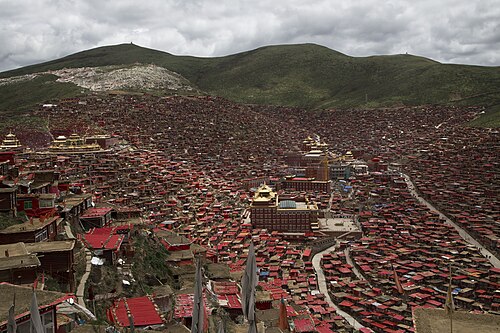
An image of the monastic center of Larung Gar, whose population has been halved using the pretext of overcrowding.. Image: BODHICITTA from cheng du shi, china, CC BY 2.0 via Wikimedia Commons
While much of the global conversation regarding Tibetan heritage focuses on the ruins left by the Cultural Revolution, we are currently witnessing a more subtle, bureaucratic form of erasure. In recent years, “fire safety” and “administrative regulation” have emerged as primary justifications for the demolition of religious sites and the displacement of monastic communities.
The case of Larung Gar serves a primary example. Chinese authorities cite overcrowding and fire risks, concerns that are technically legitimate in any high-density settlement.
However, organizations such as Human Rights Watch argue that these safety measures are applied selectively. The concern is that “safety” is not the objective, but rather a pretext to reduce the population of Buddhist practitioners and impose strict state control over religious leadership.
This creates a profound paradox: while the state may fund the physical reconstruction of iconic monuments for tourism (such as the Potala Palace), it simultaneously dismantles living communities under the guise of risk management.
True heritage preservation is not merely the act of keeping a building standing; it is the protection of the community that gives the architecture its meaning. When fire safety codes are used as tools for demolition rather than frameworks for mitigation, they cease to be safety measures and become political instruments.
To protect living Tibetan culture, we must demand transparency in heritage management. Risk assessments should be public, consultations with religious leaders must be mandatory, and “safety” must never be used as a shortcut to cultural erasure.