Crowd as a Fire Risk Multiplier in Underground Heritage Sites
In fire risk assessments for heritage sites, the crowd is almost always cast as the asset to protect — the people who must be evacuated safely before the building is lost. This framing is professionally embedded and rarely questioned. Yet in underground heritage environments, it obscures a critical dimension of risk: the crowd itself is an active hazard, capable of degrading atmospheric conditions, blocking egress, and triggering panic cascades that make a manageable emergency unmanageable.

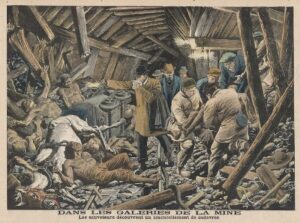
Image of the 1906 Courrieres Mine (France) disaster (By JÄannick Jérémy - Compagnie des mines de Courrières, Public Domain, https://commons.wikimedia.org/w/index.php?curid=7004452
Underground heritage spaces — caves, crypts, rock-cut churches, historic mines — share a spatial characteristic that makes crowd risk qualitatively different from surface buildings: they often have one, or very few, exit paths.
In a conventional heritage building, even a poorly configured one, evacuation geometry is usually multi-directional. An overloaded staircase may be bypassed; a blocked corridor may have alternatives. In a cave or underground gallery, there are often none. The single access tunnel that makes these sites so evocative — the sense of crossing a threshold into another world — is also the only way out.
In fire engineering terms, this creates a worst-case bottleneck scenario: when occupant density is high, exit flow rate becomes the governing variable for survival. Active fire suppression may reduce heat or smoke, but it does not remove the fundamental constraint of limited egress capacity.
Many conventional crowd-flow models were developed for stadia, airports and large surface buildings, where multiple exits and relatively predictable movement are assumed. They can understate risk when applied to single-exit topology, low ceiling heights, irregular floor geometry and the psychological stress of confinement. Underground heritage sites routinely present all four conditions at once.
The crowd as a physical hazard: atmosphere, heat and panic
Beyond egress, a large crowd in a sealed or semi-sealed underground space creates measurable physical changes to the environment — independent of any fire event.
Atmospheric degradation
Human metabolism produces carbon dioxide and water vapour. In a poorly ventilated underground space, occupant density can raise CO₂ levels well above normal indoor conditions and reduce the margin of safe air before any fire occurs. During a fire, visitor-generated CO₂ adds to the burden created by combustion products and can shorten the time available for safe evacuation.
A crowd in a confined underground space is not merely present; it is actively consuming the available atmospheric margin.
Thermal load
Each person generates roughly 80–100 W of heat at rest. In low-volume underground spaces, dense crowds can produce measurable temperature rises and disturb thermal stratification — a condition on which some passive smoke-control strategies depend.
Panic dynamics
Research on crowd behaviour in emergencies consistently shows that confined, topographically constrained environments amplify stress and panic responses. The absence of visible exits, darkness, irregular surfaces and echo effects characteristic of underground sites all increase psychological pressure.
Under these conditions, a crowd may stop behaving as a collection of rational individuals following an evacuation plan and begin to exhibit collective behaviours — compression, counter-flows, trampling — that are primary contributors to mass-casualty events in confined spaces.
Case studies: when underground crowds become the crisis
Courrières, France, 1906: fire, confinement and the arithmetic of egress
The Courrières mine disaster of 10 March 1906 was the worst mining disaster in French history and one of the most severe in Europe. It remains one of the clearest documented cases of what fire and explosion do to a dense human population in a confined underground environment when egress geometry fails.
The Courrières colliery operated a complex network of interconnected galleries linked to three shafts, at depths reaching around 270–280 metres. On the afternoon of 9 March, a fire broke out in the Cecil gallery. Unable to extinguish it directly, supervisors sealed the pit’s outlets to starve the fire of air — a standard procedure at the time. What they did not fully account for was gas permeating from fissures in the surrounding walls.
At approximately 7 a.m. on 10 March, with around 1,795 workers underground for the day shift, smouldering material ignited the accumulated gas. The explosion propagated through approximately 110 kilometres of interconnected galleries, crossing shaft boundaries through the connected ventilation system. The blast was powerful enough to project debris above surface openings, and fires at the shafts severely hampered immediate rescue.
The official toll was 1,099 miners killed; additional rescuers died during the emergency.
Why the Courrières disaster is relevant
The disaster shows how occupant density, single-path egress and atmospheric collapse interact. Many workers were not killed only by the initial blast; they died because escape routes and fire/gas propagation paths overlapped, and because toxic afterdamp — the poisonous gas mixture produced by underground fires and explosions — rapidly made galleries uninhabitable.
Rescue operations were suspended after three days, and portions of the mine were sealed while survivors were known to still be inside. Thirteen men eventually emerged after twenty days, having found unaffected sections of the gallery network and survived by moving through them.
Courrières was not a heritage visitor site, but it is an empirical baseline for underground crowd risk. Workers who knew the mine could still be trapped; visitors to a heritage underground site cannot be expected to possess equivalent spatial knowledge. The disaster prompted major French mining safety reforms, including compartmentation, atmospheric monitoring, rescue pre-planning and occupancy control.
The site is now part of the preserved mining heritage of northern France, and the Mining Basin of Northern France is a UNESCO World Heritage Site.
The Paris Catacombs: managed access and unmanaged risk
If Courrières illustrates what fire does to a crowd in an underground environment, the Paris Catacombs illustrate a different and more insidious problem: the persistent failure of governance to track who is actually underground, in what numbers, and with what fire risk implications.
The Catacombs of Paris are a network of former limestone quarries extending approximately 300 kilometres beneath the city, at depths of around 15 to 30 metres. A small section — roughly 2 kilometres of the total network — forms the official ossuary, which holds the remains of around six million people and has been open to controlled public visits since the early 19th century. This official route receives around half a million visitors annually under managed conditions, with guided access, defined maximum occupancy and controlled egress. By many measures, it is a well-managed heritage visitor site.
The wider network presents a different risk profile entirely. Unauthorised access has been illegal since 1955, and a specialist police unit — informally known as the cataflics — is responsible for enforcement. Nevertheless, unauthorised use has persisted for centuries and includes exploration, gatherings and events.
Lascaux: the lesson that predates fire
The clearest evidence that crowds constitute a standalone physical threat to underground heritage sites does not come from a fire incident. It comes from Lascaux.
Discovered in 1940 and opened to the public in 1948, the Palaeolithic cave in the Dordogne attracted as many as 1,200 visitors per day at its peak. Within fifteen years, the consequences were irreversible. The CO₂, moisture and heat generated by visitor breath and body warmth altered the cave’s microclimate, triggering algae growth and then fungal contamination that damaged the paintings directly. The French Ministry of Cultural Affairs closed Lascaux to the public in 1963.
Lascaux is not a fire story. But it demonstrates, with devastating clarity, that a crowd of visitors introduced into a confined underground environment without adequate understanding of the physical consequences can threaten an irreplaceable heritage asset — even without any ignition source.
The implication for fire risk professionals is direct: if ordinary visitation can alter the environment, then visitor-generated conditions during a fire emergency — elevated CO₂, thermal disruption and panic-driven egress failure — represent a compounded threat that cannot be assessed by treating the crowd as a neutral element in the scenario.
The institutional resistance
Recognising the crowd as a risk variable has a direct implication that heritage site managers are often reluctant to accept: it may mean limiting access.
This is not a minor operational adjustment. For many underground heritage sites, visitor numbers are tied to funding mechanisms, institutional mandates, political commitments and the basic legitimacy of heritage as a publicly accessible resource. A site manager who proposes reducing maximum occupancy on fire safety grounds is effectively challenging the economic model of the institution.
In practice, this creates a systematic bias toward underestimating crowd-related risk in fire assessments — not necessarily from negligence, but from institutional pressure that is rarely made explicit in professional discourse.
Fire risk professionals working in this field need to name this tension rather than avoid it. A vulnerability assessment that treats current visitor numbers as a fixed constraint, rather than as a variable to be evaluated against risk thresholds, is not a complete assessment. The question of how many people can this space safely receive under emergency conditions is a fire engineering question, not a management preference — and its answer may be considerably lower than current practice assumes.
Practical implications for fire risk professionals
Integrating the crowd as an active risk variable in underground heritage assessments does not require new methodology. It requires applying existing tools with greater rigour and honesty about their assumptions.
1. Occupant density as a design parameter.
Maximum occupancy should be derived from emergency egress capacity — specifically, from the time required to clear the space through available exit paths under realistic, not ideal, movement conditions. This figure should appear explicitly in the fire risk assessment and be subject to periodic review.
2. Atmospheric modelling
Where occupant density is significant, CO₂, moisture and thermal load should be modelled alongside fire scenarios, not treated as background conditions. This is particularly important for spaces with limited natural ventilation, where pre-fire atmospheric degradation may already reduce the time available for safe evacuation.
3. Scenario-specific egress drills
Evacuation exercises for underground sites should include scenarios that model partial egress failure — a blocked tunnel, lighting failure, smoke, uneven surfaces or a visitor requiring assistance. These are the conditions under which crowd dynamics become dangerous. Drills that assume ideal compliance underestimate real risk.
4. Access governance and occupancy tracking
The assessment should identify all access points, including unmanaged or informal ones. Where an underground heritage site has uncontrolled access, the risk assessment should consider whether monitoring, physical control or operational restrictions are proportionate and necessary.
5. Explicit documentation of access limits
The fire risk assessment should record the maximum safe occupancy figure, the basis on which it was calculated, and any divergence between that figure and current operational practice. Where management decisions override the technical recommendation, this should be documented as a risk acceptance decision, with named accountability.
None of these measures requires prohibiting access to underground heritage sites. What they require is treating the crowd with the same analytical seriousness already applied to structural fire loads, detection systems and suppression strategies.
Conclusion
In underground heritage environments, the crowd is not peripheral to the fire risk picture. In many scenarios, it is the central variable that determines whether an emergency remains manageable.