Fire Risk during Renovation of Historic Buildings
Renovation fire safety in heritage buildings demands explicit planning and control. FRH’s case-based framework turns documented incidents—such as Glasgow School of Art and Notre‑Dame—into technical guidance, summarised through a renovation‑fire checklist that integrates prevention measures into every conservation project
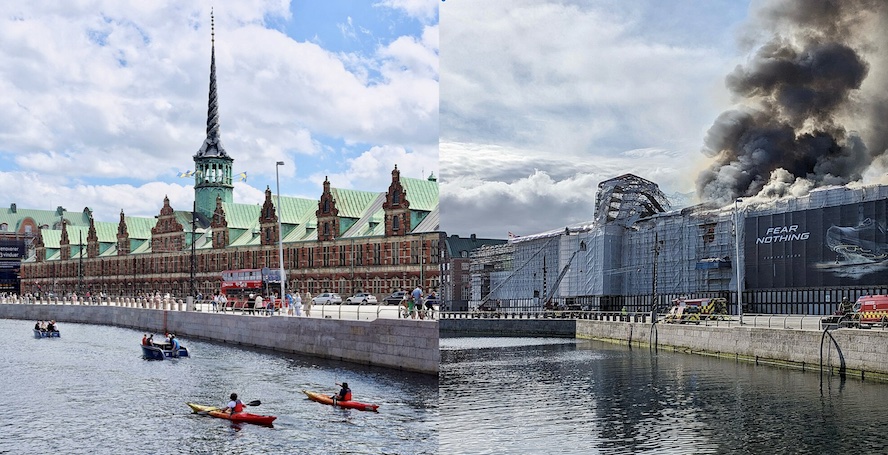
The Copenhagen Børsen on 18 June 2022 (left), and the renovation fire on 16 April 2024 (right) - Image: User:Jakubhal (top), User:Penguin (bottom), additional editing of lower image by User:W.carter, comparison stack by User:Jengod, CC BY-SA 4.0 <https://creativecommons.org/licenses/by-sa/4.0>, via Wikimedia Commons
Historic buildings under renovation are often at their most fragile the moment we believe they are being “made safer.” Several recent renovation‑related fires documented on Fire Risk Heritage (FRH) show that temporary works are not just noisy, messy, or inconvenient—they can be the leading threat to the fabric, collections, and even the legal status of a protected site. By revisiting a few of Fireriskheritage’s renovation‑work case studies, we can turn each incident into a concrete lesson rather than a generic risk list.
Lesson 1: Assume Nothing About Systems During Works
Case: Glasgow School of Art (Mackintosh Building, 2014)
When the Mackintosh Building at Glasgow School of Art caught fire during renovation, investigators found that detection and suppression systems were either not fully operational or compromised by the works. The lesson is simple but brutal: if a historic building is undergoing renovation, treat it as if it has no functioning fire protection unless proven otherwise.
- Map every system that is disabled or looped out and agree clear compensatory measures (temporary detection, stricter watch, reduced hot‑work scope).
- Insist that contractors and engineers sign off that detection and alarm routes are not accidentally blocked by hoardings or temporary partitions.
On Fireriskheritage, this case is framed as a “slow‑burn” transformation of a conservation project into a fire‑disaster story, where the temporary status of protections became the permanent condition of the building’s fate.
Lesson 2: Hot Works Are Not a Routine Task
Case: Notre‑Dame de Paris Cathedral, 2019
The Notre‑Dame fire exploded during scaffold‑related work, with the investigation pointing to an accidental ignition linked to the renovation works, most likely arising from electrical equipment or a careless ignition source such as a smouldering cigarette, although the exact cause has not been formally established.
For Fireriskheritage, this fire acts as a “macro‑case” of how a single, poorly controlled high‑temperature operation can unravel centuries of heritage in hours.
Key take‑aways for owners and contractors:
- Treat every welding, grinding, or bitumen‑boiler operation as a separate ignition scenario, not a “standard” job.
- Ban hot works in, above, or immediately adjacent to roof voids, timber structures, and historic stage machinery unless absolutely necessary and fully engineered with fire watches and barriers.
On Fireriskheritage the analysis shows that the scale of the loss almost distracted attention from the simple fact that the trigger was a renovation‑phase activity that followed operational habits from other building types, not the specific vulnerabilities of a cathedral.
Lesson 3: Temporary Power Can Be More Dangerous Than Old Wiring
Case: Renovation‑Phase Fire at a Historic Municipal Theatre (FRH‑ANALYSIS)
Fireriskheritage has documented multiple renovation‑phase fires in historic buildings where temporary cabling, extension boards, and overloaded distribution units installed during energy‑retrofit or refurbishment works acted as the primary ignition source. In one municipal theatre, the fire started in a temporary switchboard stacked behind a historic stage curtain, feeding construction tools and lighting.
From that case, the practical lessons are:
- Require a temporary electrical design reviewed by a qualified engineer and enforced through a site‑specific permit‑to‑work system.
- Never allow temporary power to run through or above historic scenery, curtains, or combustible storage, and inspect every temporary plug‑in point at the end of each shift.
On Fireriskheritage this case is presented as a “quiet” but emblematic loss: the building was not yet “closed” for the public, but the works had already turned it into a time‑bomb of undetected electrical faults.
Lesson 4: Dust and Mess Are Not Just a Clean‑Up Problem
Case: Renovation Fire in a Historic Church After Roof Repairs
Fireriskheritage has recorded a fire in a North‑European parish church where sparks from a roof‑repair activity fell into a dust‑filled attic, slowly smouldering until the building was fully involved. The church had no active detection in the roof space to speak of, and the fire only became visible once flames broke through the ceiling.
From this case, the lesson is:
- Dust and debris around works are fuel, not just a site‑tidiness issue. Limit combustible storage in voids, and seal or protect cavities during works.
- Use temporary detection or thermal imaging patrols above high‑risk work zones, especially where legacy systems do not cover the affected volume.
On Fireriskheritage, this church‑fire is framed as a “slow‑burn tutorial” in how a minor renovation can invisibly load the structure with combustibles, turning a simple repair into a major heritage loss.
Lesson 5: Blocked Escape Routes Can Turn a Small Fire into a Panic
Case: Renovation Fire in a Historic Civic Assembly Hall
This scenario reflects patterns seen in Fireriskheritage‑documented renovation‑phase fires in historic civic and assembly buildings, including the Copenhagen Stock Exchange case and other civic‑hall‑type incidents.
Key lessons from this case:
- Always keep at least one clearly signed, accessible, and unobstructed escape route open and recognized by all on site, even if this means sequencing works around accessibility.
- Run at least one live‑site evacuation drill during the renovation phase, not just when the building is fully operational.
On Fireriskheritage this case is used to show that renovation risk is not only fire‑technical but also evacuation and perception‑driven—a small fire can create a large crisis if people feel trapped.
Building a Practical Renovation‑Fire Framework
By linking each of these lessons back to Fireriskheritage’s case‑based analyses, the message becomes less abstract: renovation is not a neutral phase, it is a distinct fire scenario.
- Start with a renovation‑specific FRMP, using the Fireriskheritage gallery of renovation‑phase fires as a checklist of what not to repeat.
- Treat every hot work, every temporary cable, and every pile of dust as a potential ignition or fuel source, and apply the same rigour as to a full‑scale building design.
- Use the FRH case studies as training material—show Glasgow, Notre‑Dame, the church attic, and the civic hall in contractor briefings and safety meetings, so that lessons are tied to real heritage‑losses, not just theory.
Here’s a concise, case‑linked Renovation‑Fire Checklist you can turn into a one‑page Fireriskheritage handout for owners, contractors, and authorities. Each item is framed as a “lesson learned” from the key renovation‑phase fires you already analyse.
Renovation‑Fire Checklist: Seven Practical Steps to Avoid Turning Conservation Works into Catastrophe
Key lessons from the fires during Fireriskheritage’s renovation phase can be summarised as follows.
- Assume protection systems are disabled or weakened
- Before any works start, confirm what detection, alarm, and suppression systems are active, what is isolated, and what is temporary.
- Lesson from Glasgow School of Art: Do not assume the building is “protected” just because it has a historic system; treat all works as occurring in a partially‑unprotected state.
2. Treat every hot work as a distinct ignition risk
- Issue written hot‑work permits for welding, cutting, grinding, bitumen boilers, and similar tasks.
- Ban hot works inside or above roof voids, historic timber structures, and stage machinery unless absolutely necessary and fully engineered.
Lesson from Notre‑Dame de Paris: A single, inadequately controlled hot‑work or electrical operation can trigger a catastrophic fire in a cathedral‑scale heritage building.
3. Control temporary electrical systems strictly
- Require a temporary electrical design signed off by a qualified engineer and linked to a permit‑to‑work.
- Never allow temporary power to run through or above historic curtains, scenery, or combustible storage.
Lesson from the municipal theatre case: Unmanaged temporary cabling feeding construction tools can become the primary ignition source in a historic stage area.
4. Manage dust, debris, and combustible storage
- Limit storage of packaging, timber, insulation, and overspray materials in voids and roof spaces.
- Seal or protect cavities where sparks or embers could enter, and remove waste at the end of each day.
Lesson from the church attic fire: Dust‑filled, undetected attic spaces can smoulder for hours before erupting into a full‑scale fire.
5. Keep escape routes open and familiar
- Ensure at least one clearly signed, accessible, and unobstructed escape route is maintained at all times, even when scaffolding or hoardings are present.
- Run at least one live evacuation drill during the works phase, involving all on‑site staff and contractors.
Lesson from the historic civic assembly hall: Blocked or unfamiliar routes can turn a small fire into a panic‑driven crisis.
6. Designate clear roles and communication
- Establish a single responsible person (owner/manager) for fire safety, with defined links to the main contractor, conservation lead, and fire authority.
- Agree a site‑specific fire‑response protocol (who to call, where critical collections are, which areas to avoid aggressive intervention).
Lesson from multiple Fireriskheritage cases: Mixed responsibilities and unclear command structures lead to delayed detection and response.
7. Document changes and keep the “golden thread”
- Log every change to detection coverage, compartmentation, access, and stored collections during the works.
- Use this record for handover, for future renovations, and for post‑incident recovery or insurance.
Lesson from Fireriskheritage’s overall renovation‑case series: Poor documentation makes it impossible to reconstruct how risk built up over time.
Final remarks
Each renovation case demonstrates that fire safety during conservation works must be treated as a distinct operational phase, not an extension of normal building use. Fireskheritage’s analytical framework positions renovation‑phase fire risk within the same systematic approach applied to collection protection, emergency planning, and resilience management.
The Renovation‑Fire Checklist summarises essential prevention actions derived from verified incidents. It should be embedded in Fire Risk Management Plans (FRMPs), contractor safety protocols, and periodic site audits throughout any heritage work programme.
Integrating these lessons aligns with Fireskheritage’s mission to convert evidence from past heritage‑losses into applied standards and procedures. Each documented case—whether Glasgow, Notre‑Dame, or local civic halls—contributes to a comprehensive knowledge base supporting owners, engineers, and authorities in managing renovation‑phase risks before ignition can occur.