Why Cultural Heritage is Still Missing from Too Many Civil Protection Plans
Civil protection planning is becoming more advanced and data-driven, yet cultural heritage is still too often weakly integrated into emergency plans. If historic assets are not identified, prioritized, and connected to operational procedures before a crisis, irreversible losses become far more likely.
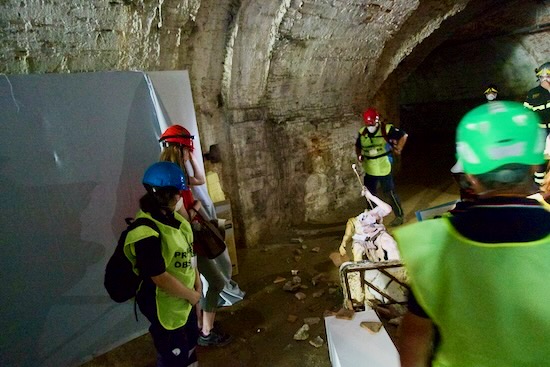
Disaster simulation exercise for salvage of cultural heritage in the PROMEDHE EU Funded action (image: ©Fireriskheritage)
Emergency and civil protection planning is undergoing a significant transformation. Public authorities and response agencies are increasingly supported by digital platforms, simulation environments, and real-time decision tools that promise more adaptive and effective crisis management than traditional standardized plans alone. At the same time, climate-related disasters, technological accidents, and hybrid threats are making emergencies more complex and more demanding for decision-makers.
Yet within this evolving framework, one gap remains insufficiently addressed: cultural and historic heritage is still not consistently or adequately integrated into civil protection planning. This is a serious weakness, because heritage is not a marginal concern in emergency management. It is part of the built environment, part of collective identity, and often part of the social and economic life of cities and regions. When it is damaged or destroyed, the loss extends far beyond property.
FireRiskHeritage.net has previously discussed the importance of organizing damage-limitation services within individual historic buildings, including support tasks that can assist professional rescuers and make post-emergency operations safer and more effective. The same logic should be extended to the urban and regional scale. If emergency planning is expected to protect people, infrastructure, and essential services, it should also consider how to reduce irreversible losses to heritage assets that embody memory, identity, and historical continuity.
Natural hazards, fires, earthquakes, floods, wildfires, armed conflict, and other human-induced events can erase in hours what cannot be recreated in centuries. Once original fabric, craftsmanship, documentary value, and symbolic meaning are lost, they cannot simply be restored through replacement. This is why preparedness for cultural heritage should not begin after a disaster, but before it, as part of ordinary emergency planning.
The problem is not that civil protection plans ignore value, but that they understandably prioritize life safety, rescue operations, and critical infrastructure, while often leaving heritage protection underdefined or delegated to separate cultural institutions. In practice, this can mean that heritage assets are not mapped in operationally useful ways, are not linked to response priorities, and are not supported by clear procedures for access, salvage, stabilization, or specialist coordination.
European initiatives
Recent European initiatives show that this gap is beginning to narrow, but not yet consistently enough. The Union Civil Protection Mechanism and related initiatives such as PROMEDHE, PROCULTHER and PROCULTHER-NET have worked to consolidate the inclusion of cultural heritage at risk within civil protection processes and structures, while UNESCO, ICCROM, and INSARAG have developed practical guidance for preparedness, search and rescue, and inter-agency cooperation at heritage sites.
Moreover, at European level, this gap is particularly relevant because the Union Civil Protection Mechanism has already created a pathway for integrating cultural heritage into emergency management. Through projects such as PROMEDHE, PROCULTHER, and PROCULTHER-NET, the mechanism has supported a common methodology, standard operating procedures, training activities, and the development of a dedicated cultural heritage assessment and advisory capacity for emergencies. Yet the operational visibility of this field remains modest when compared with the scale of the mechanism as a whole, whose annual activations cover a much wider range of emergencies and requests for assistance. This imbalance suggests that, although the European framework now exists, cultural heritage is still not systematically translated into routine preparedness arrangements, request procedures, and deployable expectations at national and international level
The direction is therefore clear. Cultural heritage should not remain outside emergency planning as a specialist afterthought to be considered only once a disaster is over. It should be integrated into prevention, preparedness, response, and early recovery through practical measures that local authorities and responders can actually use under operational.
Three practical steps for better heritage integration in civil protection plans
- Map priority heritage assets in operational terms, not only as cultural listings. Plans should include geo-referenced inventories, site maps, access constraints, basic vulnerabilities, and identification of the most significant elements to protect during emergencies.whc.unesco+1
- Establish coordination before a crisis occurs. Local emergency management authorities, fire services, heritage authorities, site managers, and cultural first-aid specialists should have defined contact points, shared procedures, and clear roles for access, safety, salvage, and stabilization.
- Include heritage in exercises and prepare essential response resources. Emergency simulations should cover heritage scenarios, while plans should identify in advance the materials, temporary storage options, protective coverings, barriers, and stabilization resources needed to secure damaged sites and collections.
These are not exceptional measures. They are practical planning elements that can help civil protection systems move from generic recognition of heritage value to real operational preparedness.civil-protection-knowledge-network.europa+1
This is not an argument against the primacy of life safety. It is an argument for recognizing that civil protection planning can and should reduce avoidable losses to heritage where the right information, coordination, and preparedness are in place. The challenge is no longer conceptual. It is operational.
In heritage cities, historic centres, museum districts, archaeological landscapes, and culturally significant rural areas, the absence of dedicated heritage provisions within emergency plans should now be seen as a planning weakness. Modern civil protection systems are becoming more intelligent, more connected, and more ambitious. Cultural heritage must be part of that evolution.