Fire Risk Management for SMEs in Cultural Heritage: The Critical Role of Vulnerability Assessment
Heritage sites often require solutions that are technically sound, operationally realistic, and compatible with conservation constraints. That means every visual element should be read not just as documentation, but as a prompt for reflection on prevention, protection, and decision-making.

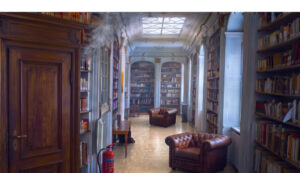
The AI-generated image highlights a recurring issue in cultural heritage fire safety: the gap between visible vulnerability and effective action. For professionals, managers, manufacturers, and suppliers, the key question is not only what the image shows, but what it means in terms of risk, feasibility, and response. Heritage sites often require solutions that are technically sound, operationally realistic, and compatible with conservation constraints. In this sense, every image can become a starting point for discussion, not just a visual record.
In the world of fire safety, there is often a gap between high-level engineering and day-to-day management.
While it is essential that certified fire safety professionals are involved from the earliest stages of a project, we believe there is immense value in the owner or the designated safety officer being able to navigate the initial phases independently.
Why? Because no one knows the “soul” of a building—its quirks, its hidden corners, and its daily rhythms — better than those who manage it every day.
Being able to address high-impact aspects autonomously allows for a more accurate dialogue with consultants and a more responsive safety culture.
Before diving into technical risks, the manager must establish a clear “baseline.” A risk assessment is only as good as the data it is built upon.
To begin, two elements are non-negotiable:
- Accurate Building Surveys: the manager cannot protect what has not mapped. A detailed survey of all surfaces and layouts is the primary requirement to understand fire spread and evacuation paths.
- Operational Mapping: A clear understanding of activities carried out within the structure. This includes “ordinary” conditions (daily operations) and “extraordinary” events (maintenance, renovations, or public celebrations).
The Vulnerability Assessment
Once the baseline is set, the next move is the Vulnerability Assessment. Rather than a simple checklist, this should be viewed as a strategic survey designed to identify both existing and potential fire hazards.
To ensure your protection plan is robust, the assessment must systematically address the following five pillars:
1. Inherent Property Hazards
Every heritage site has “built-in” risks. This involves identifying hazards intrinsic to the cultural resource property — such as ancient timber frames, outdated electrical systems, or the presence of highly combustible archival materials and artworks.
2. The Threat of Arson
Safety is not just about accidents; it is also about security. As documented in this platform, arson is not a so rare threat to any historic or culturale asset.
A thorough assessment must identify conditions that increase the threat of arson. This includes evaluating perimeter security, access control to vulnerable areas, and the presence of flammable materials in unsecured external zones.
3. Special Events and Temporary Exhibitions
Cultural sites are dynamic. The introduction of a temporary exhibition or a special event can fundamentally change the risk profile of a building. So the manages must analyze:
- New Fire Loads: do new displays introduce combustible materials?
- System Interference: does a temporary wall or installation obscure a smoke detector or block the possibility to operate with extinguishing measures?
- Egress Obstructions: Do temporary partitions narrow the corridors, compromising the means-of-egress?
4. Occupancy and Crowd Dynamics
The risk to human life increases exponentially with crowd density. The assessment must evaluate expected spikes in visitation during celebrations or exhibitions. It is vital to establish clear procedures to ensure that the number of occupants never exceeds the building’s physical capacity or the capabilities of its exit routes.
5. Audit of Existing Protection Systems
Finally, the manager must identify and evaluate all existing fire protection systems. Knowing what exists — and whether it is still functional and appropriate for the current use of the space — is the only way to identify the “gap” between your current state and a safe state.
Moving Forward
A comprehensive Vulnerability Assessment transforms fire safety from a reactive burden into a proactive management tool. By documenting these risks, SMEs can develop a Protection Plan that is not a generic document kept in a drawer, but a living strategy tailored to the unique needs of their heritage site.
In our next post, we will discuss how to translate these findings into actionable mitigation strategies. We will specifically analyze:
- Risk Prioritization: How to categorize identified hazards based on probability and impact.
- Mitigation Measures: Technical and organizational solutions to reduce the risks identified in the Vulnerability Assessment.
- The Protection Plan: Integrating the assessment into a formal, executable document.
- Monitoring and Review: Establishing a schedule for periodic updates to ensure the plan evolves with the building’s use.
From a professional standpoint, the image may immediately suggest a specific fire safety concern, such as detection, compartmentation, suppression, emergency access, or evacuation. For managers, the focus may be on operational priorities, maintenance, procedures, staffing, or continuity of protection. For manufacturers and suppliers, the main issue may be how to adapt products and systems to heritage constraints, including minimal invasiveness, reversibility, aesthetics, and installation limitations.
What is your first reaction to this image from the perspective of your role?
- Professionals: which fire safety issue do you see first?
- Managers: what would be your immediate operational concern?
- Manufacturers: what design or installation constraint stands out most?
- Sellers: what solution would you consider most relevant here?
Please share a short comment with your viewpoint. Even a few words can help build a more useful discussion for the heritage safety community.