Post-Fire Assessment of Artefacts in Heritage Institutions: A Practical Challenge for Small and Medium Entities
After a fire, heritage institutions face an urgent and difficult question: how can artefacts be assessed quickly, consistently, and safely before deterioration accelerates? For small and medium entities, this task often falls to staff with limited resources and incomplete specialist support. This article explores the role of damage limitation teams, the need for training, and the limits of current standards.

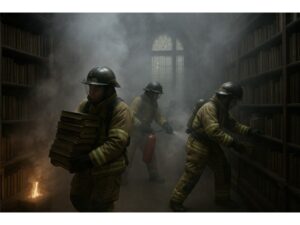
AI-generated image of firefighters putting out a fire in a small library. Image: Fireriskheritage
For many small and medium-sized museums, archives, libraries, churches, and historic buildings, the end of a fire is not the end of the emergency. The most critical phase often begins immediately afterward, when staff must decide which artefacts are stable, which require urgent intervention, and which may deteriorate further if handled incorrectly.
In heritage contexts, post-fire assessment is not simply an administrative exercise; it is a decisive step in loss limitation, recovery planning, and conservation prioritization.
The Deceptive Nature of Fire Damage
The difficulty is that fire damage is frequently deceptive. An object may appear structurally intact while suffering from smoke contamination, soot deposition, heat-induced distortion, moisture damage from suppression activities, or chemical instability that will worsen over time.
Conversely, some objects may appear severely affected yet remain salvageable if promptly stabilized. This makes rapid, independent assessment especially challenging for institutions that do not have permanent conservation teams on site.
The Need for a Clear Operational Framework
A recurrent problem for small and medium entities is the absence of a clear operational framework for immediate post-event appraisal. Staff may be highly committed and knowledgeable about their collections, but they are rarely trained to distinguish between visible damage and latent deterioration.
Moreover, documentation is often incomplete, which makes it difficult to reconstruct object location, significance, condition, and treatment priority under emergency conditions. As a result, decisions are often made under pressure, with limited information and a high risk of error.
In this context, the role of the damage limitation team is central but must be correctly understood. Such a team should be responsible for the first emergency assessment, the stabilization of conditions, the documentation of damage, and the identification of priorities for salvage and protection.
It should not, however, replace professional conservation diagnosis. Its function is to bridge the gap between the emergency phase and the arrival of specialists, ensuring that immediate decisions are cautious, reversible, and properly recorded.
Consequently, staff training is essential. At minimum, personnel assigned to emergency response should be able to recognize the main indicators of fire damage, including soot, smoke residue, heat deformation, wetness, structural instability, and contamination from extinguishing agents.
They should also know how to photograph damaged objects, record their condition consistently, apply basic triage categories, and avoid harmful interventions such as wiping surfaces, stacking unstable artefacts, or moving items without support. Training should combine theoretical instruction with practical exercises, tabletop simulations, and scenario-based drills based on the institution’s own collections and floor plans.
Are there standards on post-fire assessment?
The question of standards is more complex. There are useful international references on first aid for cultural heritage, emergency preparedness, and fire risk management, but there is still no single universally adopted standard for immediate post-fire artefact assessment across all heritage settings.
Existing guidance provides important principles and tools, yet institutions often need a simplified local protocol adapted to their size, collection type, and available expertise.
Recent research has also proposed more structured fire damage indices and vulnerability frameworks, suggesting that the field is moving toward more systematic assessment methods, although these tools are not yet a universal operational benchmark.
For practical purposes, a robust post-fire workflow for small and medium heritage entities should include five essential stages: securing the area, identifying affected objects and spaces, classifying urgency and vulnerability, stabilizing what can be safely managed, and handing over the process to conservators with complete documentation. This workflow is straightforward in principle but depends on advance preparation.
Without clear roles, contact lists, forms, and priority registers, even a well-intentioned response team may waste precious time.
Themes for Emergency Training
Emergency training for post-fire heritage response should be built around a set of practical themes that reflect real operational conditions rather than abstract principles. The aim is to help staff act safely, consistently, and in a coordinated way during the first critical hours after an incident.
Core themes to include
- Safety & Security: Emergency roles and command structure, Personal safety, access control, and scene security.
- Technical Assessment: Recognition of fire-related damage indicators, including soot, smoke, heat, water, and structural instability, Rapid documentation, including photography, condition notes, and object identification, Triage and prioritization of artefacts by significance, vulnerability, and salvageability.
- Logistics & Coordination: Safe handling, packing, and temporary relocation of damaged items, Prevention of secondary damage from moisture, contamination, or improper cleaning, Communication and handover procedures with conservators, firefighters, insurers, and civil protection authorities, Use of emergency forms, salvage lists, and object registers, Decision-making under uncertainty and escalation thresholds, Coordination between staff, volunteers, and external specialists and Recovery planning and post-incident review.
How to structure the training
A good training session should combine short theoretical modules with practical simulations. Staff should work through realistic scenarios based on their own building, collections, and likely fire conditions. Exercises should include photo-based damage recognition, mock triage, object prioritization, and a simulated handover to specialists.
Training should also test communication flow: who reports to whom, who authorizes movement of artefacts, and who records each decision. This is often where real emergencies fail, not because of lack of goodwill, but because roles and procedures were never practiced.
A useful principle
The most effective emergency training is not the one that teaches staff to “do everything,” but the one that teaches them to do the right few things quickly, safely, and in the correct order.
The broader lesson is that post-fire assessment must be treated as part of preparedness, not as an improvisation after disaster. Institutions with limited resources do not need a perfect system; they need a simple, trained, and rehearsed one.
In heritage protection, the difference between temporary damage and irreversible loss is often measured in minutes, not days.