Nine Japanese Shrines and Temples Lost to Fire in First Five Months of 2026: Context and Ongoing Protection Efforts
In the first five months of 2026, nine major shrines and temples were lost to fire across Japan—including the 573-year-old Daihoji Temple national treasure and Reikado Hall, which housed Japan’s sacred Eternal Flame burned continuously for 1,200 years. These losses are deeply significant for Japan’s cultural heritage. However, they occur within the context of one of the world’s most comprehensive heritage fire protection programs: following the 2019 Shuri Castle fire, Japan’s Agency for Cultural Affairs launched a ¥13 billion ($82.3 million) initiative to upgrade fire safety at 107 priority sites, with 64 sites (60%) already completed as of early 2026. While most 2026 fire causes remain under investigation, the incidents underscore the ongoing challenges of protecting wooden heritage structures and the importance of continued investment in fire prevention, international cooperation, and knowledge sharing among fire safety professionals.
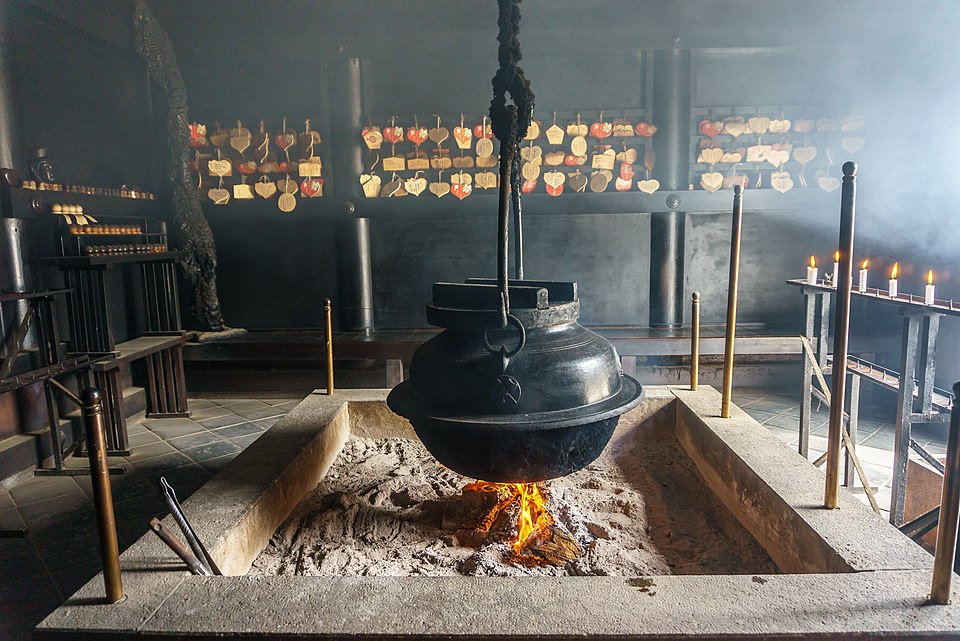
The holy fire said to have been started by the Japanese Buddhist monk Kobo Daishi, who founded the Daishoin Temple in 806. This fire was used as the pilot light for the 'Flame of Peace' in Hiroshima Peace Memorial Park. Reikado Hall, which housed the flame, burned down in 2026. Image: Maksym Grinenko, CC BY-SA 4.0 <https://creativecommons.org/licenses/by-sa/4.0>, via Wikimedia Commons
Complete Timeline: 9 Fires (January–May 2026)
Note: Most of the 2026 fires remain under investigation by local authorities. Confirmed causes should be awaited before drawing conclusions about patterns. Some incidents have historical precedents—for example, Reikado Hall on Miyajima Island previously burned in 2005 and was reconstructed.
1. Suga Shrine – January 15, 2026
- Location: Kitakyushu, Fukuoka Prefecture (northern Kyushu)
- Status: Burned down
- Significance: First major shrine/temple fire of 2026
- Cause: Not yet confirmed in available sources
2.Shiraikuji Temple – February 7, 2026
- Location: Matsuyama, Ehime Prefecture
- Status: Burned down
- Significance: Second major loss in February alone
- Cause: Not yet documented in available sources
3. Hottoji Temple – February 13, 2026
- Location: Ehime Prefecture
- Status: Burned down
- Significance: Third fire in just 6 weeks (Feb 7–13)
- Cause: Not yet documented in available sources
4. Shorinji Temple – February 20, 2026
- Location: Shimonoseki, Yamaguchi Prefecture (western Japan)
- Loss: Two-story wooden temple destroyed (main hall + residential quarters)
- Fatalities: 5 people killed (likely temple residents)
- Time: Fire at ~2:30 a.m., controlled at 5:40 a.m. (~3 hours)
- Weather: Dry weather advisory issued across Yamaguchi Prefecture
- Cause: Under investigation
5. Atago Shrine – May 6, 2026 (~23:30)
- Location: Crowded Furumachi district, Niigata City
- Loss: Historic shrine completely engulfed in massive fire
- Time: Late night (around 23:30)
- Cause: Unknown / under investigation; some sources suspect intentional fire
- Significance: Historic urban shrine in crowded district
6. Daihoji Temple – May 16–17, 2026
- Location: Takaoka, Toyama Prefecture (northern Japan)
- Loss: Completely destroyed — burned to the ground
- Age: 573-year-old national treasure (founded 1453)
- Significance: Centuries of priceless artworks vanished overnight
- Cause: Fire broke out evening of May 16, 2026
7. Daiho Temple – May 2026 (early–mid May)
- Location: Toyama Prefecture
- Damage: 13 structures damaged (not completely destroyed)
- Likely Cause: Kitchen fire
- Significance: Multiple buildings affected in single incident
8.Reikado Hall, Daishoin Temple – May 20, 2026 (~8:30 a.m.)
- Location: Mount Misen, Miyajima Island, Hiroshima Prefecture
- Loss: Complete destruction of sacred wooden hall
- Significance: Housed the “Eternal Flame” continuously lit for 1,200+ years, originally kindled by Buddhist saint Kukai (774–835)
- Survival: The Eternal Flame was salvaged and relocated to a different site
- Injuries: None confirmed
- Firefighters: ~30 firefighters responded; fire extinguished by May 21
- Previous history: Hall was previously reconstructed after a 2005 accidental fire
- Area burned: ~30 m²; nearby hut also burned; flames spread to nearby woodland
9. Renshoji Temple – April 2026 (date TBD)
- Location: Toyama City
- Status: Burned down
- Note: Some sources reference an Atago Shrine fire in April 2026, which may be the same as the May 6 Furumachi incident or a separate fire
Important Note on Documentation: Major incidents like Reikado Hall, Daihoji Temple, and Atago Shrine are well-documented by outlets such as The New York Times, Japan Times, and Tokyo Weekender. However, some earlier February fires, such as those at Horenji and Shiraikuji in Ehime, have fewer direct mainstream news sources. These incidents are primarily referenced in compilation posts and local reports. Therefore, it’s important to treat information with caution until more official details emerge. In particular, some details about incidents 2, 3, and 9 remain incomplete due to limited news coverage. We welcome any additional documentation from readers who have information about these fires.
Japan’s Comprehensive Fire Protection Initiative
Following the 2019 destruction of Shuri Castle, Japan’s Agency for Cultural Affairs launched a five-year, ¥13 billion ($82.3 million) program to enhance fire safety at priority heritage sites:
Implementation Challenges: Progress and Delays
Nearly seven years after the devastating 2019 Shuri Castle fire in Okinawa (which destroyed the World Heritage site’s three main halls, likely caused by electrical fault), implementation challenges remain in Japan’s heritage fire protection program:
| Metric | Status |
|---|---|
| Priority sites identified | 107 historic structures (2020 national program) |
| Completed | 64 sites have installed new fire defenses |
| In progress | 7 sites undergoing upgrades |
| Not yet started | ~30% of priority sites still lack upgraded fire protection |
| Root cause of delays | Unforeseen hurdles, stalled work |
The 2019 Shuri Castle fire destroyed the 600-year-old castle, a World Heritage site representing 500 years of Ryukyuan history.
Key Statistics: 2026 Fires at a Glance
Why Wooden Heritage Is Particularly Vulnerable
Fire is arguably the greatest single threat facing cultural heritage. In 2026, this risk is increasingly concentrated in worship centers—particularly those constructed from traditional wood, which dominates Japan’s religious architecture. Key risk factors:
- Traditional wooden construction with minimal fire-resistant materials
- Age of structures (many centuries old)
- Residential areas within temple complexes (increasing ignition sources)
- Electrical systems in historic buildings
- Kitchen operations in temple facilities
- Climate change intensifying fire risks globally
Lessons for Global Heritage Protection
The 2026 series of fires at Japanese shrines and temples underscores critical lessons for fire risk heritage management:
Prevention is paramount
The majority of fires affecting heritage institutions can be avoided or greatly reduced by proper maintenance and safety procedures.
Upgrades cannot be delayed
Nearly 30% of Japan’s priority heritage sites still lack fire protection upgrades nearly 7 years after Shuri Castle.
Success stories exist
The salvaged Eternal Flame and 60% completion rate of fire upgrades show progress is achievable.
Living heritage is at risk
Major shrines and temples are not just buildings—they house rituals, flames, and practices spanning centuries.
Documentation matters
Detailed documentation enables reconstruction (as done for Shuri Castle), but authentic materials and craftsmanship cannot be fully replaced.
Residential use increases risk
The Shimonoseki temple fire killed 5 residents, highlighting the danger of combining living quarters with sacred spaces.
Reconstruction is possible but costly
The Miyajima Reikado Hall was rebuilt after a 2005 fire, but the 2026 loss still destroyed irreplaceable cultural continuity.
Historical Context and International Support
Wooden shrines and temples have faced fire risk for centuries in Japan. The Great Fire of Meireki (1657) destroyed over 350 shrines and temples in Edo alone. Modern fire protection represents a significant evolution from historical practices, though challenges remain due to the sheer number of wooden heritage structures nationwide.
UNESCO expressed solidarity with Japan following the Okinawa World Heritage fire and offered assistance. In 2024, UNESCO published a global fire risk management guide for cultural and natural heritage, which Japan is implementing.
Conclusion
The loss of nine shrines and temples in just five months of 2026 is a sobering reminder that even the most comprehensive fire protection programs cannot eliminate risk entirely.
While Japan’s ¥13 billion initiative represents the world’s most advanced heritage fire safety program, with two-thirds of priority sites already upgraded. the remaining 30% without protection and the fires that occurred despite upgrades demonstrate that protection is an ongoing process, not a one-time achievement.
The 2026 fires reveal critical lessons for fire risk heritage professionals globally:
- Wooden heritage remains inherently vulnerable, regardless of protection investments
- Timing matters: Nearly seven years after Shuri Castle, delays in upgrades leave sites exposed
- Living heritage faces unique risks: Residential quarters, sacred flames, and continuous rituals create ignition sources that static protection cannot fully address
- Reconstruction is possible but incomplete: While Reikado Hall was rebuilt after 2005, the 1,200-year continuity of the Eternal Flame’s original housing was broken
- Human cost extends beyond buildings: The 5 fatalities at Shorinji Temple remind us that fire risk affects people, not just structures.
Japan’s experience underscores an urgent truth for fire safety professionals worldwide: heritage fire protection requires sustained investment, timely implementation, and international knowledge sharing.
The 2019 Shuri Castle fire galvanized action, but the 2026 losses show that without closing the remaining protection gaps, more irreplaceable cultural heritage will be lost.
As the global heritage community watches Japan’s efforts, the message is clear: prevention, rapid implementation, and continuous improvement are the only ways to protect wooden heritage from fire.
The alternative is watching centuries of history vanish overnight.