Smoke and Radiative Heat: The Hidden Damage After the 1996 Fire at Iglesia de la Compañía (Quito, Ecuador)
The 1996 fire at Quito’s baroque Iglesia de la Compañía destroyed not only what the flames touched. Major damage extended far beyond the fire zone through smoke and radiant heat, affecting unprotected heritage areas and triggering a long restoration process launched after 1996.
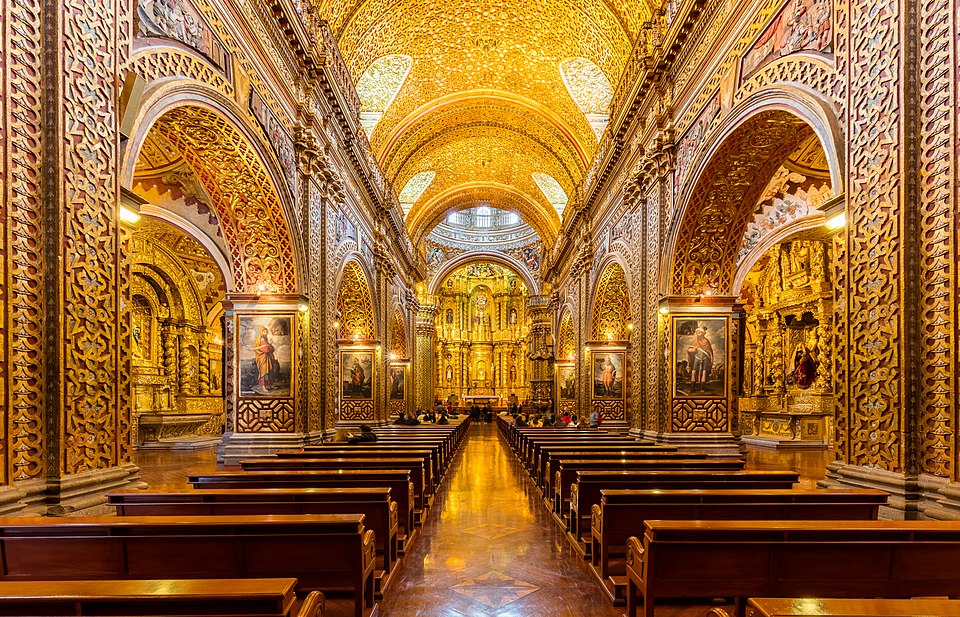
Main nave of the Church of the Society of Jesus (La Iglesia de la Compañía de Jesús) in Quito, Ecuador. - Image: Diego Delso, CC BY-SA 4.0 via Wikimedia Commons https://upload.wikimedia.org/wikipedia/commons/d/d8/Iglesia_de_La_Compa%C3%B1%C3%ADa%2C_Quito%2C_Ecuador%2C_2015-07-22%2C_DD_149-151_HDR.JPG
On January 31, 1996, at 11:10 local time, a fire ignited inside the Iglesia de la Compañía de Jesús, one of the most important baroque churches in Latin America. The ignition source was the explosion of a lamp connected to a small provisional power station used to compensate for the lack of electricity in that area of the city.
During the restoration work at the time, chemical products and materials used for conservation increased the fire load and accelerated flame propagation in a space already highly vulnerable due to extensive woodwork, gold plating, and priceless artworks.
The fire lasted approximately 1 hour and 30 minutes, until firefighters arrived and prevented total destruction of the complex.
Only one person was treated for first-degree burns; there were no fatalities.
Damage pattern: far beyond the fire zone
The most critical aspect for fire engineers and heritage conservators is that the main damage extended well beyond the area directly exposed to flames:
- The retablo of San Francisco Javier (north crucero) was severely damaged over about ¾ of its surface, with a strong chimney effect that carried smoke up to the ochavada dome.
- Artworks on the main altar, paintings, religious images, and golden reliefs (some under restoration since 1984) were lost or heavily damaged.
- The dome was blackened by smoke, requiring full cleaning and replacement of images of the four evangelists.
In heritage buildings, smoke deposition, heat radiation, and thermal gradients can cause severe, irreversible damage to areas that were never directly burned. This case clearly shows how the fire’s real impact is often much larger than the visible flame zone.
Restoration after 1996
Following the fire, a long restoration process was launched after 1996, conceived specifically to recover the church’s artistic and architectural integrity. Over the following decades, multiple interventions were carried out: restoration of the retablos in the south nave, rehabilitation of mural paintings on the central vault, work on the tower, and other conservation measures.
Public sources do not provide detailed figures on the total cost or the exact duration of the overall restoration program (UNESCO brought 50,000 US dollars for the purchase of the gold leaf sheets needed to repair the church). What is clear is that the work required extended time, specialized expertise, and significant resources to address both direct fire damage and indirect effects such as smoke staining and heat-induced degradation.
Technical lessons for fire safety in heritage
For fire protection engineers and conservators, this case highlights key points:
- Separate restoration activities from ignition sources; control provisional electrical systems and emergency power supplies
- Manage chemical products and solvents as a risk increase, not as ordinary construction materials
- Implement continuous surveillance, early detection, and emergency procedures adapted to heritage protection
- Design fire safety strategies that account for smoke spread and radiative heat, not only flame contact, especially in monumental interiors with continuous decorative surfaces
The 1996 fire at the Iglesia de la Compañía is a classic example of vulnerability increased by restoration work: an electrical ignition, an unusual combustible load, and an internal geometry favorable to smoke propagation caused significant damage without structural collapse.